Well, it seems the "end of the world" has once again come and gone. While the faithful are busy trying to rationalize their cognitive dissonance, reality continues -- as it always does -- forward. I am both enraged and saddened at Harold Camping for the casualties left in his wake of fear-mongering, and simultaneously filled with schadenfreude for the dumbfounded scratching their heads in disbelief.
Let's face it, none of raptor-ready halfwits are in any kind of "shock" right now. When the mind is addled with such a lack of critical thinking, it can come face-to-face with contrary or antipodes information and still assume it was right all along. The double-think involved is seen any many other areas of theistic ideology...it's like a staple or a necessity for it. In fact, I'd be amazed if I could find one of these May 21st people who would say, "I truly believed the world was going to end, and when it didn't I realized there was something deeply wrong with my thinking."
One can wish. Next up to get bitch-slapped by the world when it sticks around: the Mayans.
-STA
(Typed while listening to Ænema)
Showing posts with label christian myths. Show all posts
Showing posts with label christian myths. Show all posts
Saturday, May 21, 2011


Tuesday, March 22, 2011
More Pointless BS from DC
H.Con.Res. 13 is up before the House of Representatives. This proposal, with 66 co-sponsors, seeks to allow government buildings and public institutions (including schools) to be plastered with "In God We Trust". Let us see what is in this very much needed proposal, shall we?
The overall goal is stated as, "Reaffirming `In God We Trust' as the official motto of the United States and supporting and encouraging the public display of the national motto in all public buildings, public schools, and other government institutions."
Here's their confounding arguments why:
Whereas `In God We Trust' is the official motto of the United States;
Not before 1956. How short-term is this right-wing pundit memory of theirs that we have to keep reminding them of that fact. The injustices of the McCarthy era weren't justified then, and they're not justified now. These days, instead of a big "fuck you" to Russia and the scary Communists of the world, they want to give the finger to Muslims and us non-religious types. It may be "official" but that doesn't make it right. Besides that, do you really need to be reminded that you trust God so badly the phrase be everywhere?
Whereas the sentiment, `In God We Trust', has been an integral part of United States society since its founding;
What this issue (and all the others like it) really comes down to is the incorrect assumption that the God of our deist founders equals the God of the Christian bible. As I've explained many times before, many of our founders didn't believe in a personal god, and they certainly didn't believe in Jesus's Daddy. The vagueness of the word "God" makes it easier to spread this religion, because it generalizes the idea of deities. Thus, if a man 200 years ago says something about "God", people 4000 years from now can interpret it by the God of their understanding. Simply, our founders weren't talking about YOUR god when they referenced "our Creator" (read: nature).
Whereas in times of national challenge or tragedy, the people of the United States have turned to God as their source for sustenance, protection, wisdom, strength, and direction;
In times of great strife, people turn to whomever they can to seek help. But let's look at the facts: God didn't send people into the burning World Trade towers to get people out. God didn't send food, medical supplies, and water to Sudan or New Orleans. God didn't send aid to Japan, and God didn't take down the Tucson shooter. However you want to define it, "God" hasn't helped with any national challenge or tragedy. People have. Humans provide sustenance, protection, wisdom, strength, and direction. It's demonstrable. And even though many do look toward a higher power for those things, they don't all turn to YOUR God. So presupposing that all Americans trust in YOUR God is arrogantly presumptions.
Whereas the Declaration of Independence recognizes God, our Creator, as the source of our rights, `We hold these truths to be self-evident, that all men are created equal, that they are endowed by their Creator with certain unalienable rights, that among these are life, liberty and the pursuit of happiness.';
The Declaration of Independence isn't a founding document. It could say, "Jesus Christ is the nation's Lord Almighty" and it wouldn't matter. This nation was founded based on secular documents meant to keep the government out of everyone's personal beliefs. But again, that Creator they're talking about isn't the biblical God. It's the idea of how humans arrived (again, read: nature).
Whereas the national anthem of the United States says `praise the power that hath made and preserved us a nation . . . and this be our motto: in God is our trust.';
The motto could be, "We are a White Nation" and it wouldn't be true nor accurate. And it wouldn't matter if it were our national government-approved motto because again, it may be official but that doesn't make it okay. That's why we try to put away official ideas when we realize they're not honorable (slavery, anyone?).
Whereas the words `In God We Trust' appear over the entrance to the Senate Chamber and above the Speaker's rostrum in the House Chamber;
It doesn't matter how many injustices they cite, they're still trying to inject religious beliefs into government -- our collective government. Government isn't a private business that can reserve the right to serve who they like.
Whereas the oath taken by all Federal employees, except the President, states `I will well and faithfully discharge the duties of the office on which I am about to enter. So help me God.';
The phrase, "so help me God" is purely optional, as mandated by Article IV, paragraph 3 of the United States Constitution. It doesn't matter what imaginary being someone wants to seek help from to tell the truth or uphold an oath to. And what if the "God" someone swears by are the Pseudologoi? How would you know?
Whereas John Adams said, `Statesmen may plan and speculate for Liberty, but it is Religion and Morality alone, which can establish the Principles upon which Freedom can securely stand.';
Those who would think that their God is the god of everyone in America also think that morality comes from God. Morality isn't the property of, nor authored by, religion, and it certainly holds no monopoly over it. It's demonstrable that non-religious people are quite capable of being moral.
Whereas if religion and morality are taken out of the marketplace of ideas, the very freedom on which the United States was founded cannot be secured;
Our Constitution makes it clear that government is meant to stay out of religion for the sake of freedom. Do you really want the government to start endorsing religion? It might seem great, but which religion? You can't get members of the SAME CHURCH to agree on everything, so how do you propose we get government to do it? How free do you think we'd be if, say, they started plastering buildings with Mormon ideals (like God punishes people by darkening their skin)? Even if they keep the vague "God" sense, there comes a point when their God isn't your God anymore, but government's claws are in too deep. I'm an atheist and don't think religion is a good thing, but I wouldn't want my government telling a religious person how to worship. Freedom is the distance between Church and State, for ALL OUR SAKES. I see this Whereas as saying "if you don't have God then you don't have morality, and we can't guarantee your Freedom of Speech or your protection under the Fourth Amendment".
Whereas as President Eisenhower said and President Ford later repeated, `Without God, there could be no American form of government, nor, an American way of life.'; and
Whereas President John F. Kennedy said, `The guiding principle and prayer of this Nation has been, is now, and ever shall be `In God We Trust.'
It wouldn't matter if the current president said, "Those who have no God should be shot". If these clowns would read the Constitution and the words of those who helped create it, they'd see the reasons for keeping religion out of a secular government.
So to recap:
The House needs to kill this bill. Get in touch with your representative today and politely let them know -- even if you're a Christian -- that this type of legislation doesn't' belong in a government of our kind, and that you support everyone's right to see God how they want to.
If you want to go further, write them a snail mail letter (sometimes more effective than an email) and tell them how you would instead like to restore "E Pluribus Unum" as our national motto, because it more accurately reflects America: "Out of Many, One".
-STA
The overall goal is stated as, "Reaffirming `In God We Trust' as the official motto of the United States and supporting and encouraging the public display of the national motto in all public buildings, public schools, and other government institutions."
Here's their confounding arguments why:
Whereas `In God We Trust' is the official motto of the United States;
Not before 1956. How short-term is this right-wing pundit memory of theirs that we have to keep reminding them of that fact. The injustices of the McCarthy era weren't justified then, and they're not justified now. These days, instead of a big "fuck you" to Russia and the scary Communists of the world, they want to give the finger to Muslims and us non-religious types. It may be "official" but that doesn't make it right. Besides that, do you really need to be reminded that you trust God so badly the phrase be everywhere?
Whereas the sentiment, `In God We Trust', has been an integral part of United States society since its founding;
What this issue (and all the others like it) really comes down to is the incorrect assumption that the God of our deist founders equals the God of the Christian bible. As I've explained many times before, many of our founders didn't believe in a personal god, and they certainly didn't believe in Jesus's Daddy. The vagueness of the word "God" makes it easier to spread this religion, because it generalizes the idea of deities. Thus, if a man 200 years ago says something about "God", people 4000 years from now can interpret it by the God of their understanding. Simply, our founders weren't talking about YOUR god when they referenced "our Creator" (read: nature).
Whereas in times of national challenge or tragedy, the people of the United States have turned to God as their source for sustenance, protection, wisdom, strength, and direction;
In times of great strife, people turn to whomever they can to seek help. But let's look at the facts: God didn't send people into the burning World Trade towers to get people out. God didn't send food, medical supplies, and water to Sudan or New Orleans. God didn't send aid to Japan, and God didn't take down the Tucson shooter. However you want to define it, "God" hasn't helped with any national challenge or tragedy. People have. Humans provide sustenance, protection, wisdom, strength, and direction. It's demonstrable. And even though many do look toward a higher power for those things, they don't all turn to YOUR God. So presupposing that all Americans trust in YOUR God is arrogantly presumptions.
Whereas the Declaration of Independence recognizes God, our Creator, as the source of our rights, `We hold these truths to be self-evident, that all men are created equal, that they are endowed by their Creator with certain unalienable rights, that among these are life, liberty and the pursuit of happiness.';
The Declaration of Independence isn't a founding document. It could say, "Jesus Christ is the nation's Lord Almighty" and it wouldn't matter. This nation was founded based on secular documents meant to keep the government out of everyone's personal beliefs. But again, that Creator they're talking about isn't the biblical God. It's the idea of how humans arrived (again, read: nature).
Whereas the national anthem of the United States says `praise the power that hath made and preserved us a nation . . . and this be our motto: in God is our trust.';
The motto could be, "We are a White Nation" and it wouldn't be true nor accurate. And it wouldn't matter if it were our national government-approved motto because again, it may be official but that doesn't make it okay. That's why we try to put away official ideas when we realize they're not honorable (slavery, anyone?).
Whereas the words `In God We Trust' appear over the entrance to the Senate Chamber and above the Speaker's rostrum in the House Chamber;
It doesn't matter how many injustices they cite, they're still trying to inject religious beliefs into government -- our collective government. Government isn't a private business that can reserve the right to serve who they like.
Whereas the oath taken by all Federal employees, except the President, states `I will well and faithfully discharge the duties of the office on which I am about to enter. So help me God.';
The phrase, "so help me God" is purely optional, as mandated by Article IV, paragraph 3 of the United States Constitution. It doesn't matter what imaginary being someone wants to seek help from to tell the truth or uphold an oath to. And what if the "God" someone swears by are the Pseudologoi? How would you know?
Whereas John Adams said, `Statesmen may plan and speculate for Liberty, but it is Religion and Morality alone, which can establish the Principles upon which Freedom can securely stand.';
Those who would think that their God is the god of everyone in America also think that morality comes from God. Morality isn't the property of, nor authored by, religion, and it certainly holds no monopoly over it. It's demonstrable that non-religious people are quite capable of being moral.
Whereas if religion and morality are taken out of the marketplace of ideas, the very freedom on which the United States was founded cannot be secured;
Our Constitution makes it clear that government is meant to stay out of religion for the sake of freedom. Do you really want the government to start endorsing religion? It might seem great, but which religion? You can't get members of the SAME CHURCH to agree on everything, so how do you propose we get government to do it? How free do you think we'd be if, say, they started plastering buildings with Mormon ideals (like God punishes people by darkening their skin)? Even if they keep the vague "God" sense, there comes a point when their God isn't your God anymore, but government's claws are in too deep. I'm an atheist and don't think religion is a good thing, but I wouldn't want my government telling a religious person how to worship. Freedom is the distance between Church and State, for ALL OUR SAKES. I see this Whereas as saying "if you don't have God then you don't have morality, and we can't guarantee your Freedom of Speech or your protection under the Fourth Amendment".
Whereas as President Eisenhower said and President Ford later repeated, `Without God, there could be no American form of government, nor, an American way of life.'; and
Whereas President John F. Kennedy said, `The guiding principle and prayer of this Nation has been, is now, and ever shall be `In God We Trust.'
It wouldn't matter if the current president said, "Those who have no God should be shot". If these clowns would read the Constitution and the words of those who helped create it, they'd see the reasons for keeping religion out of a secular government.
So to recap:
- "God" doesn't always mean your god, and for our government to assume so makes us all look like asses.
- Government is meant to be kept separate from religion. You don't want Washington telling you what prayer to use over dinner, and I don't want my public school to feature a prominent statue of Brahma.
- Presidents and other members of government can be as religious as they want, as long as they leave their religion at the door when making policy that affects our nation (roughly sixty million of which aren't Christians).
The House needs to kill this bill. Get in touch with your representative today and politely let them know -- even if you're a Christian -- that this type of legislation doesn't' belong in a government of our kind, and that you support everyone's right to see God how they want to.
If you want to go further, write them a snail mail letter (sometimes more effective than an email) and tell them how you would instead like to restore "E Pluribus Unum" as our national motto, because it more accurately reflects America: "Out of Many, One".
-STA
Wednesday, December 15, 2010
The Reason
It's that time of year again, isn't it. The time when we come together as family and friends and express our love and appreciation toward each other. Many of us celebrate family traditions of one type or another in a festive and happy atmosphere. There are some, however, who are frothing at the mouth and angry over how others choose to spend these several weeks in the middle of winter. They are the ones who rant about "the reason for the season" and how everyone is ruining the "true meaning of Christmas".
What these folks fail to realize is that most of what they believe constitutes the "true meaning" is actually an aggregation of many different traditions and rituals from multiple religions, pagan customs, and secular sources.
Deck the Halls
Take for instance, the iconic Christmas tree. The practice of cutting down a tree and bringing it indoors during the cold winter nights is derived from several solstice traditions. The Romans decked their halls with garlands of laurel and placed candles in live trees to decorate for the celebration of Saturnalia. In Scandinavia, apples were hung from evergreen trees at the winder solstice in remembrance that spring and summer will come again. The evergreen tree itself was the special plant of their sun god, Baldor. In fact, the Christian bible expressly forbids believers to practice this tradition or act like the pagans do. As late as 1800, devout Christian sects like the Puritans forbade the celebration of Christmas because it was thought of as a pagan holiday.
Mistletoe, another iconic "Christmas" tradition, finds its roots as an ancient Druid custom during the winter solstice, complete with the concept of kissing underneath it. Mistletoe was considered a divine plant and it symbolized love and peace.
The Scandinavian solstice traditions had a lot of influences on our celebration besides the hanging of ornaments on evergreen trees. Their ancient festival of Yuletide celebrated the return of the sun, during which the Yule log (the center of the trunk of a tree) was dragged to a large fireplace where it was supposed to burn for twelve days.
Oh Holy Night
The "birth of the sun" was an integral part in ancient times, because the concept of year-around food was unattainable. The hope of an early spring and the return of long days of bright warm sunlight were things anyone eeking out a meager existence in freezing cold climates with no central heating would wish for. The early Christian church was tired of trying to get the pagan believers to stop celebrating the birth of Mithras, the Persian sun god (a deity of light and truth). So in 320 C.E., Pope Julius formally selected December 25 as the official birthday of Christ, to circumvent Mithraism. If Jesus was born at all, it would likely have been some time midsummer.
Santa Claus is Coming to Town
Even our traditions of Santa Claus have little, if nothing, to do with Christianity. The 14th century St. Francis of Assisi is the likely model of Santa, a benevolent character who is popular for giving gifts to the poor and needy, mainly women and children. The name Santa Claus is derived from the Sinter Klass, which is the Dutch pronunciation for St. Nicholas, who is said to be the patron saint for many groups of people including children, orphans, thieves, sailors, students, pawnbrokers and countries like Russia and Greece. He did a lot of work to spread Christianity among the people of Rome. This may be part of the reason why Santa Claus is similar in nature to the stories of Jesus, and the legends and myths that expound from such historical events can easily become pseudohistory for those who do not wish to investigate it. Flying reindeer too likely come from Norse legends of Thor flying through the sky in a chariot pulled by magical goats called Gnasher and Cracker.
Chestnuts Roasting on an Open Fire
The Roman celebration of Saturnalia provides a large part of our modern traditions, including large feasts and gift-giving. The pre-Christian holiday of merriment honored Saturus, the god of seed and sowing. The festival was marked by the exchange of good-luck charms and other gifts, and great feasting in which even the slaves would be allowed to participate. God bless us, every one indeed.
The Reason
Many of our current traditions began more than 4000 years ago, and even their beginnings were more than likely the result of other superstition and traditional beliefs that came before them. So the next time you hear about how Walmart or atheism is destroying the meaning of Christmas, remember this: the SEASON is the reason for the season, not a bronze-age myth that has been formed out of the debris of myths that preceded it. After all, you're not a Celtic who takes to animal sacrifice to ward off evil spirits, right? So why celebrate Halloween? And, you don't hunt colored eggs or eat chocolate bunnies to celebrate the fertility and advent of springtime in honor of the Saxon goddess Eostre or the Norse equivalent Ostara, do you? So why celebrate Easter? And even if you don't want to celebrate the birth of America, having a reason for picnicking and shooting fireworks is enough to party on July 4, isn't it?
For whatever your holiday, for whatever your reason, at the bare minimum you should acknowledge it as a time to be close to the one's you love, because we're all only here for a little while. Have a great solstice, everyone! And may the New Year bring you joy, peace, and reason.
-STA
What these folks fail to realize is that most of what they believe constitutes the "true meaning" is actually an aggregation of many different traditions and rituals from multiple religions, pagan customs, and secular sources.
Deck the Halls
Take for instance, the iconic Christmas tree. The practice of cutting down a tree and bringing it indoors during the cold winter nights is derived from several solstice traditions. The Romans decked their halls with garlands of laurel and placed candles in live trees to decorate for the celebration of Saturnalia. In Scandinavia, apples were hung from evergreen trees at the winder solstice in remembrance that spring and summer will come again. The evergreen tree itself was the special plant of their sun god, Baldor. In fact, the Christian bible expressly forbids believers to practice this tradition or act like the pagans do. As late as 1800, devout Christian sects like the Puritans forbade the celebration of Christmas because it was thought of as a pagan holiday.
Mistletoe, another iconic "Christmas" tradition, finds its roots as an ancient Druid custom during the winter solstice, complete with the concept of kissing underneath it. Mistletoe was considered a divine plant and it symbolized love and peace.
The Scandinavian solstice traditions had a lot of influences on our celebration besides the hanging of ornaments on evergreen trees. Their ancient festival of Yuletide celebrated the return of the sun, during which the Yule log (the center of the trunk of a tree) was dragged to a large fireplace where it was supposed to burn for twelve days.
Oh Holy Night
The "birth of the sun" was an integral part in ancient times, because the concept of year-around food was unattainable. The hope of an early spring and the return of long days of bright warm sunlight were things anyone eeking out a meager existence in freezing cold climates with no central heating would wish for. The early Christian church was tired of trying to get the pagan believers to stop celebrating the birth of Mithras, the Persian sun god (a deity of light and truth). So in 320 C.E., Pope Julius formally selected December 25 as the official birthday of Christ, to circumvent Mithraism. If Jesus was born at all, it would likely have been some time midsummer.
Santa Claus is Coming to Town
Even our traditions of Santa Claus have little, if nothing, to do with Christianity. The 14th century St. Francis of Assisi is the likely model of Santa, a benevolent character who is popular for giving gifts to the poor and needy, mainly women and children. The name Santa Claus is derived from the Sinter Klass, which is the Dutch pronunciation for St. Nicholas, who is said to be the patron saint for many groups of people including children, orphans, thieves, sailors, students, pawnbrokers and countries like Russia and Greece. He did a lot of work to spread Christianity among the people of Rome. This may be part of the reason why Santa Claus is similar in nature to the stories of Jesus, and the legends and myths that expound from such historical events can easily become pseudohistory for those who do not wish to investigate it. Flying reindeer too likely come from Norse legends of Thor flying through the sky in a chariot pulled by magical goats called Gnasher and Cracker.
Chestnuts Roasting on an Open Fire
The Roman celebration of Saturnalia provides a large part of our modern traditions, including large feasts and gift-giving. The pre-Christian holiday of merriment honored Saturus, the god of seed and sowing. The festival was marked by the exchange of good-luck charms and other gifts, and great feasting in which even the slaves would be allowed to participate. God bless us, every one indeed.
The Reason
Many of our current traditions began more than 4000 years ago, and even their beginnings were more than likely the result of other superstition and traditional beliefs that came before them. So the next time you hear about how Walmart or atheism is destroying the meaning of Christmas, remember this: the SEASON is the reason for the season, not a bronze-age myth that has been formed out of the debris of myths that preceded it. After all, you're not a Celtic who takes to animal sacrifice to ward off evil spirits, right? So why celebrate Halloween? And, you don't hunt colored eggs or eat chocolate bunnies to celebrate the fertility and advent of springtime in honor of the Saxon goddess Eostre or the Norse equivalent Ostara, do you? So why celebrate Easter? And even if you don't want to celebrate the birth of America, having a reason for picnicking and shooting fireworks is enough to party on July 4, isn't it?
For whatever your holiday, for whatever your reason, at the bare minimum you should acknowledge it as a time to be close to the one's you love, because we're all only here for a little while. Have a great solstice, everyone! And may the New Year bring you joy, peace, and reason.
-STA
Sunday, July 4, 2010
Jesus is Anti-American
Well, it's the time of year when many Christians in this country become neocon patriots focused on letting everyone know how important Jesus and his daddy are to the creation of our country. (If this generalization doesn't fit you or your situation, please tell me where you live so I can move there.)
What most Christians fail to realize, unsurprisingly, is just how anti-American Jesus actually is.
1) Jesus Is Your "Lord"
When the colonies declared independence from the Kingdom of Great Britain on July 4, 1776, they ceased bowing to lords. And while many people still had "masters", the practice of subjugation was whittled down and stripped away because of the very ideals the nation was found on: the right of every human to seek happiness in life, and to have the necessary liberties needed to attain it.
The Christan religion, however, teaches that Jesus is a master and ultimate overlord to his subjects. This antiquated, small-minded idea is clearly against American values. We are a free people. We have no lords, no masters.
2) Jesus Pervades Everything
With Jesus, it's an all-or-nothing deal. As Bush would say, "Your either with us, or against us". Matthew 12:30 and Luke 11:23 share the same sentiment. This all-consuming approach to your religious ideologies are what drive vehicles like the Religious Right and, more importantly, becomes so pervasive that it starts seeping out into daily life. People in power many decisions based on their religious beliefs (with exceptions, a personal favorite being JFK, who truly understood what it meant to put personal beliefs aside for the bigger picture). But with the tunnel vision such a mind-frame puts you in, it's obvious that if God is your whole life, you'll be spreading it around everywhere you go...and indeed the practice is expressly encouraged.
The founders of America understood this. They had been the subjects of British religious intolerance. They didn't have a choice. They also understood that the only way for all men to be free was to keep the business of governing separate from the business of the church -- from any church. We can't have freedom of religion without having freedom from it, and America's separation of church and state makes that fundamental dream a reality. It's sad and sometimes a little scary to think just how many ignorant citizens are working to change that basic idea. They rant and rave about the men who died to give them liberty and freedom, but then bitch and moan when we want to undo the polarization effects of removing "IN GOD WE TRUST" from our currency or striking "Under GOD" from the allegiance pledge. Do they truly know what "freedom" is?
3) The Ten Commandments vs Founding Documents
Once we get past the argument about which ten commandments are "the" Ten Commandments, we're left with the inane drivel that the nation's laws were derived from these ten lordly decrees. I have a lengthy and perhaps vitriolic post from a few years back that deals with this very issue, so I'll direct you there. Suffice it to say (for those of you who might be skimming these lines between rolls of your eyes) that there are zero "commandments" that became law because they were commandments. The ones that did, such as not killing, did so with stipulations and conditional requirements -- something kingly overseers fail to consider -- and they just happened to be good ideas. But just because a crackhead mentions it's good to put water out for your dog, does that mean you'll let him babysit you kids? Sure, the bible got some things right but that doesn't give it a free pass to scrutiny, nor does it entail some privileged information.
The Christian nation myth will most likely abound right now, just look around. Be sure to check local businesses for signs saying "God Bless America" too. I just saw a local news channel show some redneck blubbering about how the nation was founded on God. Did the "news" station provide any opposition? What do you think?
These were just three reasons, but being free from religion, to me it's clear: the Christian religion -- the one claimed by so many to be the foundation of the United States -- does not secure the blessings of liberty to anyone.
Happy 4th!
~STA
What most Christians fail to realize, unsurprisingly, is just how anti-American Jesus actually is.
1) Jesus Is Your "Lord"
When the colonies declared independence from the Kingdom of Great Britain on July 4, 1776, they ceased bowing to lords. And while many people still had "masters", the practice of subjugation was whittled down and stripped away because of the very ideals the nation was found on: the right of every human to seek happiness in life, and to have the necessary liberties needed to attain it.
The Christan religion, however, teaches that Jesus is a master and ultimate overlord to his subjects. This antiquated, small-minded idea is clearly against American values. We are a free people. We have no lords, no masters.
2) Jesus Pervades Everything
With Jesus, it's an all-or-nothing deal. As Bush would say, "Your either with us, or against us". Matthew 12:30 and Luke 11:23 share the same sentiment. This all-consuming approach to your religious ideologies are what drive vehicles like the Religious Right and, more importantly, becomes so pervasive that it starts seeping out into daily life. People in power many decisions based on their religious beliefs (with exceptions, a personal favorite being JFK, who truly understood what it meant to put personal beliefs aside for the bigger picture). But with the tunnel vision such a mind-frame puts you in, it's obvious that if God is your whole life, you'll be spreading it around everywhere you go...and indeed the practice is expressly encouraged.
The founders of America understood this. They had been the subjects of British religious intolerance. They didn't have a choice. They also understood that the only way for all men to be free was to keep the business of governing separate from the business of the church -- from any church. We can't have freedom of religion without having freedom from it, and America's separation of church and state makes that fundamental dream a reality. It's sad and sometimes a little scary to think just how many ignorant citizens are working to change that basic idea. They rant and rave about the men who died to give them liberty and freedom, but then bitch and moan when we want to undo the polarization effects of removing "IN GOD WE TRUST" from our currency or striking "Under GOD" from the allegiance pledge. Do they truly know what "freedom" is?
3) The Ten Commandments vs Founding Documents
Once we get past the argument about which ten commandments are "the" Ten Commandments, we're left with the inane drivel that the nation's laws were derived from these ten lordly decrees. I have a lengthy and perhaps vitriolic post from a few years back that deals with this very issue, so I'll direct you there. Suffice it to say (for those of you who might be skimming these lines between rolls of your eyes) that there are zero "commandments" that became law because they were commandments. The ones that did, such as not killing, did so with stipulations and conditional requirements -- something kingly overseers fail to consider -- and they just happened to be good ideas. But just because a crackhead mentions it's good to put water out for your dog, does that mean you'll let him babysit you kids? Sure, the bible got some things right but that doesn't give it a free pass to scrutiny, nor does it entail some privileged information.
The Christian nation myth will most likely abound right now, just look around. Be sure to check local businesses for signs saying "God Bless America" too. I just saw a local news channel show some redneck blubbering about how the nation was founded on God. Did the "news" station provide any opposition? What do you think?
These were just three reasons, but being free from religion, to me it's clear: the Christian religion -- the one claimed by so many to be the foundation of the United States -- does not secure the blessings of liberty to anyone.
Happy 4th!
~STA
Tuesday, March 2, 2010
Divine Slang, or How "Soon" Means "A Really Long Time"
You Better Watch Out...
When I was a Christian, I was swept up into the idea that I was living in the "end times". The Son of Man would be flying in on clouds of glory, probably in just a couple years. This was back before Y2K, and so we all thought that sounded like a date Jesus would pick. So we all got ready, prayed, and stayed awake, fearing and waiting. And waiting.
And waiting...
Okay, so not the turn of the century. That's fine -- but it will be soon! Just look at all the wars, earthquakes, death, pestilence, and hardships around the world! Kids are listening to heavy metal and cutting themselves! You can't leave your front door unlocked anymore! The world is turning to shit! The end is neigh!!!!!!!!
It wasn't until I escaped Christianity that I realized this was an ongoing thing. Really. Since the dawn of Christianity, believers have been claiming the end of the world was just around the corner. I love browsing the website "A Brief History of the Apocalypse" whenever I hear a doomsday preacher on TV or read an end-times blog post. The phenomenon of predicting the end of the world is almost as old as the world itself.
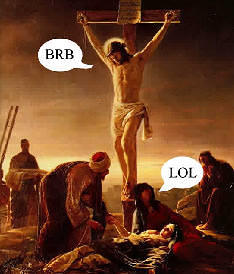
Back In 5 Mins --J.C.
Examining the bible without my Jesus goggles, I started to understand things a little clearer. Things like Jesus's quotes in Matthew. "Immediately after the distress of those days 'the sun will be darkened, and the moon will not give its light; the stars will fall from the sky, and the heavenly bodies will be shaken'... Even so, when you see all these things, you know that it is near, right at the door...I tell you the truth, this generation will certainly not pass away until all these things have happened...I tell you the truth, you will not finish going through the cities of Israel before the Son of Man comes...For the Son of Man is going to come in his Father's glory with his angels, and then he will reward each person according to what he has done. I tell you the truth, some who are standing here will not taste death before they see the Son of Man coming in his kingdom."
That's a pretty clear indication that Jesus expected to return within his follower's lifetime. I find it both amusing and startling how every generation thinks of itself as the quoted "this generation". I guess it makes since to want to be "the generation" that gets to see Glory coming.
Even the apostles of Christ felt similar sentiments. James (5:8) instructs his fellow believers to "be patient and stand firm, because the Lord's coming is near." In fact, a lot of the New Testament is full of this sort of "be ready to go" language.
"For in just a little while, 'He who is coming will come and will not delay'." -Hebrews 10:37
"The hour has come for you to wake up from your slumber, because our salvation is nearer now than when we first believed." -Romans 13:11
"...time is short...For this world in its present form is passing away." -1 Corinthians 7:29
"The end of all things is near." -1 Peter 4:7
Dude, You are Soooooooo Fuggin' Late!
The looming threat of Judgment Day is held over believers by one another and by themselves. The other day I drove past a peeling, weather-worn church sign and I though, It never crosses a Christian's mind when they have to pay for a brand new billboard that says, "Jesus is coming SOON!" when the old one is decrepit and broken and has been sitting there for the past 20 years. Let's face the facts, people: Jesus promised to return soon and very soon, and that was nearly 2,000 years ago. I'm not really sure why Christians need to keep that sense of urgency, though it may have something to do with the fact that their god died 2000 years ago (if he ever really existed in the first place). Otherwise, it's a moot and unostentatious ending.

-STA
When I was a Christian, I was swept up into the idea that I was living in the "end times". The Son of Man would be flying in on clouds of glory, probably in just a couple years. This was back before Y2K, and so we all thought that sounded like a date Jesus would pick. So we all got ready, prayed, and stayed awake, fearing and waiting. And waiting.
And waiting...
Okay, so not the turn of the century. That's fine -- but it will be soon! Just look at all the wars, earthquakes, death, pestilence, and hardships around the world! Kids are listening to heavy metal and cutting themselves! You can't leave your front door unlocked anymore! The world is turning to shit! The end is neigh!!!!!!!!
It wasn't until I escaped Christianity that I realized this was an ongoing thing. Really. Since the dawn of Christianity, believers have been claiming the end of the world was just around the corner. I love browsing the website "A Brief History of the Apocalypse" whenever I hear a doomsday preacher on TV or read an end-times blog post. The phenomenon of predicting the end of the world is almost as old as the world itself.
Back In 5 Mins --J.C.
Examining the bible without my Jesus goggles, I started to understand things a little clearer. Things like Jesus's quotes in Matthew. "Immediately after the distress of those days 'the sun will be darkened, and the moon will not give its light; the stars will fall from the sky, and the heavenly bodies will be shaken'... Even so, when you see all these things, you know that it is near, right at the door...I tell you the truth, this generation will certainly not pass away until all these things have happened...I tell you the truth, you will not finish going through the cities of Israel before the Son of Man comes...For the Son of Man is going to come in his Father's glory with his angels, and then he will reward each person according to what he has done. I tell you the truth, some who are standing here will not taste death before they see the Son of Man coming in his kingdom."
That's a pretty clear indication that Jesus expected to return within his follower's lifetime. I find it both amusing and startling how every generation thinks of itself as the quoted "this generation". I guess it makes since to want to be "the generation" that gets to see Glory coming.
Even the apostles of Christ felt similar sentiments. James (5:8) instructs his fellow believers to "be patient and stand firm, because the Lord's coming is near." In fact, a lot of the New Testament is full of this sort of "be ready to go" language.
"For in just a little while, 'He who is coming will come and will not delay'." -Hebrews 10:37
"The hour has come for you to wake up from your slumber, because our salvation is nearer now than when we first believed." -Romans 13:11
"...time is short...For this world in its present form is passing away." -1 Corinthians 7:29
"The end of all things is near." -1 Peter 4:7
Dude, You are Soooooooo Fuggin' Late!
The looming threat of Judgment Day is held over believers by one another and by themselves. The other day I drove past a peeling, weather-worn church sign and I though, It never crosses a Christian's mind when they have to pay for a brand new billboard that says, "Jesus is coming SOON!" when the old one is decrepit and broken and has been sitting there for the past 20 years. Let's face the facts, people: Jesus promised to return soon and very soon, and that was nearly 2,000 years ago. I'm not really sure why Christians need to keep that sense of urgency, though it may have something to do with the fact that their god died 2000 years ago (if he ever really existed in the first place). Otherwise, it's a moot and unostentatious ending.
-STA
Friday, February 5, 2010
Treaty of Tripoli in Modern Terms
It's common to hear from Christian revisionists that America is a "Christian Nation" founded on Christian values, and other unsupported claims. I've already covered this in another entry, so I won't go through it again.
Instead, today I wanted to take a look at the document known as the Treaty of Tripoli. This was a peace treaty between the US and the Bey of Tripoli in 1797. The treaty was unanimously approved by the Senate and signed by President John Adams and proudly proclaimed to the nation.
The relevant part of the treaty is Article 11, which states in its entirety:
"As the Government of the United States of America is not, in any sense, founded on the Christian religion; as it has in itself no character of enmity against the laws, religion, or tranquillity, of Mussulmen; and, as the said States never entered into any war, or act of hostility against any Mahometan nation, it is declared by the parties, that no pretext arising from religious opinions, shall ever produce an interruption of the harmony existing between the two countries."
America is not a Christian nation -- it can't be. The laws of this country are at odds with the laws the Christian God. If the above isn't clear enough, let's break it down in modern terms:
"The USA is NOT a Christian nation. It has laws that protect all religion, Christianity, Islam, or any other. America welcomes people of all faiths with open arms and does not actively engage in prejudice or hostility based on religion or creed. Both parties signing this treaty of friendship agree that actions and diplomatic discussions will not be hindered by matters of religion or faith-based opinions."
Doesn't that sound like a great place to live? Whether or not Glenn Beck, Sarah Palin, Ray Comfort, or George Bush agrees with sentiments expressed in the treaty, the Constitution backs it up. America was founded on freedom. Anyone can be an American. Any American can have any religion they want, or none at all. The government can't and should not uphold one religion, because doing so pushes all others down. Equality, freedom, and opportunity is the name of the US game, not the laws of Jesus or his Heavenly Father.
-STA
Instead, today I wanted to take a look at the document known as the Treaty of Tripoli. This was a peace treaty between the US and the Bey of Tripoli in 1797. The treaty was unanimously approved by the Senate and signed by President John Adams and proudly proclaimed to the nation.
The relevant part of the treaty is Article 11, which states in its entirety:
"As the Government of the United States of America is not, in any sense, founded on the Christian religion; as it has in itself no character of enmity against the laws, religion, or tranquillity, of Mussulmen; and, as the said States never entered into any war, or act of hostility against any Mahometan nation, it is declared by the parties, that no pretext arising from religious opinions, shall ever produce an interruption of the harmony existing between the two countries."
America is not a Christian nation -- it can't be. The laws of this country are at odds with the laws the Christian God. If the above isn't clear enough, let's break it down in modern terms:
"The USA is NOT a Christian nation. It has laws that protect all religion, Christianity, Islam, or any other. America welcomes people of all faiths with open arms and does not actively engage in prejudice or hostility based on religion or creed. Both parties signing this treaty of friendship agree that actions and diplomatic discussions will not be hindered by matters of religion or faith-based opinions."
Doesn't that sound like a great place to live? Whether or not Glenn Beck, Sarah Palin, Ray Comfort, or George Bush agrees with sentiments expressed in the treaty, the Constitution backs it up. America was founded on freedom. Anyone can be an American. Any American can have any religion they want, or none at all. The government can't and should not uphold one religion, because doing so pushes all others down. Equality, freedom, and opportunity is the name of the US game, not the laws of Jesus or his Heavenly Father.
-STA
Tuesday, December 15, 2009
Get Back To The True Meaning
Every year America is inundated with pleas from the Christian populace to cast off the secular traditions and once again return to the true meaning of Christmas.
If only they'd study a little history.
Origins of Christmastime
Roman pagans first introduced the holiday of Saturnalia, a week long period of lawlessness celebrated between December 17-25. Saturnus, the god of seed and sowing, was honored with a festival. During this time the Roman courts were closed, law was lifted, and the social order was inverted. Slaves didn't have to work, banquets were held, and all seriousness was essentially barred. There were gifts given and informal dress with felt hats (normally used by slaves) were worn to symbolize the freedom of the celebration.
It was an occasion for jubilation, visits to friends, and the presentation of gifts. Slaves were treated as equals, allowed to wear their masters' clothing, and be waited on at meal time in remembrance of an earlier golden age thought to have been ushered in by the god Saturn. Lucian of Samosata wrote, "Drinking, noise and games and dice, appointing of kings and feasting of slaves, singing naked, clapping of frenzied hands, an occasional ducking of corked faces in icy water—such are the functions over which I preside." The Saturnalia continued to be celebrated as Brumalia, the winter solstice, down to the Christian era, when its rituals had become absorbed in the celebration of Christmas (just as the festival of the Germanic goddess Eastre).

The Real Reason
When I was a Christian, I despised what I saw as the corruption and commercialization of my Lord's birthday by the evils of Walmart, Target, and Santa Claus (who I saw as a way of getting Christ's message across to heathens). Now that I actually looked into a bit of history surrounding the time, it's clear that we're not too far off from the "original meaning". I admit that I was an ignorant theist, as I think many today are; they don't want to learn anything past Jesus. They don't realize that centuries of time, traditions, and practices came before the third century! Just as with Christmas, they stop at 4AD and refuse to accept that gods like Mithra, Horace, Dionysus, Osiris, and lots of others all call that date their birthday.
Traditions get taken over as ideas slowly change. As the culture changes, you either adopt the new traditions by relating to them in some way, or you ignore them outright. I find it amusing that the pagan influences are still wrapped around the Christian face of the holiday. Jeremiah 10:2-4 warns not to put up what we today call a Christmas tree. And yet how many Christians have a tree in there house right now? Like I said, you go with the flow and change the meanings to fit your own tastes and beliefs or you die by the wayside. Our contemporary traditions are just as much the "true meaning" as any.
The fact is, the season is the reason for the season; it's the winter solstice. We must realize that feasts and festivals in honor of to the gods and forces of the seasons have existed for millenia. In our modern times of abundance and prevalence of food (the fact that you can get strawberries in the winter, etc.), in a way removes the reasons for many of our traditional holidays like Thanksgiving and Christmas. Thus, we're free to "celebrate" whatever we want. If you want to view Christmas as a celebration of the hope of the next spring, go for it. If you want to see it as another chance to spend time with loved ones, be my guest. If you want to think that it's the day your god was born or as a festival to one of the many fertility gods, that's fine too. Whatever reason you decide the season is for, just make sure to eat, drink, and be merry -- and don't force your practices on everyone else.
And have a wonderful Christma-Hanu-Rama-Ka-Dona-Kwanzaa-Wali-Solstice!
-STA
If only they'd study a little history.
Origins of Christmastime
Roman pagans first introduced the holiday of Saturnalia, a week long period of lawlessness celebrated between December 17-25. Saturnus, the god of seed and sowing, was honored with a festival. During this time the Roman courts were closed, law was lifted, and the social order was inverted. Slaves didn't have to work, banquets were held, and all seriousness was essentially barred. There were gifts given and informal dress with felt hats (normally used by slaves) were worn to symbolize the freedom of the celebration.
It was an occasion for jubilation, visits to friends, and the presentation of gifts. Slaves were treated as equals, allowed to wear their masters' clothing, and be waited on at meal time in remembrance of an earlier golden age thought to have been ushered in by the god Saturn. Lucian of Samosata wrote, "Drinking, noise and games and dice, appointing of kings and feasting of slaves, singing naked, clapping of frenzied hands, an occasional ducking of corked faces in icy water—such are the functions over which I preside." The Saturnalia continued to be celebrated as Brumalia, the winter solstice, down to the Christian era, when its rituals had become absorbed in the celebration of Christmas (just as the festival of the Germanic goddess Eastre).
The Real Reason
When I was a Christian, I despised what I saw as the corruption and commercialization of my Lord's birthday by the evils of Walmart, Target, and Santa Claus (who I saw as a way of getting Christ's message across to heathens). Now that I actually looked into a bit of history surrounding the time, it's clear that we're not too far off from the "original meaning". I admit that I was an ignorant theist, as I think many today are; they don't want to learn anything past Jesus. They don't realize that centuries of time, traditions, and practices came before the third century! Just as with Christmas, they stop at 4AD and refuse to accept that gods like Mithra, Horace, Dionysus, Osiris, and lots of others all call that date their birthday.
Traditions get taken over as ideas slowly change. As the culture changes, you either adopt the new traditions by relating to them in some way, or you ignore them outright. I find it amusing that the pagan influences are still wrapped around the Christian face of the holiday. Jeremiah 10:2-4 warns not to put up what we today call a Christmas tree. And yet how many Christians have a tree in there house right now? Like I said, you go with the flow and change the meanings to fit your own tastes and beliefs or you die by the wayside. Our contemporary traditions are just as much the "true meaning" as any.
The fact is, the season is the reason for the season; it's the winter solstice. We must realize that feasts and festivals in honor of to the gods and forces of the seasons have existed for millenia. In our modern times of abundance and prevalence of food (the fact that you can get strawberries in the winter, etc.), in a way removes the reasons for many of our traditional holidays like Thanksgiving and Christmas. Thus, we're free to "celebrate" whatever we want. If you want to view Christmas as a celebration of the hope of the next spring, go for it. If you want to see it as another chance to spend time with loved ones, be my guest. If you want to think that it's the day your god was born or as a festival to one of the many fertility gods, that's fine too. Whatever reason you decide the season is for, just make sure to eat, drink, and be merry -- and don't force your practices on everyone else.
And have a wonderful Christma-Hanu-Rama-Ka-Dona-Kwanzaa-Wali-Solstice!
-STA
Tuesday, December 8, 2009
Claus and Christ
It's that time of year again. We see you-know-who's face plastered up on billboards and posters all over the place, at least here in America. With his big blue eyes wishing peace and love to the world. Yep, Jesus is everywhere. And so is that pagan red devil, Santa Claus. Coincidence???
Let's look at some similarities of these two fairy-tale personas:
It's pretty clear that they both represent attempts in our culture to keep children in line. Some even view Santa as a way of passing the messages of Christianity onto nonbelievers. What about their differences?
It's also interesting to note how society relates to these two. Santa is looked upon as fantasy, whereas Jesus is touted as 100% fact (even though Santa is more plausible, baring the "magic" and violations of physics and economics). The Santa myth is looked upon with fondness as something innocuous that we can look back upon and laugh about. But the much more bloody and unbelievable myth is put forth in all seriousness.
There isn't many wars fought over which of Santa's ideas are to be followed. There isn't any Santaquisions or Elf Burnings. As Stefan Molyneux of FreeDomainRadio.com points out (paraphrased), "Nobody drinks the wine that is supposed to turn into the blood of Santa, and you don't eat bread that turns into Santa's flesh. Santa doesn't come back from the dead, Santa doesn't heal the sick and so on."
That's why I don't have a problem partaking in the pagan and secular mythologies of Santa Claus. When the time comes, I won't be lying to my susceptible children about the existence of Santa. It's indeed just as harmful if you lead a child into thinking they "better watch out" because Santa is watching them, as it is to tell them God is watching them and they'll burn in hell forever if they're not good. I'll most likely let my children know that it's just a fun story, and I'll pretend with them for as long as they want to. I see it as an opportunity to show them critical thinking, weighing of evidence, and the parallels with religion. When a majority of the world can see the universality of myth -- that their creation stories are one in the same, unjustifiable myth -- we'll be a lot better off.
I get asked sometimes why I bother writing about and making videos on religion if I don't believe in it. The fact is that many, many people do believe in the teaching of their supposed prophets and deities. These people's beliefs affect the actions they take upon others, and that's the problem. If there were "Santa Wars" fought daily, I'd be here pointing out the absurdities of flying reindeer, the lack of evidence for elves, and arguing for people to put away their childish notions of a fat guy who lives at a toy workshop at the North-Pole. Luckily, no one takes Santa seriously enough to jeopardize the fate of the planet, so I'll keep railing against the bigoted religious intolerance that is doing just that.
*Assuming Jesus ever existed in the first place.
-STA
Let's look at some similarities of these two fairy-tale personas:
- Jesus (being God) is ever-watchful -- see Psalm 139:1-4
- Santa sees you too -- see "Santa Claus Is Coming To Town"
- Jesus rewards good behavior (heaven) and punishes bad behavior (hell)
- Santa also rewards good behavior (toys) and punishes bad behavior (coal)
- Jesus has a list of good people (The Lamb's Book of Life)
- Santa has a list of naughty and nice children

It's pretty clear that they both represent attempts in our culture to keep children in line. Some even view Santa as a way of passing the messages of Christianity onto nonbelievers. What about their differences?
- Santa has a physical, tangible existence -- he eats cookies, drinks milk, comes down chimneys, etc.
- Jesus lives in your "heart" and is no longer* a flesh and blood being
- Santa rewards you in the here-and-now with material positions
- Jesus's gifts have to wait til you die (except for babbling incoherently and other "gifts of the Spirit")
- Santa will put you on the naught list as long as you're bad
- Jesus will roast your ass in hell forever if you screw up and forget to say 'Sorry' before you kick the bucket
- Kids who stop believing in Santa Claus are praised for their cleverness and skills of deduction
- Kids who stop believing in Jesus are shunned for immorality and outlandish blasphemy
It's also interesting to note how society relates to these two. Santa is looked upon as fantasy, whereas Jesus is touted as 100% fact (even though Santa is more plausible, baring the "magic" and violations of physics and economics). The Santa myth is looked upon with fondness as something innocuous that we can look back upon and laugh about. But the much more bloody and unbelievable myth is put forth in all seriousness.
There isn't many wars fought over which of Santa's ideas are to be followed. There isn't any Santaquisions or Elf Burnings. As Stefan Molyneux of FreeDomainRadio.com points out (paraphrased), "Nobody drinks the wine that is supposed to turn into the blood of Santa, and you don't eat bread that turns into Santa's flesh. Santa doesn't come back from the dead, Santa doesn't heal the sick and so on."
That's why I don't have a problem partaking in the pagan and secular mythologies of Santa Claus. When the time comes, I won't be lying to my susceptible children about the existence of Santa. It's indeed just as harmful if you lead a child into thinking they "better watch out" because Santa is watching them, as it is to tell them God is watching them and they'll burn in hell forever if they're not good. I'll most likely let my children know that it's just a fun story, and I'll pretend with them for as long as they want to. I see it as an opportunity to show them critical thinking, weighing of evidence, and the parallels with religion. When a majority of the world can see the universality of myth -- that their creation stories are one in the same, unjustifiable myth -- we'll be a lot better off.
I get asked sometimes why I bother writing about and making videos on religion if I don't believe in it. The fact is that many, many people do believe in the teaching of their supposed prophets and deities. These people's beliefs affect the actions they take upon others, and that's the problem. If there were "Santa Wars" fought daily, I'd be here pointing out the absurdities of flying reindeer, the lack of evidence for elves, and arguing for people to put away their childish notions of a fat guy who lives at a toy workshop at the North-Pole. Luckily, no one takes Santa seriously enough to jeopardize the fate of the planet, so I'll keep railing against the bigoted religious intolerance that is doing just that.

*Assuming Jesus ever existed in the first place.
-STA
Tuesday, September 8, 2009
The Righteous Judge
From "Tim" to The Non-Prophets internet radio show:
So I was driving 66 in a 65 mph zone, got pulled over, given a ticket, and had to go to court. The judge said that because I had broken the law I had to serve the minimum sentence of life in prison with no possibility of parole at a maximum security penitentiary that makes HBO's Oz look like the merry old land of Oz.
I thought the sentence was a bit steep, but I later realized that we all fall short of the glory of the judge who never broke any laws whatsoever and cannot tolerate even the slightest unlawfulness, so I had no choice but to accept my punishment.
However, the judge did take pity on me. He called his son in and proceeded to brutally whip him with a cat 'o nine tails until he was raw and bloody, and then nailed him to a cross until he was dead. He then told me to eat his flesh and drink his blood. I did, and after that I was free to go.
I walked out of the court room a free man, as did the serial child molester who also ate the judge's son's flesh and blood (he was a cannibal, so really didn't mind). However this other woman said she didn't want to cannibalize the judge's son and that she didn't do anything wrong. But the judge just said that all have committed crimes and all must be endlessly punished for them, and the only way for her to escape was to eat his son. The woman still refused so she was sentenced to life in prison.
I guess I kinda felt bad for her spending the rest of her life in prison. Nevertheless, I know that she deserved it because the judge was truly a good man. I mean you'd have to be a really, really good person in order to brutally beat your own son and then crucify him and have his flesh and blood consumed so that me and a serial killer could go free. Truly these are actions of a righteous man. Well I guess it just sucks to be her.
Anyway, I'm a free man now, although my schedule is pretty full. I've been spending most of my time at the judge's house, thanking him for freeing me and telling him how great he is over and over and over and over and over again.
So I was driving 66 in a 65 mph zone, got pulled over, given a ticket, and had to go to court. The judge said that because I had broken the law I had to serve the minimum sentence of life in prison with no possibility of parole at a maximum security penitentiary that makes HBO's Oz look like the merry old land of Oz.
I thought the sentence was a bit steep, but I later realized that we all fall short of the glory of the judge who never broke any laws whatsoever and cannot tolerate even the slightest unlawfulness, so I had no choice but to accept my punishment.
However, the judge did take pity on me. He called his son in and proceeded to brutally whip him with a cat 'o nine tails until he was raw and bloody, and then nailed him to a cross until he was dead. He then told me to eat his flesh and drink his blood. I did, and after that I was free to go.
I walked out of the court room a free man, as did the serial child molester who also ate the judge's son's flesh and blood (he was a cannibal, so really didn't mind). However this other woman said she didn't want to cannibalize the judge's son and that she didn't do anything wrong. But the judge just said that all have committed crimes and all must be endlessly punished for them, and the only way for her to escape was to eat his son. The woman still refused so she was sentenced to life in prison.
I guess I kinda felt bad for her spending the rest of her life in prison. Nevertheless, I know that she deserved it because the judge was truly a good man. I mean you'd have to be a really, really good person in order to brutally beat your own son and then crucify him and have his flesh and blood consumed so that me and a serial killer could go free. Truly these are actions of a righteous man. Well I guess it just sucks to be her.
Anyway, I'm a free man now, although my schedule is pretty full. I've been spending most of my time at the judge's house, thanking him for freeing me and telling him how great he is over and over and over and over and over again.
Friday, March 20, 2009
Why I Left Atheism - A Critique
During a recent conversation I was challenged to read Why I Left Atheism, a paper by a guy named John N. Clayton who runs DoesGodExist.org. The autobiographical "booklet" details Clayton's story of becoming a Christian, and I was encouraged to read it in the hopes that I'd find it convincing. Thus I sat about hear out the exposition of this so-called former atheist-turned-evangelical with an open mind. Here's what I found:
Common Caricature
Very early on, Clayton begins making the common mistakes we see Christian evangelists make. In the second paragraph, he states that he used to be an atheist and the life he led was a stone's throw from pure evil. Clayton writes, "...that kind of life and conviction led me to do and say things and to be something that was really very unpleasant. I lived a life that was immoral and which reflected a lack of belief in God. I lived in a way that was very self-centered and that satisfied my own pleasures and desires regardless of whether or not other people were hurt in the process of what I was doing."
It is in this manner that Clayton shows us the first face of his ignorance. He equates being an atheist to living a "self-centered", "unpleasant", and otherwise "immoral" life. He argues from morality, assuming that all atheists are immoral by default, and that that kind of lifestyle is a reflection of not believing in God.
He couldn't be more wrong right off the bat. To falsify his claim we'd only have to find one person who doesn't believe in God (that is of course, the Christian God) and who leads a life that is not "self-centered", "unpleasant", or "immoral". Shouldn't be too hard.
We Don't Know Yet
Clayton then tells us that he was raised, nay indoctrinated as an atheist by non-believing parents. I'll give Clayton the benefit of the doubt, although this composition is already taking on the standard tone of the "once-blind-but-now-I-see" crowd. Things really start to get shady when Clayton claims to have had a discussion with one of his college professors on the "creation of matter from nothing" (apparently during an astronomy class where the topic was "origins"). Upon asking the professor which theory best explains creation ex-nihilo, Clayton is told he needs to learn to ask intelligent questions. Indeed, that's the smartest line so far, for Clayton should understand that matter/energy cannot be created or destroyed as per the First Law of Thermodynamics. The professor supposedly tells Clayton that these are questions not for the scientist but for the theologian, and Clayton is stunned that science doesn't know everything. The tone of this paragraph (and the following one) is reminiscent of the old email that has made the rounds a few times, the one about the atheist professor and the Christian student who "defeats" him with science.
The point of the paragraph seems to be that we are to focus on the answer the professor gave, about origins not being within the realm of science. Richard Dawkins covers this topic well in Chapter 2 of his book, The God Delusion. Put simply, religion falsely claims the right to answer why questions, and science gets the how. But not only is such a thing as a why question nonsensical, but the fact that most of the claims made by God-believers about their deity require some sort of physical interface, as it were. Dawkins writes, "The moment there was the smallest suggestion of any evidence in favour of religious belief, religious apologists would lose no time in throwing NOMA out the window." (NOMA being non-overlapping magisterium, the idea that science can't answer questions about God.) If God interacts in any way with the physical world, that point where the transaction occurs is (or should be) a place of testability.
Nevertheless, Clayton's unoriginal idea that science can't solve poorly-worded questions continues throughout the missive. Clayton moves on to the next professor (who always seems to be "one of the great XYZ professors in the country"), this time, biology. Again Clayton poses the question of origins to the all-knowing scientist, and again he is told that it is a question for religion, not for science. He then attempts to slip in a little argument-from-authority: "I guess what was happening to me was the same thing that Lord Kelvin, a very famous British scientist, described in his writings when he made the statement, 'If you study science deep enough and long enough it will force you to believe in God.' That is what happened to me. I began to realize that science had its limitations--that science, in fact, strongly pointed to other explanations than natural ones to certain questions."
A very famous scientist said science leads to God, so it must be true. More importantly, science doesn't know every answer to every question, so therefore Magic-Man done it! Clayton is just not seeing the problem here. An explanation has to stand on its own two feet. Even if the whole of science turns out to be a load of cow shit doesn't mean that God, FSM, Bigfoot, or Santa Claus wins by default.
Science is making progress; a thousand years ago people thought that lightening was caused by an angry god throwing bolts down to earth, and that illness was caused by evil spirits. We've come a long way to closing those gaps in our knowledge, but still some remain. Those gaps -- however convenient a hiding place to stuff a deity into -- do not suggest anything "supernatural" simply because they are unknowns. This God-of-the-gaps argument is the most-used attempt offered by theology. Not knowing something isn't a proof for anything except ignorance.
How The Bible Is Accurate
Clayton's next words reek of absurdity. While keeping the bad-boy image of living an evil immoral atheist life, Clayton reads his bible in the hopes of discovering scientific contradictions. You guessed it, he finds none! I'm not sure what his definition of "scientific contradictions" is, but I'm pretty sure "bats = birds" should qualify.
The intellectual bankruptcy continues for the rest of the paper, all the while Clayton cherry-picks bible verses and reiterates the view that he could do whatever he wanted to -- because after all, there was no God. He talks about his rebellious youth and implies that children who don't believe in a supernatural father-figure can't be good moral people and this is what's wrong with society today. Clayton recounts having to lie to his mother about certain happenings with a girl whom he had taken out the night before, and because "that was the last thing I was going to tell my mother", he learned to lie reeeel good. He then points to a bible verse that says "Fathers, provoke not your children to anger", thus blaming his lying, stealing, and general wickedness on the sins of his parents as strictly forbid in the "inerrant Word".
And of course no theistic proclamation is complete without the classic Psalm 53 attack: "The fool says in his heart there is no God"! Ouch, John. That always stings us heathens! Why you gotta do that?
The Need for God
Clayton admits to thoughts of suicide, recounting how his immoral atheistic lifestyle drove him to sink so low. It's the same old story you hear again and again about the drug-using rebellious hedonist who's hit rock bottom, then they "find Jesus" and all their problems just melt away. Even Clayton himself admits this and writes, "Have you ever wondered why it is that when a person gets clean from drugs, gets rid of the problem of alcohol, or conquers some of the problems like the ones I had, that the person always seems to get involved in some religious cause, halfway house, or something like that? Why is that?"
I'll tell you why that is. First off, it's easy to believe in God given the standard definition of his attributes. You can't see him, touch him, etc. but he'll take all your cares away and you'll even get to survive your own death! What's not to like about that, given your current state of mind?
But most importantly the reason lies in a common misconception (one that Clayton himself admits to subscribing to). There is this perception that you're either a godless, immoral, no-good asshat OR a god-fearing, virtuous, upright religious pillar. It's the idea that somehow religious people automatically receive respect simply because they're religious. By starting out claiming that you were a somewhat shitty person because you had no sky-master demonstrates this fallacy. According to this false dichotomy, what other choice do the run-downs think they have? People who think in this manner can't seem to understand that human beings don't need a god to be good.
Even if religion was proven to be the best way at dealing with these stereotypical problems, that would not make any of its claims true one bit. Being helpful doesn't equal being real. Beneficial? Maybe. But can anyone give me a benefit that religion offers that can't be provided by secular means?
Picking A God
Clayton next claims that he sought answers from other religions and "found that [they] taught many things I could not accept. There were teachings in their writings concerning what life was like after this life that were unrewarding and unrealistic and there were descriptions of God that were illogical and inconsistent."
Oh? And the omniscient/omnipotent or infinitely-just/infinitely merciful inheritances are logical? Streets of gold and worms that never die are realistic? Since he can't find anything to suit his personal taste, Clayton picks the bible as the only obvious truth (since truth is based on what suits you best). "I decided that if I ever came to believe in God, it would be a belief based upon the Bible." Statements such as these reveal Clayton as a poorly-reasoned atheist.
After picking out which flavor of Christianity he liked best (Church of Christ, apparently), Clayton finally gives us "the final straw" that took him from godless heathen to moral sainthood. Again, it's one of his "leading atheist" professors. This time it's geology, and Clayton ends up his somewhat contrived banter by telling his professor, "Sir, you have not really shown me any contradiction between what we have studied in this course and in what the Bible has to teach," to which he replied, "Well, I guess if you really study it, there is no contradiction." So again, he paints the picture of science (or scientists) not being able to solve his ill-formed questions...therefore Yahweh exists and the bible is literally true.
John Clayton finally sums up his "lesson" by saying if you're not with God you're against God. So remember, if you're not with the Tooth Fairy you're against the Tooth Fairy -- you can't be both!
Fail
This laughable tale has no hope of convenience any intellectual to take him seriously. At every point he incorrectly summarizes the state of things as we know them with regards to science, logic, and reason. He assumes first, and since no satisfactory answer is found, he turns to untested dogmatic irrational thinking that lacks any evidence whatsoever. Clayton's only arguments are from incredulity and morality. As for the latter, he doesn't get that he was just an immoral person, not because there was no God to tell him what to do or think, but because he didn't respect himself or his fellow man.
Clayton may indeed have been an atheist, although a poorly-informed and irrational one. Still, he displays an enormous lack of understanding about the scientific method and the fields of biology, cosmology, and geology. Those of us who hold our position due to reason and intellectual rationalization can quickly point out the flaws in Clayton's pesudo-arguments. This exercise has not truly been a waste, however, for the doors of conversation remain open, and the bright light of knowledge is still shining through and rousing the ill-informed.
-STA
Common Caricature
Very early on, Clayton begins making the common mistakes we see Christian evangelists make. In the second paragraph, he states that he used to be an atheist and the life he led was a stone's throw from pure evil. Clayton writes, "...that kind of life and conviction led me to do and say things and to be something that was really very unpleasant. I lived a life that was immoral and which reflected a lack of belief in God. I lived in a way that was very self-centered and that satisfied my own pleasures and desires regardless of whether or not other people were hurt in the process of what I was doing."
It is in this manner that Clayton shows us the first face of his ignorance. He equates being an atheist to living a "self-centered", "unpleasant", and otherwise "immoral" life. He argues from morality, assuming that all atheists are immoral by default, and that that kind of lifestyle is a reflection of not believing in God.
He couldn't be more wrong right off the bat. To falsify his claim we'd only have to find one person who doesn't believe in God (that is of course, the Christian God) and who leads a life that is not "self-centered", "unpleasant", or "immoral". Shouldn't be too hard.
We Don't Know Yet
Clayton then tells us that he was raised, nay indoctrinated as an atheist by non-believing parents. I'll give Clayton the benefit of the doubt, although this composition is already taking on the standard tone of the "once-blind-but-now-I-see" crowd. Things really start to get shady when Clayton claims to have had a discussion with one of his college professors on the "creation of matter from nothing" (apparently during an astronomy class where the topic was "origins"). Upon asking the professor which theory best explains creation ex-nihilo, Clayton is told he needs to learn to ask intelligent questions. Indeed, that's the smartest line so far, for Clayton should understand that matter/energy cannot be created or destroyed as per the First Law of Thermodynamics. The professor supposedly tells Clayton that these are questions not for the scientist but for the theologian, and Clayton is stunned that science doesn't know everything. The tone of this paragraph (and the following one) is reminiscent of the old email that has made the rounds a few times, the one about the atheist professor and the Christian student who "defeats" him with science.
The point of the paragraph seems to be that we are to focus on the answer the professor gave, about origins not being within the realm of science. Richard Dawkins covers this topic well in Chapter 2 of his book, The God Delusion. Put simply, religion falsely claims the right to answer why questions, and science gets the how. But not only is such a thing as a why question nonsensical, but the fact that most of the claims made by God-believers about their deity require some sort of physical interface, as it were. Dawkins writes, "The moment there was the smallest suggestion of any evidence in favour of religious belief, religious apologists would lose no time in throwing NOMA out the window." (NOMA being non-overlapping magisterium, the idea that science can't answer questions about God.) If God interacts in any way with the physical world, that point where the transaction occurs is (or should be) a place of testability.
Nevertheless, Clayton's unoriginal idea that science can't solve poorly-worded questions continues throughout the missive. Clayton moves on to the next professor (who always seems to be "one of the great XYZ professors in the country"), this time, biology. Again Clayton poses the question of origins to the all-knowing scientist, and again he is told that it is a question for religion, not for science. He then attempts to slip in a little argument-from-authority: "I guess what was happening to me was the same thing that Lord Kelvin, a very famous British scientist, described in his writings when he made the statement, 'If you study science deep enough and long enough it will force you to believe in God.' That is what happened to me. I began to realize that science had its limitations--that science, in fact, strongly pointed to other explanations than natural ones to certain questions."
A very famous scientist said science leads to God, so it must be true. More importantly, science doesn't know every answer to every question, so therefore Magic-Man done it! Clayton is just not seeing the problem here. An explanation has to stand on its own two feet. Even if the whole of science turns out to be a load of cow shit doesn't mean that God, FSM, Bigfoot, or Santa Claus wins by default.
Science is making progress; a thousand years ago people thought that lightening was caused by an angry god throwing bolts down to earth, and that illness was caused by evil spirits. We've come a long way to closing those gaps in our knowledge, but still some remain. Those gaps -- however convenient a hiding place to stuff a deity into -- do not suggest anything "supernatural" simply because they are unknowns. This God-of-the-gaps argument is the most-used attempt offered by theology. Not knowing something isn't a proof for anything except ignorance.
How The Bible Is Accurate
Clayton's next words reek of absurdity. While keeping the bad-boy image of living an evil immoral atheist life, Clayton reads his bible in the hopes of discovering scientific contradictions. You guessed it, he finds none! I'm not sure what his definition of "scientific contradictions" is, but I'm pretty sure "bats = birds" should qualify.
The intellectual bankruptcy continues for the rest of the paper, all the while Clayton cherry-picks bible verses and reiterates the view that he could do whatever he wanted to -- because after all, there was no God. He talks about his rebellious youth and implies that children who don't believe in a supernatural father-figure can't be good moral people and this is what's wrong with society today. Clayton recounts having to lie to his mother about certain happenings with a girl whom he had taken out the night before, and because "that was the last thing I was going to tell my mother", he learned to lie reeeel good. He then points to a bible verse that says "Fathers, provoke not your children to anger", thus blaming his lying, stealing, and general wickedness on the sins of his parents as strictly forbid in the "inerrant Word".
And of course no theistic proclamation is complete without the classic Psalm 53 attack: "The fool says in his heart there is no God"! Ouch, John. That always stings us heathens! Why you gotta do that?
The Need for God
Clayton admits to thoughts of suicide, recounting how his immoral atheistic lifestyle drove him to sink so low. It's the same old story you hear again and again about the drug-using rebellious hedonist who's hit rock bottom, then they "find Jesus" and all their problems just melt away. Even Clayton himself admits this and writes, "Have you ever wondered why it is that when a person gets clean from drugs, gets rid of the problem of alcohol, or conquers some of the problems like the ones I had, that the person always seems to get involved in some religious cause, halfway house, or something like that? Why is that?"
I'll tell you why that is. First off, it's easy to believe in God given the standard definition of his attributes. You can't see him, touch him, etc. but he'll take all your cares away and you'll even get to survive your own death! What's not to like about that, given your current state of mind?
But most importantly the reason lies in a common misconception (one that Clayton himself admits to subscribing to). There is this perception that you're either a godless, immoral, no-good asshat OR a god-fearing, virtuous, upright religious pillar. It's the idea that somehow religious people automatically receive respect simply because they're religious. By starting out claiming that you were a somewhat shitty person because you had no sky-master demonstrates this fallacy. According to this false dichotomy, what other choice do the run-downs think they have? People who think in this manner can't seem to understand that human beings don't need a god to be good.
Even if religion was proven to be the best way at dealing with these stereotypical problems, that would not make any of its claims true one bit. Being helpful doesn't equal being real. Beneficial? Maybe. But can anyone give me a benefit that religion offers that can't be provided by secular means?
Picking A God
Clayton next claims that he sought answers from other religions and "found that [they] taught many things I could not accept. There were teachings in their writings concerning what life was like after this life that were unrewarding and unrealistic and there were descriptions of God that were illogical and inconsistent."
Oh? And the omniscient/omnipotent or infinitely-just/infinitely merciful inheritances are logical? Streets of gold and worms that never die are realistic? Since he can't find anything to suit his personal taste, Clayton picks the bible as the only obvious truth (since truth is based on what suits you best). "I decided that if I ever came to believe in God, it would be a belief based upon the Bible." Statements such as these reveal Clayton as a poorly-reasoned atheist.
After picking out which flavor of Christianity he liked best (Church of Christ, apparently), Clayton finally gives us "the final straw" that took him from godless heathen to moral sainthood. Again, it's one of his "leading atheist" professors. This time it's geology, and Clayton ends up his somewhat contrived banter by telling his professor, "Sir, you have not really shown me any contradiction between what we have studied in this course and in what the Bible has to teach," to which he replied, "Well, I guess if you really study it, there is no contradiction." So again, he paints the picture of science (or scientists) not being able to solve his ill-formed questions...therefore Yahweh exists and the bible is literally true.
John Clayton finally sums up his "lesson" by saying if you're not with God you're against God. So remember, if you're not with the Tooth Fairy you're against the Tooth Fairy -- you can't be both!
Fail
This laughable tale has no hope of convenience any intellectual to take him seriously. At every point he incorrectly summarizes the state of things as we know them with regards to science, logic, and reason. He assumes first, and since no satisfactory answer is found, he turns to untested dogmatic irrational thinking that lacks any evidence whatsoever. Clayton's only arguments are from incredulity and morality. As for the latter, he doesn't get that he was just an immoral person, not because there was no God to tell him what to do or think, but because he didn't respect himself or his fellow man.
Clayton may indeed have been an atheist, although a poorly-informed and irrational one. Still, he displays an enormous lack of understanding about the scientific method and the fields of biology, cosmology, and geology. Those of us who hold our position due to reason and intellectual rationalization can quickly point out the flaws in Clayton's pesudo-arguments. This exercise has not truly been a waste, however, for the doors of conversation remain open, and the bright light of knowledge is still shining through and rousing the ill-informed.
-STA
Monday, February 9, 2009
Indulge In Lunacy
In today's modern age, we're used to getting things fast. Our food, our money, even our social interactions can be brought to us at the speed of light and in the comfort of our home. And now, from the guys who first invented and then abolished Limbo, you can get to your afterlife faster.
The Catholic Church announced today that they're bringing back Plenary Indulgences. According to the church teaching, sinners still face Purgatory (an imaginary place where they have to face punishment before going on to heaven). Even if you are absolved in the confessional and say your Our Fathers or Hail Marys as penance, you still gotta stop by heaven's waiting room when you die. But now, thanks to the Church, you can receive an indulgence that reduces or eliminates the your stay in Purgatory.
This idea of indulgence isn't new; back in the 1500's, the Church would literally sell them. But now they come free with one confession per year. Dioceses are hard-up for people to go hold fast to their traditions and keep the Church as the number-one authority of matters of sin and afterlife, and they're offering this incentive to try to reclaim their dwindling numbers. As said Bishop Nicholas DiMarzio of Brooklyn, "We just want to people to return to the ideas they used to know."
The very nature of religion is exposed in that statement. After all that we've learned since the Bronze Age, why on Earth would anyone want to return to the ways we used to do things? I'll tell you why: it's because they want to live in their fantasy. They don't like the fact that we're learning more and more about how reality works, and they just wish we could go back to the days of witch-burnings, bloodletting, and the iron rule superstition. We're dragging them, kicking and screaming, into the twenty-first century's light of reason and science -- and they're scared to death.
I hope this backfires, and more and more intellectually inquisitive people continue to doubt the ridiculous ideas that the Vatican comes up with. If they can just make this shit up without any sort of evidence, there's no reason at all for agreeing with them. It's like the saying goes, "if you give a mouse a cookie, he'll want a glass of milk". If we continue to keep a mindset of "Well, you can't DISPROVE it" then this and anything else is fair game. Hell, maybe tomorrow they'll say that members of the Church get a free t-shirt when they enter heaven. You gonna buy that too?
-STA
The Catholic Church announced today that they're bringing back Plenary Indulgences. According to the church teaching, sinners still face Purgatory (an imaginary place where they have to face punishment before going on to heaven). Even if you are absolved in the confessional and say your Our Fathers or Hail Marys as penance, you still gotta stop by heaven's waiting room when you die. But now, thanks to the Church, you can receive an indulgence that reduces or eliminates the your stay in Purgatory.
This idea of indulgence isn't new; back in the 1500's, the Church would literally sell them. But now they come free with one confession per year. Dioceses are hard-up for people to go hold fast to their traditions and keep the Church as the number-one authority of matters of sin and afterlife, and they're offering this incentive to try to reclaim their dwindling numbers. As said Bishop Nicholas DiMarzio of Brooklyn, "We just want to people to return to the ideas they used to know."
The very nature of religion is exposed in that statement. After all that we've learned since the Bronze Age, why on Earth would anyone want to return to the ways we used to do things? I'll tell you why: it's because they want to live in their fantasy. They don't like the fact that we're learning more and more about how reality works, and they just wish we could go back to the days of witch-burnings, bloodletting, and the iron rule superstition. We're dragging them, kicking and screaming, into the twenty-first century's light of reason and science -- and they're scared to death.
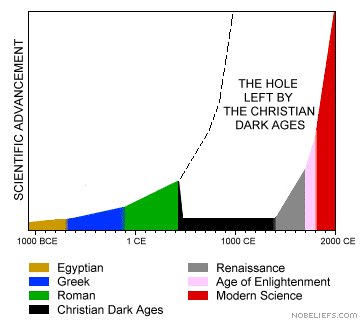
I hope this backfires, and more and more intellectually inquisitive people continue to doubt the ridiculous ideas that the Vatican comes up with. If they can just make this shit up without any sort of evidence, there's no reason at all for agreeing with them. It's like the saying goes, "if you give a mouse a cookie, he'll want a glass of milk". If we continue to keep a mindset of "Well, you can't DISPROVE it" then this and anything else is fair game. Hell, maybe tomorrow they'll say that members of the Church get a free t-shirt when they enter heaven. You gonna buy that too?
-STA
Tuesday, June 17, 2008
John McCain Flunked History
McCain thinks America was founded on Christianity, that his Christan faith is the best one, and that "In God We Trust" was put on our money by the Founding Fathers.
What a total fucktard.
-STA
What a total fucktard.
-STA
Tuesday, February 19, 2008
Satan is a Team-Killer
Sorry for the lack of posts recently, but I've been a bit under the weather. The Devil is trying to shut down my efforts.
Trials and Tribulations
I had a thought today that I thought I'd share. As some of my readers know, I was once a Christian. I believed all of it: talking snakes, divine tongues, flying zombie kings; all of it. I believed that our congregation could heal broken bones and cast out demons. I thought that I was chosen to do great work as part of God's divine plan.
But sometimes, I got sick. At times, I did poorly work in school, or lost money, or had car trouble, or just had "bad days". I was a "Good Christian", of course, but not perfect. Still, I knew I had God's angles to protect me, and the Holy Spirit to help me find my car keys if only I'd ask.
Funny thing is, now that I don't believe in God, angles, devils, unicorns, talking donkeys, or flying zombie kings, these "bad" things still happen to me. I've noticed that I still have the same trials and tribulations that I did as a believer. I see no increase or decrease in anything. Well, except one thing...
Rhyme and Reason
I'm much happier now. I'm not worried that some scary creature is out to get me whenever I spill my milkshake all over my lap. I understand now that there is no magic man in the sky who's controlling everything and who might decide to "test" me or strike me dead. It's easier to cope with life, I think, when you finally understand that things happen, not for a reason, but just because. At the start of this post, I joked that the Devil is out to get me. This is something that ex-Christians will identify with, because when you're a theist, you tell other believers that because you're doing God's work, Satan is trying to usurp you.
Satan must be trying to kill me, even though I'm on his team (according to Christians)!
::cough, cough::
-STA
Trials and Tribulations
I had a thought today that I thought I'd share. As some of my readers know, I was once a Christian. I believed all of it: talking snakes, divine tongues, flying zombie kings; all of it. I believed that our congregation could heal broken bones and cast out demons. I thought that I was chosen to do great work as part of God's divine plan.
But sometimes, I got sick. At times, I did poorly work in school, or lost money, or had car trouble, or just had "bad days". I was a "Good Christian", of course, but not perfect. Still, I knew I had God's angles to protect me, and the Holy Spirit to help me find my car keys if only I'd ask.
Funny thing is, now that I don't believe in God, angles, devils, unicorns, talking donkeys, or flying zombie kings, these "bad" things still happen to me. I've noticed that I still have the same trials and tribulations that I did as a believer. I see no increase or decrease in anything. Well, except one thing...
Rhyme and Reason
I'm much happier now. I'm not worried that some scary creature is out to get me whenever I spill my milkshake all over my lap. I understand now that there is no magic man in the sky who's controlling everything and who might decide to "test" me or strike me dead. It's easier to cope with life, I think, when you finally understand that things happen, not for a reason, but just because. At the start of this post, I joked that the Devil is out to get me. This is something that ex-Christians will identify with, because when you're a theist, you tell other believers that because you're doing God's work, Satan is trying to usurp you.
Satan must be trying to kill me, even though I'm on his team (according to Christians)!
::cough, cough::
-STA
Monday, February 4, 2008
Jesus Thinks I'm Hot
I saw a tee-shirt last week that said something like “Jesus Thinks I’m a Hottie”. The teenage girl it was wrapped around seemed like your typical, average Southern middle-class Jesus-freak teen. But what drew my attention was not the girl, of course, but the style of the message.
Personal Jesus
Practically any person can have their own, personal Jesus. Conservatives have the holier-than-thou, take-no-shit, obey-or-burn Jesus; the hippies have the shaggy, peace-and-love Jesus; and now the teens and ‘tweens have the boy-band Jesus.
Man or Myth?
There were historians at the supposed time of Jesus, and none of them mention him either. There is a mention in a document by Flavius Josephus, but it is a known forgery (some Christian followers went in long after he had written, and stuck in some drivel about everyone worshiping Jesus). There are only a few other first-century historians (Tacitus, Thallus, Suetonius, and Pliny the Younger), but they don’t say anything about “Jesus”, but instead mention “the Christ”, and there were several people running around in that time calling them selves “the Christ”. These historians’ writings provide no independent confirmation of the events of the New Testament. At the very most, they provide evidence of Christians living in first-century
My Kind of Christ
-STA
Wednesday, January 30, 2008
Monkeys From Nothing
"So lemme get this straight. You’re saying that there was just a big explosion in space that came from nothing, and then we crawled out of the goop and turned into monkeys? That’s how we got here? That’s absurd!"
Reason To Believe
As I’ve shown, we have a plethora of evidence and reason to believe that everything occurred naturally. This is a big question, and I’d advise everyone to read and learn more about what we *really* known and what we’re trying to figure out. But there’s no significant justification or evidence that there was any kind of intelligent, transcendent “force” that caused life, the universe, and everything. Because of this lack of knowledge, I'm agnostic. Because of this lack of evidence, I will not believe.
Visit talkorigins.org for more information.
Disclaimer
It’s extremely disheartening to think that in the 21st century, where man has accomplished amazing things, kids are not being adequately equipped in the public school system to understand even the fundamentals of cosmology, biology, or history. While the above hypothetical query is a vague generalization of ignorance and a strawman argument, it doesn’t stray too far from what some religious people believe. Therefore, I will attack it for what it is, and take from it what you will.
It’s extremely disheartening to think that in the 21st century, where man has accomplished amazing things, kids are not being adequately equipped in the public school system to understand even the fundamentals of cosmology, biology, or history. While the above hypothetical query is a vague generalization of ignorance and a strawman argument, it doesn’t stray too far from what some religious people believe. Therefore, I will attack it for what it is, and take from it what you will.
Okay, that’s about as straight as a corkscrew. I agree that what you said is absurd. No, I am not claiming (nor is anyone else, as far as I can tell) that we “came from nothing” or “turned into monkeys”.
What you’re really asking involves three different sciences: cosmology, abiogenesis, and evolution.
You Are What You Eat
First of all, we know evolution happened. It’s a provable fact that we can observe today (by studying microorganisms), and there’s a mountain of fossil evidence for common ancestry. Francis Collins, the head of the Human Genome Project that was completed in 2003 (and an evangelical Christian), said that even if there were no fossils, the DNA evidence *alone* is enough to confirm common decent.
First of all, we know evolution happened. It’s a provable fact that we can observe today (by studying microorganisms), and there’s a mountain of fossil evidence for common ancestry. Francis Collins, the head of the Human Genome Project that was completed in 2003 (and an evangelical Christian), said that even if there were no fossils, the DNA evidence *alone* is enough to confirm common decent.
So, we can trace the lineage of every living thing back to some sort of beginning (yes, you and a carrot are very, very, very, very, very, distant cousins). We know that life is here, and we know that it’s changed. Now the question becomes, where did life come from? That’s handled by abiogenesis. There are a number of scientific theories about how life could have evolved from nothing, and some of them have actually demonstrated the possibility of life from non-life. The Miller/Urey Experiment simulated hypothetical conditions present on the early Earth and showed that, given billions of years, organic life can grow out of inorganic material. There are a number of other theories about how life could have came from maybe another planet or at the bottom of the ocean…the point is, we don’t yet know exactly where or how, but we do know that it is scientifically possible for this to occur.
Now we have to go even farther back. We can trace back the history of the universe—using cosmology—to the formation of planets, galaxies, stars, etc. and eventually to the Big Bang, which isn’t a “something-from-nothing” proposition. We don’t know what happened before the Big Bang, we don’t know the state of the universe at the time before time. The laws of thermodynamics state that matter and energy are interchangeable, and that it cannot be created or destroyed.
I Don't Know
You may notice that I’m saying “we don’t know” a lot. That’s actually the wonderful thing about science: you don’t know, so you try to figure it out. You look for an answer. This is also where theistic belief asserts an answer and labels it “God”. Saying “God did it” is just an attempt to solve a mystery with another even greater mystery. It tells you nothing about how or why, and more importantly, it forces you to stop searching for a real answer. Asking “who cause the Big Bang” is a fallacious question, because it assumes a) that there had to be a “who”, and b) that it was “caused” by something, meaning it wouldn’t have happened otherwise.
You may notice that I’m saying “we don’t know” a lot. That’s actually the wonderful thing about science: you don’t know, so you try to figure it out. You look for an answer. This is also where theistic belief asserts an answer and labels it “God”. Saying “God did it” is just an attempt to solve a mystery with another even greater mystery. It tells you nothing about how or why, and more importantly, it forces you to stop searching for a real answer. Asking “who cause the Big Bang” is a fallacious question, because it assumes a) that there had to be a “who”, and b) that it was “caused” by something, meaning it wouldn’t have happened otherwise.
To argue against the popular alternative to all this provable, demonstrable, evidence is the theist, who simply states that he, too, doesn’t know how or why, but that “God did it” in his “mysterious ways”.
Reason To Believe
As I’ve shown, we have a plethora of evidence and reason to believe that everything occurred naturally. This is a big question, and I’d advise everyone to read and learn more about what we *really* known and what we’re trying to figure out. But there’s no significant justification or evidence that there was any kind of intelligent, transcendent “force” that caused life, the universe, and everything. Because of this lack of knowledge, I'm agnostic. Because of this lack of evidence, I will not believe.
Will you?
-STA
Thursday, January 17, 2008
Seeing Is Believing?
I've talked about faith so much that it makes me sick, but still it's an almost daily battle. One of the main contributors to my sorrow is the Judeo-Christian holy book. The bible is filled with stories and metaphors of people who didn't believe and were subsequently punished or hurt for it. The book breeds this ideology of faith so much so that it still affects humanity to this day.
You Gotta Have Faith!
Take for example, the story of Balaam's talking ass in Numbers 22. In a nutshell, the king of a town called Moab was afraid for his people because God's chosen people were destroying everything in their path (like good little believers do). This king sent forth for a guy named Balaam, a prophet. The king's men asked Balaam if he would mind putting a curse on these Israelites. Balaam talked it over with God, but of course these were God's people they were talking about, and God ordered Balaam not to curse them. Balaam told the king's men to go back to their country because Yahweh wouldn't let him curse their enemies.
The men did, but not taking 'no' for an answer, the Moab king sent another larger band of men for Balaam. They found Balaam and delivered the message from the king: "now do not refuse to come to me. I will load you with honors and do anything you say. I beg you to come and curse the people for me."
Being the ever-obedient one, Balaam replied that even if the king gave him is whole palace of silver and gold, he still couldn't disobey his God. He offered to let the men stay the night there before traveling back. Here's where it gets screwy...
No! I Mean, Yes! I Mean, No!
The bible says that Yahweh came to Balaam that night, and said "Have not these men come to summon you? Get up and go with them! But do only what I tell you to do." Once again, this is an example of God sending mixed messages. This can be explained if one considers the pantheistic religions of which Judaism and Christianity (and others) were molded from, but that's another topic.
So in the morning, Balaam saddles up his donkey and heads back with the men to Moab. The bible says that "God's anger was kindled because he went"...WTF?? So God says, "don't go!", then he says "okay, go" and then gets mad because he goes?! Perhaps Yaheweh's getting Alzheimer's?
As if this weren't enough to sell the story, it gets even loonier! So Balaam is riding his donkey, traveling back with the men from Moab, when God sends an angel to stand in the middle of the road. Balaam can't see this "angel of the lord", but his donkey can, and doesn't want to continue on down the road, but veers off into the open countryside. Balaam hits the donkey and steers her back toward the road.
Think about it, he's ridin' along, and his donkey leaves the road, so he strikes it and steers it back toward the road. Remember, Balaam can't see the angel that God sent to block the road cause he was pissed that Balaam went.
The angel then moves up the road a little ways and stands in the road between two vinyards, where there are walls along both sides of the road. The donkey has to squeeze right up against the wall to go past the invisible angel, and doing so, it crushes Balaams foot into the wall. Balaam of course beats his ass's ass again.
The angel then positions itself at a narrow passage (like maybe a bridge or something) where there's no way for the donkey and rider to go around. Get the picture -- it's like telling a joke, there's power in the one-two-three. The donkey can't go around the angel, so it lays down in the road. By this time Balaam is fed up with this damned stubborn donkey and lays his riding stick across its head one more time.
Talking Outta My Ass
The bible -- the holy book that some people believe every word of -- then says that Yahweh gave the donkey the power to talk! It tells Balaam that it doesn't understand why he beats it all the time, to which the infuriated (though not-so-much amazed) Balaam replies that he'd kill it if he only had a sword. The donkey then asks, "Am I not your donkey, and have you not been riding me all your life? Have I ever behaved like this with you before?"
"No," answers Balaam (now remember, a man is having a conversation with his donkey). God then opens Balaam's eyes so that he can see the angel standing there. Balaam bows down beside the donkey, in yielding to the angel of the lord.
The angel then says, "Why did you strike your donkey three times like that? You are lucky she turned aside or I would have certainly killed you by now, though I would have spared her." Huh? Wait, I know the story is trying to teach the lesson that you should just believe without evidence, but let's not forget that the donkey *could* see the angel, but Balaam *could not*. How would sparing the donkey but killing the rider be justice?
Balaam says to the angel, "I didn't see you standing there, but if what I'm doing displeases you, I'll turn back." The angel tells him to keep going, but to say only what he/God tells Balaam to say.
Flip-flop! So...wait a sec....huh?! So the point of the story was...to not go, but then go, then not go because God's angel is blocking the way, but because he can't see it he thinks his ass is just malfunctioning, so he beats it, but that's bad, so he should go anyway?!
Oh, Just Do Whatever The Hell You Want
There are tons of these kinds of screwy stories. There's the ultimate tale of "put your trust in God" with the story of Doubting Thomas, who wouldn't accept that Jesus had risen until he actually poked his fingers into the deity's wounds. The bible is filled to the brim with these kinds of stories, teaching the "value" of belief without evidence is always better.
I hope you can see that it isn't.
-STA
You Gotta Have Faith!
Take for example, the story of Balaam's talking ass in Numbers 22. In a nutshell, the king of a town called Moab was afraid for his people because God's chosen people were destroying everything in their path (like good little believers do). This king sent forth for a guy named Balaam, a prophet. The king's men asked Balaam if he would mind putting a curse on these Israelites. Balaam talked it over with God, but of course these were God's people they were talking about, and God ordered Balaam not to curse them. Balaam told the king's men to go back to their country because Yahweh wouldn't let him curse their enemies.
The men did, but not taking 'no' for an answer, the Moab king sent another larger band of men for Balaam. They found Balaam and delivered the message from the king: "now do not refuse to come to me. I will load you with honors and do anything you say. I beg you to come and curse the people for me."
Being the ever-obedient one, Balaam replied that even if the king gave him is whole palace of silver and gold, he still couldn't disobey his God. He offered to let the men stay the night there before traveling back. Here's where it gets screwy...
No! I Mean, Yes! I Mean, No!
The bible says that Yahweh came to Balaam that night, and said "Have not these men come to summon you? Get up and go with them! But do only what I tell you to do." Once again, this is an example of God sending mixed messages. This can be explained if one considers the pantheistic religions of which Judaism and Christianity (and others) were molded from, but that's another topic.
So in the morning, Balaam saddles up his donkey and heads back with the men to Moab. The bible says that "God's anger was kindled because he went"...WTF?? So God says, "don't go!", then he says "okay, go" and then gets mad because he goes?! Perhaps Yaheweh's getting Alzheimer's?
As if this weren't enough to sell the story, it gets even loonier! So Balaam is riding his donkey, traveling back with the men from Moab, when God sends an angel to stand in the middle of the road. Balaam can't see this "angel of the lord", but his donkey can, and doesn't want to continue on down the road, but veers off into the open countryside. Balaam hits the donkey and steers her back toward the road.
Think about it, he's ridin' along, and his donkey leaves the road, so he strikes it and steers it back toward the road. Remember, Balaam can't see the angel that God sent to block the road cause he was pissed that Balaam went.
The angel then moves up the road a little ways and stands in the road between two vinyards, where there are walls along both sides of the road. The donkey has to squeeze right up against the wall to go past the invisible angel, and doing so, it crushes Balaams foot into the wall. Balaam of course beats his ass's ass again.
The angel then positions itself at a narrow passage (like maybe a bridge or something) where there's no way for the donkey and rider to go around. Get the picture -- it's like telling a joke, there's power in the one-two-three. The donkey can't go around the angel, so it lays down in the road. By this time Balaam is fed up with this damned stubborn donkey and lays his riding stick across its head one more time.
Talking Outta My Ass
The bible -- the holy book that some people believe every word of -- then says that Yahweh gave the donkey the power to talk! It tells Balaam that it doesn't understand why he beats it all the time, to which the infuriated (though not-so-much amazed) Balaam replies that he'd kill it if he only had a sword. The donkey then asks, "Am I not your donkey, and have you not been riding me all your life? Have I ever behaved like this with you before?"
"No," answers Balaam (now remember, a man is having a conversation with his donkey). God then opens Balaam's eyes so that he can see the angel standing there. Balaam bows down beside the donkey, in yielding to the angel of the lord.
The angel then says, "Why did you strike your donkey three times like that? You are lucky she turned aside or I would have certainly killed you by now, though I would have spared her." Huh? Wait, I know the story is trying to teach the lesson that you should just believe without evidence, but let's not forget that the donkey *could* see the angel, but Balaam *could not*. How would sparing the donkey but killing the rider be justice?
Balaam says to the angel, "I didn't see you standing there, but if what I'm doing displeases you, I'll turn back." The angel tells him to keep going, but to say only what he/God tells Balaam to say.
Flip-flop! So...wait a sec....huh?! So the point of the story was...to not go, but then go, then not go because God's angel is blocking the way, but because he can't see it he thinks his ass is just malfunctioning, so he beats it, but that's bad, so he should go anyway?!
Oh, Just Do Whatever The Hell You Want
There are tons of these kinds of screwy stories. There's the ultimate tale of "put your trust in God" with the story of Doubting Thomas, who wouldn't accept that Jesus had risen until he actually poked his fingers into the deity's wounds. The bible is filled to the brim with these kinds of stories, teaching the "value" of belief without evidence is always better.
I hope you can see that it isn't.
-STA
Wednesday, December 19, 2007
Christmas Cheer
Hey everyone! I hope you're enjoying the holiday season. We'll pick up the posts next year, but for now I just wanted to pass this along from mattbors.com.

Merry Christmas, and Fuck the Pope!
-STA

Merry Christmas, and Fuck the Pope!
-STA
Tuesday, December 4, 2007
Best Explanation Never
I recently received the following email. My comments to it are in italics.
-----------------------
BEST EXPLANATION EVER!
This is one of the best explanations of why God allows pain and suffering that I have seen:
Oh? Well you'd first need to prove that God exists in the first place, but I'll let that slide for now. I've been waiting for a "good" explanation.
A man went to a barbershop to have his hair cut and his beard trimmed. As the barber began to work, they began to have a good conversation. They talked about so many things and various subjects. When they eventually touched on the subject of God, the barber said:
'I don't believe that God exists.'
'Why do you say that?' asked the customer.
'Well, you just have to go out in the street to realize that God doesn't exist. Tell me, if God exists, would there be so many sick people? Would there be abandoned children? If God existed, there would be neither suffering nor pain. I can't imagine a loving God who would allow all of these things.'
For those of you who are not familiar with it, read the PROBLEM OF EVIL
The customer thought for a moment, but didn't respond because he didn't want to start an argument. The barber finished his job and the customer left the shop. Just after he left the barbershop, he saw a man in the street with long, stringy, dirty hair and an untrimmed beard. He looked dirty and unkempt.
The customer turned back and entered the barber shop again and he said to the barber: 'You know what? Barbers do not exist.'
'How can you say that?' asked the surprised barber. 'I am here, and I am a barber. And I just worked on you!'
'No!' the customer exclaimed. 'Barbers don't exist because if they did, there would be no people with dirty long hair and untrimmed beards, like that man outside.'
I'm guessing that if barbers did exist, you wouldn't be able to find a pair of scissors?
'Ah, but barbers DO exist! That's what happens when people do not come to me.'
'Exactly!' affirmed the customer. 'That's the point! God, too, DOES exist! That's what happens when people do not go to Him and don't look to Him for help. That's why there's so much pain and suffering in the world.'
That's your "best explanation"?? Permit me to jump in for the barber here. So I'm to believe that there exists a supremely powerful, all-loving magical force that would gladly stop all the pain and suffering in the world, if only we'd first acknowledge its existence? Um...isn't that *conditional love*?
If this being is so powerful and all-mighty, why does he give a flying fuck what his supposed "creation" thinks about him? Why would it matter, if this "God" really loves us and wants to help us? That's like watching someone drown and saying, "if you only acknowledge my presence, then I'd save you. I don't want you to drown...I love you...but you don't believe in me, so I can't help you."
If such a being exists, it is morally bankrupt, as are the people who subscribe to such teachings.
If you think God exists, send this to other people--If you think God does not exist, delete it!
I'll do better than just delete it. I'll tell anyone who thinks this trash represents "good, wholesome moral values" -- or that it represents "proof" of anything -- that they need to stop and think.
-----------------------
Hey, Where Did All The Barbers Go?
Let me get this straight...you're "proving" that the Judeo-Christian "God" Yahweh exists (that is the right "God" we're talking about here, isn't it? It's not Zeus or Anu, right?), with all the magical qualities generally attributed to him, by hinging it on a lack of belief it said being? So that means if we just believe, then we'll believe?
If you're shaking your head, I'm not sure you realize this one important thing: what you believe cannot change what is and what isn't real. You can believe all you want that there's a billion dollars in your bank account, but your beliefs cannot affect reality. (Of course I'm not saying that you shouldn't hope to one day be a billionaire, and that you shouldn't strive to become one. I'm saying that because you believe you have the money right now doesn't make it magically so. But this is getting a little off topic.)
Belief Beats God
I don't think such a god exists (and not just because of the Problem of Evil). If there is a "higher power", it 1) doesn't know about the pain, evil, and suffering -- in which case it isn't omniscient; 2) knows about the pain, but can't stop it -- in which case it isn't omnipotent; or 3) it knows about the pain and has the power to stop it, but chooses not to -- in which case it is not omnibenevolent. Again, read about the Problem of Evil if you can't quite understand where the barber is coming from.
The fact is, it cannot be proven that a "higher power" with any of these qualities exists. This spam's so-called "explanation" hasn't provided a single SHRED of evidence to support its absurd claims. Maybe you're worshiping the wrong god. Maybe we should go to Odin or Shamash for help. Not only that, but it promotes the callous and harmful belief that the world is fucked up because it's your fault. Try this: next time you see a two-year old, give it a razor blade. Then wait until it comes to you bleeding and crying for help before you do anything. Like I said, even if such a god exists, I wouldn't want to worship its sick, misogynistic, homophobic, racist, infanticidal, genocidal, filicidal, pestilential, megalomaniacal, sadomasochistic, capriciously malevolent, ego-stroking self
The email above basically amounts to: You know why there's bad stuff in the world? Because everybody doesn't believe in my God. So, God exists!
By that logic alone, believers should NEVER experience pain or suffering.
The Devil Made Me Do It!
A "god" is not the reason there's pain and suffering in the world. There are several reasons, perhaps several for every type of pain or every cause of suffering (viruses, hatred, greed, ignorance). It is sad though, to think that a large portion of pain and suffering since earliest recorded history has been the divisive concept of a God.
If we want to help rid the world of suffering, we should start doing more to be good to each other and help one another--not because some "god" said so, but because we don't want others to suffer. I wonder if the unkempt man on the street was homeless. Did the customer offer him something to eat, or help him find a shelter? If so, did he do it because of an idea of god, or did he do it for goodness sake?
Think about that as we approach the Winter Solstice.
(PS: thanks for the quote, Professor!)
-STA
-----------------------
BEST EXPLANATION EVER!
This is one of the best explanations of why God allows pain and suffering that I have seen:
Oh? Well you'd first need to prove that God exists in the first place, but I'll let that slide for now. I've been waiting for a "good" explanation.
A man went to a barbershop to have his hair cut and his beard trimmed. As the barber began to work, they began to have a good conversation. They talked about so many things and various subjects. When they eventually touched on the subject of God, the barber said:
'I don't believe that God exists.'
'Why do you say that?' asked the customer.
'Well, you just have to go out in the street to realize that God doesn't exist. Tell me, if God exists, would there be so many sick people? Would there be abandoned children? If God existed, there would be neither suffering nor pain. I can't imagine a loving God who would allow all of these things.'
For those of you who are not familiar with it, read the PROBLEM OF EVIL
The customer thought for a moment, but didn't respond because he didn't want to start an argument. The barber finished his job and the customer left the shop. Just after he left the barbershop, he saw a man in the street with long, stringy, dirty hair and an untrimmed beard. He looked dirty and unkempt.
The customer turned back and entered the barber shop again and he said to the barber: 'You know what? Barbers do not exist.'
'How can you say that?' asked the surprised barber. 'I am here, and I am a barber. And I just worked on you!'
'No!' the customer exclaimed. 'Barbers don't exist because if they did, there would be no people with dirty long hair and untrimmed beards, like that man outside.'
I'm guessing that if barbers did exist, you wouldn't be able to find a pair of scissors?
'Ah, but barbers DO exist! That's what happens when people do not come to me.'
'Exactly!' affirmed the customer. 'That's the point! God, too, DOES exist! That's what happens when people do not go to Him and don't look to Him for help. That's why there's so much pain and suffering in the world.'
That's your "best explanation"?? Permit me to jump in for the barber here. So I'm to believe that there exists a supremely powerful, all-loving magical force that would gladly stop all the pain and suffering in the world, if only we'd first acknowledge its existence? Um...isn't that *conditional love*?
If this being is so powerful and all-mighty, why does he give a flying fuck what his supposed "creation" thinks about him? Why would it matter, if this "God" really loves us and wants to help us? That's like watching someone drown and saying, "if you only acknowledge my presence, then I'd save you. I don't want you to drown...I love you...but you don't believe in me, so I can't help you."
If such a being exists, it is morally bankrupt, as are the people who subscribe to such teachings.
If you think God exists, send this to other people--If you think God does not exist, delete it!
I'll do better than just delete it. I'll tell anyone who thinks this trash represents "good, wholesome moral values" -- or that it represents "proof" of anything -- that they need to stop and think.
-----------------------
Hey, Where Did All The Barbers Go?
Let me get this straight...you're "proving" that the Judeo-Christian "God" Yahweh exists (that is the right "God" we're talking about here, isn't it? It's not Zeus or Anu, right?), with all the magical qualities generally attributed to him, by hinging it on a lack of belief it said being? So that means if we just believe, then we'll believe?
If you're shaking your head, I'm not sure you realize this one important thing: what you believe cannot change what is and what isn't real. You can believe all you want that there's a billion dollars in your bank account, but your beliefs cannot affect reality. (Of course I'm not saying that you shouldn't hope to one day be a billionaire, and that you shouldn't strive to become one. I'm saying that because you believe you have the money right now doesn't make it magically so. But this is getting a little off topic.)
Belief Beats God
I don't think such a god exists (and not just because of the Problem of Evil). If there is a "higher power", it 1) doesn't know about the pain, evil, and suffering -- in which case it isn't omniscient; 2) knows about the pain, but can't stop it -- in which case it isn't omnipotent; or 3) it knows about the pain and has the power to stop it, but chooses not to -- in which case it is not omnibenevolent. Again, read about the Problem of Evil if you can't quite understand where the barber is coming from.
The fact is, it cannot be proven that a "higher power" with any of these qualities exists. This spam's so-called "explanation" hasn't provided a single SHRED of evidence to support its absurd claims. Maybe you're worshiping the wrong god. Maybe we should go to Odin or Shamash for help. Not only that, but it promotes the callous and harmful belief that the world is fucked up because it's your fault. Try this: next time you see a two-year old, give it a razor blade. Then wait until it comes to you bleeding and crying for help before you do anything. Like I said, even if such a god exists, I wouldn't want to worship its sick, misogynistic, homophobic, racist, infanticidal, genocidal, filicidal, pestilential, megalomaniacal, sadomasochistic, capriciously malevolent, ego-stroking self
The email above basically amounts to: You know why there's bad stuff in the world? Because everybody doesn't believe in my God. So, God exists!
By that logic alone, believers should NEVER experience pain or suffering.
The Devil Made Me Do It!
A "god" is not the reason there's pain and suffering in the world. There are several reasons, perhaps several for every type of pain or every cause of suffering (viruses, hatred, greed, ignorance). It is sad though, to think that a large portion of pain and suffering since earliest recorded history has been the divisive concept of a God.
If we want to help rid the world of suffering, we should start doing more to be good to each other and help one another--not because some "god" said so, but because we don't want others to suffer. I wonder if the unkempt man on the street was homeless. Did the customer offer him something to eat, or help him find a shelter? If so, did he do it because of an idea of god, or did he do it for goodness sake?
Think about that as we approach the Winter Solstice.
(PS: thanks for the quote, Professor!)
-STA
Wednesday, October 24, 2007
U.S. of J.
I suppose that even though it's been refuted again and again on the websites listed to the right (as well as countless others not listed), and by numerous authors in major best-selling books, articles, columns, videos, and blogs, I guess I'll have to make my own rant for those not yet aware of reality.
America was NOT FOUNDED ON CHRISTIANITY!!!!
Please don't take me yelling it as a reason to trust it. I'll prove my point with evidence.
Nature's God
I will not deny that a lot of our Founding Fathers were religious; many were Episcopalian, some Presbyterian, even a Catholic or two. In reality, there were over ten different "faiths" among the lot.
But most were Deists. A Deist believes in a God who created the universe and everything in it (including humans), and then just sort of "let it go", like a wind-up toy. The Deist God doesn't answer prayers, write holy books, or care about your sex life. Some modern Deists take the explanation of evolution by natural selection as the way that this "First Cause" God set things up. I think Deism a cop-out answer, because there's no evidence for the claims of God, but it's one of the steps most people take when reconverting from a religion where God cares what you think.
But we're not talking about Deism today, and I'm not suggesting that America's founders were idiots or deconverters. I wanted to make it clear that most of these men thought of God in the Einsteinian sense of "Nature's God"; an idea synonymous with the way nature works. This obviously has nothing do with anyone being nailed to a cross because the first humans ate off-limits apples. It has nothing to do with any religion.
The 10 Command-stutions
Of course, the Christians never cease with there claims that America is a Christian nation, and anyone who doesn't agree should just leave. They also claim that the Framers of the Constitution used God's 10 Commandments as a cornerstone to our nation's laws.
Really? Let's look at a couple real quick:
Commandment #1 (about not worshiping anyone 'cept Jesus's Daddy) is contrary to our right to freedom of religion and against the establishment of State-sponsored religion. As Dan Barker puts it in his book "Losing Faith in Faith": This is better suited to establishing the nation of Israel, not the USA.
Commandment #2 is contrary to freedom of speech, and the Catholics don't seem to mind it at all!
Commandment #3 is also against free speech, and dissenting opinion is what built this country.
I'll cover the rest in an upcoming post more suited to attacking these commandments, but needless to say these are not good morals, wise guidelines, or American law.
The Words of our Forefathers
The Fathers of our country understood what it was like being ruled under a theocratic dictatorship. They knew how it felt to have absolutely zero church-state separation, and having to support the religion of the King. They wanted to be free to worship as they saw fit and to think and debate concepts of God and other taboo conceptions. They knew that in order to have freedom of religion, there must also be freedom FROM religion. These brave men deliberately set up a secular Constitution--which makes no mention of a God, and certainly no Christ.
Sure, Thomas Jefferson wrote in the Declaration of Independence that men are endowed with inalienable rights "by their Creator", but this document did not establish US law. The Constitution does.
And the Puritans wanted a Christian Nation, but they preceded the founding of the nation by more than a century.
"In God We Trust" was established as the national motto in 1956, the phrase "under God" was added to the Pledge of Allegiance in 1954 (62 years after Francis Bellamy wrote it) -- all as a reaction to "godless communism" during the Cold War McCarthyism era.
Let me allow our Forefathers speak for themselves:
"What has been Christianity's fruits? More or less, in all places, pride and indolence in the clergy; ignorance and servility in the laity; in both, superstition, bigotry and persecution." -James Madison
"This would be the best of all possible worlds, if there were no religion in it." -John Adams
"There is nothing which can better deserve our patronage than the promotion of science and literature. Knowledge is in every country the surest basis of public happiness." -George Washington
"As the Government of the United States of America is not, in any sense, founded on the Christian religion..." -John Adams, Treaty of Tripoli, Article 11
One Nation, Indivisible
Freedom of religion helps churches -- you're free to go into any church anywhere and believe whatever the hell you want (or don't want). Think of what life would be like if the Constitution said that we must support Jainism.
If you honestly have a "love it or leave it" mentality toward people of opposing faiths, I'd implore you to look into the empathic teaching of your own religion. Sure, the Founding Fathers weren't 100% right or "good" in everything they did (Washington, Jefferson, and others, owned slaves). But that doesn't mean that we have to accept things the way they are. Why not "make it better"? That's what those men (and indeed, women) of the past fought and died for. For our freedom to believe, to question, to think, and to change.
And just because the majority of Americans are Christian doesn't make it right to call the United States of America a "Christian Nation". The majority of Americans are also white. Does that make America a "white nation"?
-STA
America was NOT FOUNDED ON CHRISTIANITY!!!!
Please don't take me yelling it as a reason to trust it. I'll prove my point with evidence.
Nature's God
I will not deny that a lot of our Founding Fathers were religious; many were Episcopalian, some Presbyterian, even a Catholic or two. In reality, there were over ten different "faiths" among the lot.
But most were Deists. A Deist believes in a God who created the universe and everything in it (including humans), and then just sort of "let it go", like a wind-up toy. The Deist God doesn't answer prayers, write holy books, or care about your sex life. Some modern Deists take the explanation of evolution by natural selection as the way that this "First Cause" God set things up. I think Deism a cop-out answer, because there's no evidence for the claims of God, but it's one of the steps most people take when reconverting from a religion where God cares what you think.
But we're not talking about Deism today, and I'm not suggesting that America's founders were idiots or deconverters. I wanted to make it clear that most of these men thought of God in the Einsteinian sense of "Nature's God"; an idea synonymous with the way nature works. This obviously has nothing do with anyone being nailed to a cross because the first humans ate off-limits apples. It has nothing to do with any religion.
The 10 Command-stutions
Of course, the Christians never cease with there claims that America is a Christian nation, and anyone who doesn't agree should just leave. They also claim that the Framers of the Constitution used God's 10 Commandments as a cornerstone to our nation's laws.
Really? Let's look at a couple real quick:
Commandment #1 (about not worshiping anyone 'cept Jesus's Daddy) is contrary to our right to freedom of religion and against the establishment of State-sponsored religion. As Dan Barker puts it in his book "Losing Faith in Faith": This is better suited to establishing the nation of Israel, not the USA.
Commandment #2 is contrary to freedom of speech, and the Catholics don't seem to mind it at all!
Commandment #3 is also against free speech, and dissenting opinion is what built this country.
I'll cover the rest in an upcoming post more suited to attacking these commandments, but needless to say these are not good morals, wise guidelines, or American law.
The Words of our Forefathers
The Fathers of our country understood what it was like being ruled under a theocratic dictatorship. They knew how it felt to have absolutely zero church-state separation, and having to support the religion of the King. They wanted to be free to worship as they saw fit and to think and debate concepts of God and other taboo conceptions. They knew that in order to have freedom of religion, there must also be freedom FROM religion. These brave men deliberately set up a secular Constitution--which makes no mention of a God, and certainly no Christ.
Sure, Thomas Jefferson wrote in the Declaration of Independence that men are endowed with inalienable rights "by their Creator", but this document did not establish US law. The Constitution does.
And the Puritans wanted a Christian Nation, but they preceded the founding of the nation by more than a century.
"In God We Trust" was established as the national motto in 1956, the phrase "under God" was added to the Pledge of Allegiance in 1954 (62 years after Francis Bellamy wrote it) -- all as a reaction to "godless communism" during the Cold War McCarthyism era.
Let me allow our Forefathers speak for themselves:
"What has been Christianity's fruits? More or less, in all places, pride and indolence in the clergy; ignorance and servility in the laity; in both, superstition, bigotry and persecution." -James Madison
"This would be the best of all possible worlds, if there were no religion in it." -John Adams
"There is nothing which can better deserve our patronage than the promotion of science and literature. Knowledge is in every country the surest basis of public happiness." -George Washington
"As the Government of the United States of America is not, in any sense, founded on the Christian religion..." -John Adams, Treaty of Tripoli, Article 11
One Nation, Indivisible
Freedom of religion helps churches -- you're free to go into any church anywhere and believe whatever the hell you want (or don't want). Think of what life would be like if the Constitution said that we must support Jainism.
If you honestly have a "love it or leave it" mentality toward people of opposing faiths, I'd implore you to look into the empathic teaching of your own religion. Sure, the Founding Fathers weren't 100% right or "good" in everything they did (Washington, Jefferson, and others, owned slaves). But that doesn't mean that we have to accept things the way they are. Why not "make it better"? That's what those men (and indeed, women) of the past fought and died for. For our freedom to believe, to question, to think, and to change.
And just because the majority of Americans are Christian doesn't make it right to call the United States of America a "Christian Nation". The majority of Americans are also white. Does that make America a "white nation"?
-STA
Subscribe to:
Posts (Atom)