Showing posts with label god belief. Show all posts

Wednesday, February 19, 2014

Seek and You Will Find

In both Luke 11:9 and Matthew 7:7 of the bible one can read the words, "seek and ye shall find".  For every one who asks receives, and whoever seeks finds, and whoever knocks is admitted.  It means if you go looking for a god, you'll find it.

And I believe it's true.

Believe First, Then You'll Know
I get told time and again from believers in God, if I would only accept the signs that their particular deity exists, I'd be able to believe it.  If only I would believe first that mysteries could be answered with "god did it", then I can know "god did it" when I get have questions.

Ken Ham said several times in his recent debate with Bill Nye that he starts with the bible, and if you do that, you can claim you know:

He and many others who belong to this faith chant that same mantra: believe in god, and seek him, then you'll know god exists.

The reason we shouldn't do this should be obvious simply by looking at the logic in that statement, but we can further illustrate it with a little experimentation.  If you first believe that fairies exist, then you should be able to see evidence of them.  You'll probably one day be missing a sock, or the remote, or your car keys.

That's evidence of the fairies.

Have you ever been wondering where you sat that thing you were holding, and asked aloud, "now where did I put that"?  And then you have a gut feeling to look in the very place you find it?

That's evidence of the fairies -- you just have to ask and they blow invisible dust on you that draws you toward the object you desire.  It's similar to siren magic, only not as potent.

Ever known who was calling before you looked at the phone?  Or how about when you almost choke on a soft drink or a piece of candy, but then you don't.

That's evidence of the fairies.

So Open-Minded Your Brain Falls Out
We can even have different factions, similar to differing religions: maybe it's not exactly, fairies.  Elves?  Maybe spirits of dead relatives?  It works with anything, but the point is, see how far down this rabbit hole we can go?  At this point, we have no explanatory power -- we're explaining with mysteries.  If you look at some of the arguments made by those who believe in "higher powers", it see something very similar.  If you would only first believe that there is an infinite creator god trying to speak with you, you'd see evidence of that in rainbows and babies eyes.  Just like if you would only first believe that there are fairies who want to help you find your car keys, then you'd see evidence of them when such an event happens.

Turn on the TV and find a preacher -- I'll guarantee you at some point he'll tell you to seek God.  From local youth pastors to your religious grandmother, you'll be told to read your bible, trust in God first, then you'll gain understanding of him.  But then don't question that belief, or the whole thing falls apart because it's all built on simple belief.

It happens in religious contexts because theists base everything on a certain perception, a certain preconception, a starting-point that is taken for granted.  Instead, we should start with a blank slate, and build only on top of things we can demonstrate.  Block by block, we move higher and higher into better understanding.  When we make jumps in that stepladder of understanding by inserting appeals to unexplained or unexplainable things, we don't do justice to the institution of knowledge.

Those of us who don't believe things without first having a reason to are often told we are being "close-minded", that if we would just allow for the possibility of [insert whatever supernatural or metaphysical thing you wish], then we would be able to see what they see.

Translation: believe first, even if just a little, then find things you can claim as evidence to grow your belief.

Further translation: seek and ye shall find.


-STA

Friday, February 14, 2014

Relationships Need Input

I'm often encouraged by my opposition to "seek a personal relationship" with the deity they espouse.  And indeed, that sounds like a good idea to someone who is curious about a particular god.  Despite the fact that I was a tongue-talking Christian for a lot of my young adult life, I'm implored by the religious to get into a relationship with their savior.

1 John 4:8, 1 Corinthians 13:4, Exodus 34:14
But what exactly does that mean?  A relationship has at the least, two people.  Unless a "personal" relationship is akin to the way a stalker feels about his victim.  And since I'm hard-pressed to find a theist who believes their god is a physical person, it seems like the latter is the direction one has to go in.

In an actual relationship between two people, each party grows, changes, and effects one another.  Each participating member benefits from the others' involvement.  It is possible to be in a relationship and not contribute to it, and those relationships don't last long.  I realize that from a theistic standpoint, one can hope to change and grow "in God" or "in Jesus" or "in Minerva", but that really only proves the case for a one-sided relationship.

What can a changeless, all-powerful, all-knowing god hope to gain from a relationship? Gaining something itself implies a lack of something in the first place.  If the god knows all in the future, no excitement or surprise can come, so there's no benefit there.  Such a deity can't change, can't grow, can't be effected.

I realize at best I'm arguing for deism here, and I don't intend to.  Let's turn the focus back to the idea that each worshiper has their own "personal relationship" with God.  I don't think I can do a better job of illustrating the flaws with this idea than what has already been done by YouTube user NonStampCollector:


Put simply: there wouldn't be so many differing views on the wishes of a (supposedly) singular entity if all those who profess to engage in a personal relationship with said entity actually did so.

Happy Valentine's Day everyone.  Find someone -- a real person -- with whom you have an actual, personal relationship with, and spend some time with them.


-STA

Wednesday, March 16, 2011

For God So Loved The World

...He Stood By And Watched
The recent crisis unfolding in the island nation of Japan is frightening and heartbreaking to witness.  In this age of hand-held computers and instant communication, we are able to see first-hand the destruction our planet is capable of.  We can use our phones, netbooks, game consoles, and other devices to offer monetary aid and coordinate relief efforts.

Yet, there are many who use this technology to do something that is a lot less helpful.  Twitter tweets, YouTube videos, and Facebook comments have exploded with droves of prayers.  The religious-minded in all countries have looked at this tragedy and in lieu of lending money or a helping hand to clean up, have instead turned to -- in their mind -- a deity who has all of this under control.

As an atheist, I get laughed at when I ask the simple, "Where's your God now?" questions to theists.  They don't seem to appreciate the logic and instead take it as an emotional attack.  But I'm serious...where was God when the Tōhoku earthquake and subsequent tsunami slammed Japan, killing 20,000 and washing away entire villages?  You'd think that for a being of unequaled love, keeping that way of reaching the shore would be a no-brainer.  If you could have stopped it, would you?  I know I would, and yet an All-Loving being is supposed to be overseeing -- or at worst, planning out -- this kind of destruction. 

And yet, religious people everywhere seem to perform backbreaking mental gymnastics to rationalize to themselves that the All-Powerful creator of the universe has His/Her/Their reasons for not intervening.  Free will and mysterious ways are high up on the list, for not only things like earthquakes, but also rape victims, or those afflicted with childhood leukemia.  For an All-Loving God, he seems to be on the sidelines a lot.


...He Commanded Hatred
Since I'm in the bible-belt of America, I'll address what I hear most about this "God" thing everyone seems so keen on sharing.  More importantly, I'm to aqueous to His love for me and my fellow man, and "trust only in Him".  But love and trust are earned, and so far God's track record does not show a loving being.  (It actually shows a world operating without such a deity, but I'm getting ahead of myself.)

The testament to this God's supposed love is found in the Holy Bible.  A book where, even a cursory read should show atrocities that would anger a rational person.  Genocide, mass murder, and other forms of hatred are not only committed by God, but are commanded by him.  If God loved the world so much, why did he drown nearly every living thing in it?
 
...He Created Atrocities
But many of the religious will holler, "That's not my God!".  Indeed, many theists don't profess the bible has any bearing on the nature of their deity -- even if they do call themselves "Christian" or "Jewish".  But even if your god is a Magic Hamburger in outer space, you probably subscribe to the idea of a deity who created the world.  This deity created rainbows, gravity, puppies, and the laughter of babies.  But this deity would then also have had to create birth defects, cancer, and scores of viruses that can kill us in ways that would give you nightmares.  Perspective again seems to be lost on the theist.

...He Never Existed At All
So instead of falling victim to a fallacy or wearing yourself out trying to jump through the hoops it takes to make a 100% Good God do evil things, instead comfort yourself with the thought that there was never any divine plan for it in the first place.  You'll see that the universe wasn't made for us, but we have what it takes (so far) to be in it.  You won't have to try to come to grips with why God won't heal your dying mother of cancer, something that is truly comforting.  It's nice to know that no one's intending for bad things to happen, or that someone is deserving somehow for the ill that befalls them.

We're in this boat together, and it's up to us -- not any gods or magical creatures -- to do what's right, to help, and to provide.  Please, give $5 to help the people of Japan, or find other ways to help.  We don't need God, we need you.

Happy 3/16

-STA

Tuesday, September 28, 2010

We Know What We Don't Believe

A new survey given by the Pew Forum on Religion and Public Life has shown something I have found to be pretty much the norm: atheists know more about religious than believers do.  Yeah, we know about the claims of religions -- that's why we're atheists!

Questions were asked to people of all faiths, including atheists and agnostics.  While most of the reports I've seen stat that on this survey label "atheists" as "people who say there is no god" and "agnostics" as "people who just aren't sure".  If you're a long-time reader (or someone who's remotely familiar with the issue), you'll know that those definitions aren't entirely correct.  But for the sake of this survey I'll let it slide.  The study found that that on average, most atheists and agnostics scored higher on all questions (average 21 correct out of 32 questions), while religious people scored poorly on questions about their own religion and even worse on questions about other faiths.  These were multiple-choice questions where things like, "What religion was Mother Teresa?" or "In what city was Jesus born?".

We atheists tend to be a thinking bunch.  We are generally well-educated and highly analytical.  As Pew director of research Alan Cooperman said, "[Atheists] are people who thought a lot about religion," he said. "They're not indifferent. They care about it."

And we do.  We care more about whether or not what we think is true rather than if it makes us feel good.  We want to know how the world works.  We listen to claims of religions (and scientists, politicians, ghost hunters etc.) and we think critically.  Most religious people either can't be bothered to -- or have been trained to -- not analyze what they're being told.  The just accept it as truth and repeat it.  In Brian Flemming's documentary, "The God Who Wasn't There", he asks random church-goers questions like "Have you ever heard of Dionysus?" or "Who was Mithras?" and the believers just respond with umms and aahhs and "All I know is Jesus, man; it's just all about Jesus!"

Some believers also seem to think that they can spend two minutes on the internet and are thus qualified to tell a field scientist he's wrong.  This is particularly popular with Evangelical creationists, but no believer is immune. 

So if you are a believer, ask yourself why.  Ask yourself if you can name one of Hinduism's holy texts.  Do you know who Joseph Smith is?  What were the first Ten Commandments given to Moses?  In what century was Mohammad born?  You don't have to be highly intelligent or all that educated, just learn when you don't know something, and learn how to look into it.

Actual survey here (PDF) or test yourself here.

-STA

Tuesday, April 20, 2010

Why Some People Need A God: Ignorance

In conclusion of this three-part miniseries, we take a look at what is most likely the main reason for some people to need gods or god-like figures in their lives: ignorance.  I call it the main reason because it ties together nearly all other reasons.  In part one, we discussed the fear of the unknown that drives some people to seek invented and unsupported answers -- in other words, being ignorant of the causes and reasons for those unknowns.  Part two discussed companionship, bred from ignorance of the unknown future, and the need for father-figures and "soul-mates".

You Don't Need Empty Answers
Staring into the maw of the unfamiliar and trying to make sense out of it is something we humans do pretty much constantly.  It should be no surprise that there should then arise a grand answer to fill those unsettling gaps. There are those who chose to remain purposefully ignorant of scientific knowledge and understanding, and that's a shame.  But there are a large portion of moderate believers who are clinging to religious beliefs in order to not have to learn or attempt to learn the answers to life's deep questions.

But once you remove yourself from the realm of religion, you begin to see the reality of the world, and fear actually diminishes.  You start realizing that the world is what you make it, how you behave and live your life is ultimately up to you, and the way you treat others matters in this one and only life you get.  Sure, we'll all be ignorant about something at some time or another, but it's how we handle that fact that determines the course and nature of our lives.

You Don't Need A God
If you've read this series and are a believer of some kind, I encourage you to challenge yourself with the following exercises.  Think about what you would need to change in order to live without God.  Think about what God actually "does" in your life that you can't find any other way of accomplishing.  Try taking off the theist mindset and view the world -- perhaps only momentarily -- without the need for your deity.  Imagine you and your family and friends having to live and help one another through hardships on your own, with the help of only each other.  Hopefully you'll find that you do much of this already, you only give God the credit.  Maybe you'll grow closer to becoming a person who doesn't need a god.


-STA

Friday, April 9, 2010

Why Some People Need A God: Companionship

We are by nature social creatures, and when we are young sometimes it's difficult to find other children to play or "practice" with.  Just as our brains create dreams probably to function as training grounds for exploration of situations and emotions, our brains also dream up daydreams and imaginary friends to help us learn to socialize.

Talking to Yourself
Or perhaps it goes a little deeper than that.  Perhaps the child with an imaginary friend needs said friend for companionship.  In The God Delusion, Richard Dawkins reprinted the classic poem by A. A. Milne, "Binker", to illustrate the point of how children create and use imaginary friends to serve needs for companionship.  The child in the poem plays with his imaginary friend, teaches him to talk, and shares sweets with him -- all the while realizing that grown-ups don't "get it".

This deep-seated need for companionship gets expressed in the embodiment of so-called spiritual things.  Gods, Great Spirits, and other deities serve the basic social needs of some people.  Once we see a god as nothing more than an imaginary friend, we realize the same power exists: to comfort, to commune.  God fills the gaps in people's lives who need someone to talk to; to understand what they're feeling or explore questions.  God relieves the tension we feel and supports our natural desires for companionship.

You See it Too
Not only that, but another layer gets added on when believers fellowship with each other.  Suddenly, a very real person with the same imaginary friend becomes a companion, and subsequent stories can be shared that reinforce the feelings supplied by the deity.  Where the imaginary entity fails (in the lack of physical embraces, for example), the other believers succeed.  This is a powerful social reality that has direct, lasting consequences and effects in the lives of real people, and is not to be overlooked. 

Even if you, reader, are a believer in a god (or perhaps an imaginary friend), I encourage you to think about the idea that your deity is nothing more than a concept you invented.  Think about what that would entail, and note the similarities if that were the case.  I think you'll find, probably initially to your horror, that the similarities are immense.  Your God hates the things you hate, loves the people you love, and will understand you deeper than any other person.  How is that any different than Binker?


-STA

Saturday, March 27, 2010

Why Some People Need A God: Fear

In this, the first post in a three-part miniseries exploring some of the common responses from theists to the question, why do you need a god?

Help Me...Someone?
Many of those responses include, at least in part, a desire to be safe and secure.  We all need a Superman every now and then; someone who can "take the wheel" as it were.  Even those of us who have no illusions of magical beings that interact with or even guide our day-to-day activities occasionally yearn for a break.

At the heart of it all lies fear -- generally of the unknown.  People are afraid of death, afraid of not knowing what tomorrow will bring, afraid of being helpless in any given situation.  To a lot of these people, their deities come to the rescue.

As with most of the reasons theists give for being theists, however seemingly innocuous, this reason hinges on the idea that you cannot help yourself.  How many of you (theist or otherwise) have heard phrases like, "put it in God's hands", or "God has it all planned out"?  It is true that there are certain situations in which we all find ourselves unable to cope or do something to better are predicament.  Those helpless situations reveal two distinct types of people: those who resort to fanciful ideas and talk of magic, and those who find comfort and strength in themselves and their fellow humans.  While it may not be easy to be the latter, it is certainly more honest and, I think, ultimately better than wishful thinking. 

Don't get me wrong; I'm not saying nobody should ever hope for anything.  I'm saying stop lying to yourself and saying that you can't get out of bed without Jesus, or you could have never ran that obstacle course without the strength of the Lord.  Start doing things for yourself.  Find self-confidence and throw away these primitive notions of doom and antiquated doctrines that tell you you're worthless and undeserving of happiness.  You don't need that bullshit, and you don't need a God to find help, happiness, love, peace, or an end to your fear.


-STA

Tuesday, March 2, 2010

Divine Slang, or How "Soon" Means "A Really Long Time"

You Better Watch Out...
When I was a Christian, I was swept up into the idea that I was living in the "end times".  The Son of Man would be flying in on clouds of glory, probably in just a couple years.  This was back before Y2K, and so we all thought that sounded like a date Jesus would pick.  So we all got ready, prayed, and stayed awake, fearing and waiting.  And waiting.

And waiting...

Okay, so not the turn of the century.  That's fine -- but it will be soon!  Just look at all the wars, earthquakes, death, pestilence, and hardships around the world!  Kids are listening to heavy metal and cutting themselves!  You can't leave your front door unlocked anymore!  The world is turning to shit!  The end is neigh!!!!!!!!

It wasn't until I escaped Christianity that I realized this was an ongoing thing.  Really.  Since the dawn of Christianity, believers have been claiming the end of the world was just around the corner.  I love browsing the website "A Brief History of the Apocalypse" whenever I hear a doomsday preacher on TV or read an end-times blog post.  The phenomenon of predicting the end of the world is almost as old as the world itself.

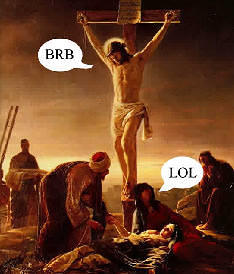
Back In 5 Mins  --J.C.
Examining the bible without my Jesus goggles, I started to understand things a little clearer.  Things like Jesus's quotes in Matthew.  "Immediately after the distress of those days 'the sun will be darkened, and the moon will not give its light; the stars will fall from the sky, and the heavenly bodies will be shaken'... Even so, when you see all these things, you know that it is near, right at the door...I tell you the truth, this generation will certainly not pass away until all these things have happened...I tell you the truth, you will not finish going through the cities of Israel before the Son of Man comes...For the Son of Man is going to come in his Father's glory with his angels, and then he will reward each person according to what he has done. I tell you the truth, some who are standing here will not taste death before they see the Son of Man coming in his kingdom."

That's a pretty clear indication that Jesus expected to return within his follower's lifetime.  I find it both amusing and startling how every generation thinks of itself as the quoted "this generation".  I guess it makes since to want to be "the generation" that gets to see Glory coming.

Even the apostles of Christ felt similar sentiments. James (5:8) instructs his fellow believers to "be patient and stand firm, because the Lord's coming is near."  In fact, a lot of the New Testament is full of this sort of "be ready to go" language.

"For in just a little while, 'He who is coming will come and will not delay'." -Hebrews 10:37

"The hour has come for you to wake up from your slumber, because our salvation is nearer now than when we first believed." -Romans 13:11

"...time is short...For this world in its present form is passing away." -1 Corinthians 7:29

"The end of all things is near." -1 Peter 4:7

Dude, You are Soooooooo Fuggin' Late!
The looming threat of Judgment Day is held over believers by one another and by themselves.  The other day I drove past a peeling, weather-worn church sign and I though, It never crosses a Christian's mind when they have to pay for a brand new billboard that says, "Jesus is coming SOON!" when the old one is decrepit and broken and has been sitting there for the past 20 years.  Let's face the facts, people: Jesus promised to return soon and very soon, and that was nearly 2,000 years ago.  I'm not really sure why Christians need to keep that sense of urgency, though it may have something to do with the fact that their god died 2000 years ago (if he ever really existed in the first place).  Otherwise, it's a moot and unostentatious ending.


 -STA

Saturday, January 9, 2010

Why And How To Worship God

In recent talks with theists I've once again come across the question of what I would do if "God" showed up to me.  While that is a big discussion in itself, another aspect arrives from contemplating the question: worship.  Why should we worship a reveled God, and what exactly does it mean to worship it?

Brown-Nosed And Rolling Over
Assuming the God in question is the all-powerful creator of everything, several factors reveal themselves in this scenario (at least to an armchair psychologist), the first of which is fear.  We are naturally (be it by evolution or intelligent design) submissive to those with greater power than our own.  We create hierarchical social structures and our treatment of others reflects our perceived level of dominance of them, among other things.  From an evolutionary standpoint, it's a survival mechanism.  Sure, we could all just fight to the death but that would help anyone, especially ourselves.  So we push as far as we can, gaining and giving as much as beneficially possible.  Therefore, should a mighty creator being suddenly plop down and begin issuing edicts, we'd most likely obey out of fear and a desire to live and remain unharmed.

The other side to this is the protection such a being would offer.  Just as the tiny fish seek protection and food from a shark, so too would many humans begin to suck up to the regnant deity.  True, some may also seek companionship and an honest exploration of the previously unstudied.  But I think that most would simply bow out of fear and respect to power unlimited.

Here I Am, Now Entertain Me
That might be the why, but what about the how?  What does it mean to worship a being?  Is it unquestionable love and veneration?  Is it reverence in the form of consent?  I wouldn't expect to automatically love any being just out of awe, surprise, or fear.  Love is earned.  I might be able to respect the deity's authority and powers, but love is an entirely different ball game.

I suppose too that it would depend on the demands made by the god.  Will it stand before us and proudly exclaim, "Bow down to me or be crushed!"?  I'm willing to bet that the best form of "worship" would be the actions, words, and behaviors that the god did not ask for.  Many people may solicit the being to gain protection, companionship, a freedom from responsibilities, or to share in the power.  I would rather worship (and be worship by) beings that love or respect me enough to want to make me happy -- not out of fear of punishment or hopes of reward -- but just out of the goodness of the heart.

R-E-S-P-E-C-T, Find Out What It Means To Me
I can hear the religious people now, "But that's just exactly what God wants!  He wants you to love him out of your own free will, and he wants to be worshiped by you and share his glory with you."  I'm sorry, but it would depend on the character of your God.  If, as I've said before, the deity is the actual Yahweh from the Old Testament, I wouldn't worship him if he threatened me directly to my face.  Might doesn't make right.  I don't care how powerful it is or how much right it has to me as its property, being my creator and being stronger than me doesn't give it the prerogative of my respect, honor, love, worship, or even acknowledgment.  The content of its character and its actions toward others determine where it would sit in my book.  I'll obey the might only if I accept its justifications for the requests it makes, and only if its standards meet those worthy of devotion.  The Gods of people today do not warrant my respect, and they are not worthy of worship by anyone, including you.


-STA

Sunday, December 6, 2009

Day In The Life: Accused

I just have to share this because I'm jazzed about it.

Many of my regular readers will know that while I'm very outspoken about my atheism on the web, I'm still a mostly-in-the-closet atheist when it comes to my immediate family members.  (I know, I'm working on it; these things take time.)  Said family members were have their Thanksgiving celebration yesterday, myself included.  I love our Thanksgiving.  I mean, sure, I still like going to the houses of parents' and grandparents' of extended family for the holidays, but nothing can beat the spread, quality, and atmosphere of having Thanksgiving at home (and Mom's food is always better).  They're not an overtly religious bunch.  None go to church regularly and holidays have always been about family and food and togetherness, never about Jesus or other religious hogwash.  So there I was, sitting at the dinner table in the house that I grew up in, stuffing my face with...well, stuffing, when one of my grandmother's many brothers walked into the kitchen with his southern boisterous ululations.

"You god-damned atheist!" he roared.

I froze, heart thumping.

"With yer bumper sticker saying 'The hard work of one does more than the prayers of millions'!  I'm gonna go get Brother Jack and we're going to send you straight to hell!"

I nearly choked on the turkey -- with laughter.  "Well, send him over!" I quipped.  My mother chuckled.

You'd probably have to know the man to appreciate it all.  He's known for that type of language, but I was surprised to hear it and being in the form a joke softened it a little.  But the fact was there...I was called an ATHEIST in front of my whole family!  Holy shit!  I'm sure because of me not objecting to the term and congenially welcoming the attack was in a way a coming out of sorts.  At least I'm sure it will aid in the real event, should it arise in the future.  It was great.  In one instant I essentially made the topic accessible.  Call me an atheist, I don't mind.

I assume that my family suspects at least something's up.  I mean, they realize I stopped going to church.  And I have that bumper sticker and an EvolveFish on my truck.  And I made the priest who came into my hospital room when I had my cholecystectomy leave immediately.  And I sent my mom a reply linking to this blog when she forwarded me a stupid email.  And some of my kinfolks and related-in-law already know for sure, through either direct conversation or finding me on the internet (no telling who they talk to).  So I think at least some of my core family members might get the picture, although they're not aware of all the details.


My great uncle was joking, of course.  He meant no ill toward me, though I'm not entirely sure he'd be so cordial if I had stood up and said, "yeah, I'm a soulless, faithless, godless atheist...so what?!"  And I was all ready to defend my position.  This is it, I thought.  Oh well, perhaps for the better; it may have ruined the festivities.  But at least my uncle can joke about it.  He was raised in a tough Catholic school way back in the days where they would beat your hands with rulers for not obeying their strict requirements.  He hates nuns now.

Anyway, I'm still all goosebumpy over it even though it literally was one sentence and nothing more from anybody.  I never thought I'd be (semi)outed by one of own family.  Being called an atheist, just out in public like that, was exilerating.

I hope it happens again.


-STA

Thursday, December 3, 2009

Prayer and the Internet

The bible states that prayer somehow works better when you get a bunch of like-minded people together.  You'd think that with the invention of the internet and therefore the ability for billions of believers to sync up their communication channels to God and send requests en mass, we could easily change things.  Things like, oh I don't know, world peace, the end of hunger, cancer, and other needless suffering.  After millennia of just a spattering of people here and there asking for a global change, we have now within our means a way to systematically connect all the conduits of faith, and with a glorious roar reminiscent of Horton Hears a Who, simultaneously unleash a massive prayer toward the heavens.

But still nothing happens.  Either everyone isn't synced up just right, or not enough people care about the state of things, or too many people are talking to too many different Gods, or -- the more likely answer -- prayer just doesn't work.


-STA

Tuesday, December 1, 2009

Who Really Needs God?

I hope everyone's Thanksgiving weekend went well.  How many of you nonbelievers had discussions with religious family members?  I'm betting a lot of you 1) sat quietly through the prayer before dinner, and then 2) listened to your aunt bitch about how Obama is the Muslim Communist Antichrist.  I was lucky enough to only have to deal with a few racist jokes this year; and all-in-all fairly good Thanksgiving.

This time of year always gets me thinking about why people cling to the ideas they have.  What makes these otherwise kind, sane, decent people feel the need to uphold barbaric, antiquated, immoral concepts?


Religion Binds Culture
Religions tend to contain directives that are divisive and harmful.  They are prone to being used by people who are willing to take the necessary actions suggested by them.  Take the passage of "thou shall not suffer a witch to live".  That passage is toothless until someone comes along who is of such character as to accept it as an authority and then act upon it.  Therefore, the passage (or the religion, moreover) becomes a reflection of that individual's character.

Not only that, but religions change -- and poison -- the culture they're in.  They increase the likelihood that people with these characteristics will be cultivated.  Cultures change over time if left to their own devices.  The problem is that a religion, upon its creation, encodes the current culture.  Once locked in, it attempts to maintain the status quo.  This is why the believers of the Bronze Age ideals of Christianity and Islam are trying to keep their outdated ways of thinking in the norm.  Religion shackles culture, inhibits progress, and encourages stasis and stagnation.

Breaking The Chains
So who needs religion?  Many people feel that without religion humanity would have no sense of right and wrong.  Some even feel that its impossible to breath without God.

A lot of the ideas modern folks have about God, prayer, and religion has grown out of the mindset of the contemporaries of their belief systems.  As stated above, religion naturally assumes the state in which it is founded.  Those who hold Bronze Age beliefs come from a long line of people wanting a better life.  The average poor person in America would be considered rich by the standards at the time the New Testament was written.  The average tween probably knows more and is generally smarter than anyone who lived over two thousand years ago.

But even by comparison, some people today still feel like the world is against them.  They covet the positions of the rich, feel like the "good guys" are loosing, and see the world as doomed.  Most people still cling to hopes for a better life.  I suppose in some sense that will never go away; no matter how good things get, there will always be a need to find something better.  Religion thrives on this idea.  It tells you that things are guaranteed to be better for you, if not in this life, then in the next.  It's the ultimate "grass is greener" mentality -- something that's extremely appealing to the downtrodden.


We have to eliminate the need for god.  We have to realize, as a whole, that together we can accomplish amazing things.  With the scientific discoveries of the century, we've discovered microbiology, cured major diseases, and even walked on the moon.  As long as our society neglects people, as long as there is major injustice and suffering, god will be there as the last resort and the empty hope for surrendered minds.


-STA

Monday, November 16, 2009

Wedding Hells

I recently attended a wedding reception and there was one thing that bothered me (enough to sit down and rant about it today).  And no, it wasn't the "blessing" that was given before people ate the buffet.  A song was sung to the newly-weds; a narrative offering advice on how to stay together.  A line in the song suggested, in effect, when times get tough to turn to God and he'll fix it.

Bad Chord
I'm finding several issues I personally have with the otherwise great original song.  First off, like so many other theistic pronouncements, it assumes that a) the speaker's God and the audience's God are the same, and b) that the audience even has a God.  It's akin to singing a poignant song about real-life things such as love and marriage, then including a line about finding leprechauns grading gold at the end of rainbows.  It kills the mood of the song and makes you look small-minded.

Keep-Away
The biggest beef I have with it is the idea itself.  Let's look at it from both the viewpoint of the believer and the atheist.  First, the former.  Using the idea of the Christian God, one may easily see how seeking His guidance is obviously the route to take.  He is all-knowing, after all.  According to their theology, God has a plan for everyone.  Thus, when a couple's marriage is on the rocks, a quick voice-mail up to the clouds and all should be well.  But how many Christian marriages fail, even with the fervent prayers of not only the betrothed but often times their families and friends as well?  If the answer is as easy as asking God what to do, and getting the sense that the answer is "be kind to and TALK with each other", then why do over half of all theistic unions fail?

Assuming God does exist with all the superpowers generally attributed to him, it goes without saying that such a being is, for lack of better terminology at the moment, a giant prick.  In fact, those reading this right now, be they theist or atheist, are probably more moral and ethical than the Christian deity.  For how many of you would, if you knew the answer to healing the hurting hearts of two people, would refuse to administer your aid until asked?  Would you wait to poor out your miraculous blessings upon the hungry until all of them sought your help?  Would you withhold a cure that would strike leukemia from a dying girl until not just the girl asked for it, but her family, the whole ward floor, the entire hospital, town -- or continent -- agreed you could?

It Takes Two -- Me and You
Since I am one of the millions who do not subscribe to such egotistical bullshit, I will say that the obvious course of action is not to turn to some imaginary friend to fix your martial issues, but instead turn to each other, the flesh-and-blood human being with whom you committed your life to.  Seek the problem at its source.  Talk with each other.  Listen to each other.  Find out what the hell is going on and do not cower from it.  If you need to involve beings from outside of yourselves, turn to your family, your friends.  I'm sure there's at least one person every married couple can talk to (we all had at least one witness, right?).  Find the bug.  Hunt it down like a heat-seeking missile.  The point is that the answer is within you; it's not going to come from some mysterious force outside of you.  Both of you -- whether you knew it or not -- took the necessary steps to fall in love.  It's going to take both of you again to stay that way.

And if he's reading this, let the songwriter know that this is in no way an attack on him directly.  He's one of the best and most upstanding guys I know, and a wonderful friend.  The contention is merely with the message and wording of his outstanding and touching song -- a small disputation, yet one I think worthy of mention.


-STA

Tuesday, October 20, 2009

Today from Ray: What Have You Been Doing?

In a small effort to spice things up around here -- and get me blogging more -- we're starting a new running series. I like to argue. More importantly, I like to help people. I feel that pointing out errors aids in the stamping out of ignorance.

Our good friend Ray Comfort has loads of such ignorance spewing forth from his blog here on blogger. Ray's "Comfort Food" blog is now "Atheist Central", and since I fit the description of his target, I've tried to regularly participate. The only problem is that of censorship. The only comments that are shown are those that Ray judges as appropriate. He'll even cut off discussions if you fail to capitalize specific words like jesus! (You can read his rules for commenting just below his title graphic full of argumentum ad verecundiam.) So since taking him on on his own turf is rather ineffectual and self-defeating, I'll have to answer Ray's criticisms and characterizations of atheism here. Occasionally we'll take a look at what's going down on Ray's blog today.

And Ray, if you want to comment here, I don't give a rat's ass how you type "jesus".

Big Words From Little Woody
Jumping right into what I find displayed on the page right now, Ray's October 18th drips with his basic Way of The Master rhetoric. "When the atheist stands before God," Ray writes, "it will be a waste of time telling Him what he thinks of Him." Ray fails to convince atheists with this kind of "logic" by failing to see the enormous assumption. After all, what will Ray really have to say to FSM when he stands before him, huh?

The snide title of the post comes from the fact that Ray quotes atheist Woody Allen and then calls him a "sad man who is fearful of dying". He somehow gets that out of Allen's words: "God has some explaining to do". Indeed, I'd ask the same from God if I died and met Ray's deity in the clouds. Aside from reading in a fear of death, Ray fails to see that if his god is real, it would already know exactly what it would take to convince every single non-believer on the planet. This is the point of Allen's quote. It's not a matter of being hostile towards religion, or just wanting to be a naughty little sinner. It's not that he's scared of dying, or scared of finding out he was wrong, it's the fact that a god with qualities that Ray and other Christians profess wouldn't and shouldn't expect a surprise run-in with an atheist.


You're an idiot, Ray. This is going to be harder than I thought...I'm going to go lay down and try to get rid of the headache I got from pulling my hair out.


-STA

Wednesday, October 7, 2009

It's My Choice

I've recently received a lot of comments regarding the Problem of Evil, namely the theist's attempt to solve said problem. Many theists will claim the reason bad things happen to good people is because "God can't (or doesn't want to) interfere with our free will to be able to choose to love Him on our own. Otherwise, we'd all be robots", etc, etc, ad nauseum. Let's take a look at why free will fails as a defense.

The Greater Good
Free will is assumed to be a greater good than the evil that it causes. If a young girl is raped and murdered, is this because God needed to preserve the rapists free will so that his actions could result in greater good or so that the rapist could freely love God? Or is it so that the young girl would pray to God and beg him to make her attacker stop?

What about natural disasters (if you want to call them "evil")? God -- being omnipotent -- could have devised a way to remove all the evil in the world, and still give us free choices. What does shingles or hypospadias have to do with choice or the absolute knowledge of God?


Take Me To Your Leader
"We'd all be robots" is a conjecture based on what, exactly? You're claiming that God would destroy our free will to worship him simply by giving us evidence of his existence. Not to do your own theology for you, but according to the bible there have been several individuals who had first-hand knowledge of God's existence and still managed to have the free will to choose or not choose him: Adam, Eve, Moses, Satan, just to name a few. These beings had repeated conversations and interactions with God -- did they loose their free will? And what about Heaven? Will you lose your free will there?

The idea that we would have no choice to love/worship a deity who revealed itself unquestionably is preposterous. You'd still have a choice in the matter. You know for certain of the President's existence, correct? Did you lose the free will to disagree with his policies? If the God of the bible convincingly revealed himself to me, I would still not get down on my hands and knees and grovel at his feet. Such a tyrant, hiding or otherwise, deserves no worship.


Free will is not an excuse for why bad things happen to good people. Knowledge of God still affords us a choice in the matter, except we'd have better evidence to base our opinions on. Besides, you can't truly love someone without an absolute knowledge on them.


-STA

Wednesday, September 30, 2009

Happy Blasphemy Day

September 30th is international Blasphemy Day. Here's Penn explaining it.

So go out and express disrespect for the god of your choice. If you're religious, you're encouraged to blaspheme too -- it'll mean more if you do it.

Happy Blasphemy Day, everyone...and fuck Ra!


-STA

Friday, September 11, 2009

Tuesday, September 8, 2009

The Righteous Judge

From "Tim" to The Non-Prophets internet radio show:

So I was driving 66 in a 65 mph zone, got pulled over, given a ticket, and had to go to court. The judge said that because I had broken the law I had to serve the minimum sentence of life in prison with no possibility of parole at a maximum security penitentiary that makes HBO's Oz look like the merry old land of Oz.

I thought the sentence was a bit steep, but I later realized that we all fall short of the glory of the judge who never broke any laws whatsoever and cannot tolerate even the slightest unlawfulness, so I had no choice but to accept my punishment.

However, the judge did take pity on me. He called his son in and proceeded to brutally whip him with a cat 'o nine tails until he was raw and bloody, and then nailed him to a cross until he was dead. He then told me to eat his flesh and drink his blood. I did, and after that I was free to go.

I walked out of the court room a free man, as did the serial child molester who also ate the judge's son's flesh and blood (he was a cannibal, so really didn't mind). However this other woman said she didn't want to cannibalize the judge's son and that she didn't do anything wrong. But the judge just said that all have committed crimes and all must be endlessly punished for them, and the only way for her to escape was to eat his son. The woman still refused so she was sentenced to life in prison.

I guess I kinda felt bad for her spending the rest of her life in prison. Nevertheless, I know that she deserved it because the judge was truly a good man. I mean you'd have to be a really, really good person in order to brutally beat your own son and then crucify him and have his flesh and blood consumed so that me and a serial killer could go free. Truly these are actions of a righteous man. Well I guess it just sucks to be her.

Anyway, I'm a free man now, although my schedule is pretty full. I've been spending most of my time at the judge's house, thanking him for freeing me and telling him how great he is over and over and over and over and over again.

Wednesday, July 22, 2009

The Unmoving Mover

I realize I haven't done much lately as far as posting videos or making blog entries. That got me thinking about the definitions I'm often hearing about "God". Hopefully you'll see the connection in a minute.

Not only is the traditional concept of God a logically self-contradictory idea (consciousness without matter, life without birth or death, complexity without evolution, simultaneously all-knowing and all-powerful), it also produces static divinity.

A Static God
If God is everywhere, then there is nowhere he can go. I have the freedom to sit in that chair, but God doesn't because he's already in it. He is omnipresent and omnidirectional . If he knows everything already, then there's nothing he can learn (or change). He can't "want" something, because he's supposed to be perfect (and you can't want what you lack). He is essentially an unchanging, unmoving, inactive idea; an everything and a nothing all at once. Add one to the self-contradictory list.

The theists will disagree, but the basic God-triangle (omnipotent, omniscient, omnibenevolent) produces a static deity. The omnipotence paradox and the omnipotence-omniscience paradox show how God is restricted by simply applying the "omni-" attribute. Another simpler way to look at it is the phrase "a expert of everything is an expert of nothing". You can't judge your expertise against anything if you're already counting everything. Maybe all that means to you is that your god is super-powerful, but to me that means he can't change. Change is good and necessary, especially in a being that's supposed to be a healthy judge.


-STA

Translate