In conclusion of this three-part miniseries, we take a look at what is most likely the main reason for some people to need gods or god-like figures in their lives: ignorance. I call it the main reason because it ties together nearly all other reasons. In part one, we discussed the fear of the unknown that drives some people to seek invented and unsupported answers -- in other words, being ignorant of the causes and reasons for those unknowns. Part two discussed companionship, bred from ignorance of the unknown future, and the need for father-figures and "soul-mates".
You Don't Need Empty Answers
Staring into the maw of the unfamiliar and trying to make sense out of it is something we humans do pretty much constantly. It should be no surprise that there should then arise a grand answer to fill those unsettling gaps. There are those who chose to remain purposefully ignorant of scientific knowledge and understanding, and that's a shame. But there are a large portion of moderate believers who are clinging to religious beliefs in order to not have to learn or attempt to learn the answers to life's deep questions.
But once you remove yourself from the realm of religion, you begin to see the reality of the world, and fear actually diminishes. You start realizing that the world is what you make it, how you behave and live your life is ultimately up to you, and the way you treat others matters in this one and only life you get. Sure, we'll all be ignorant about something at some time or another, but it's how we handle that fact that determines the course and nature of our lives.
You Don't Need A God
If you've read this series and are a believer of some kind, I encourage you to challenge yourself with the following exercises. Think about what you would need to change in order to live without God. Think about what God actually "does" in your life that you can't find any other way of accomplishing. Try taking off the theist mindset and view the world -- perhaps only momentarily -- without the need for your deity. Imagine you and your family and friends having to live and help one another through hardships on your own, with the help of only each other. Hopefully you'll find that you do much of this already, you only give God the credit. Maybe you'll grow closer to becoming a person who doesn't need a god.
-STA
Tuesday, April 20, 2010


Friday, April 9, 2010
Why Some People Need A God: Companionship
We are by nature social creatures, and when we are young sometimes it's difficult to find other children to play or "practice" with. Just as our brains create dreams probably to function as training grounds for exploration of situations and emotions, our brains also dream up daydreams and imaginary friends to help us learn to socialize.
Talking to Yourself
Or perhaps it goes a little deeper than that. Perhaps the child with an imaginary friend needs said friend for companionship. In The God Delusion, Richard Dawkins reprinted the classic poem by A. A. Milne, "Binker", to illustrate the point of how children create and use imaginary friends to serve needs for companionship. The child in the poem plays with his imaginary friend, teaches him to talk, and shares sweets with him -- all the while realizing that grown-ups don't "get it".
This deep-seated need for companionship gets expressed in the embodiment of so-called spiritual things. Gods, Great Spirits, and other deities serve the basic social needs of some people. Once we see a god as nothing more than an imaginary friend, we realize the same power exists: to comfort, to commune. God fills the gaps in people's lives who need someone to talk to; to understand what they're feeling or explore questions. God relieves the tension we feel and supports our natural desires for companionship.
You See it Too
Not only that, but another layer gets added on when believers fellowship with each other. Suddenly, a very real person with the same imaginary friend becomes a companion, and subsequent stories can be shared that reinforce the feelings supplied by the deity. Where the imaginary entity fails (in the lack of physical embraces, for example), the other believers succeed. This is a powerful social reality that has direct, lasting consequences and effects in the lives of real people, and is not to be overlooked.
Even if you, reader, are a believer in a god (or perhaps an imaginary friend), I encourage you to think about the idea that your deity is nothing more than a concept you invented. Think about what that would entail, and note the similarities if that were the case. I think you'll find, probably initially to your horror, that the similarities are immense. Your God hates the things you hate, loves the people you love, and will understand you deeper than any other person. How is that any different than Binker?
-STA
Talking to Yourself
Or perhaps it goes a little deeper than that. Perhaps the child with an imaginary friend needs said friend for companionship. In The God Delusion, Richard Dawkins reprinted the classic poem by A. A. Milne, "Binker", to illustrate the point of how children create and use imaginary friends to serve needs for companionship. The child in the poem plays with his imaginary friend, teaches him to talk, and shares sweets with him -- all the while realizing that grown-ups don't "get it".
This deep-seated need for companionship gets expressed in the embodiment of so-called spiritual things. Gods, Great Spirits, and other deities serve the basic social needs of some people. Once we see a god as nothing more than an imaginary friend, we realize the same power exists: to comfort, to commune. God fills the gaps in people's lives who need someone to talk to; to understand what they're feeling or explore questions. God relieves the tension we feel and supports our natural desires for companionship.
You See it Too
Not only that, but another layer gets added on when believers fellowship with each other. Suddenly, a very real person with the same imaginary friend becomes a companion, and subsequent stories can be shared that reinforce the feelings supplied by the deity. Where the imaginary entity fails (in the lack of physical embraces, for example), the other believers succeed. This is a powerful social reality that has direct, lasting consequences and effects in the lives of real people, and is not to be overlooked.
Even if you, reader, are a believer in a god (or perhaps an imaginary friend), I encourage you to think about the idea that your deity is nothing more than a concept you invented. Think about what that would entail, and note the similarities if that were the case. I think you'll find, probably initially to your horror, that the similarities are immense. Your God hates the things you hate, loves the people you love, and will understand you deeper than any other person. How is that any different than Binker?
-STA
Saturday, March 27, 2010
Why Some People Need A God: Fear
In this, the first post in a three-part miniseries exploring some of the common responses from theists to the question, why do you need a god?
Help Me...Someone?
Many of those responses include, at least in part, a desire to be safe and secure. We all need a Superman every now and then; someone who can "take the wheel" as it were. Even those of us who have no illusions of magical beings that interact with or even guide our day-to-day activities occasionally yearn for a break.
At the heart of it all lies fear -- generally of the unknown. People are afraid of death, afraid of not knowing what tomorrow will bring, afraid of being helpless in any given situation. To a lot of these people, their deities come to the rescue.
As with most of the reasons theists give for being theists, however seemingly innocuous, this reason hinges on the idea that you cannot help yourself. How many of you (theist or otherwise) have heard phrases like, "put it in God's hands", or "God has it all planned out"? It is true that there are certain situations in which we all find ourselves unable to cope or do something to better are predicament. Those helpless situations reveal two distinct types of people: those who resort to fanciful ideas and talk of magic, and those who find comfort and strength in themselves and their fellow humans. While it may not be easy to be the latter, it is certainly more honest and, I think, ultimately better than wishful thinking.
Don't get me wrong; I'm not saying nobody should ever hope for anything. I'm saying stop lying to yourself and saying that you can't get out of bed without Jesus, or you could have never ran that obstacle course without the strength of the Lord. Start doing things for yourself. Find self-confidence and throw away these primitive notions of doom and antiquated doctrines that tell you you're worthless and undeserving of happiness. You don't need that bullshit, and you don't need a God to find help, happiness, love, peace, or an end to your fear.
-STA
Help Me...Someone?
Many of those responses include, at least in part, a desire to be safe and secure. We all need a Superman every now and then; someone who can "take the wheel" as it were. Even those of us who have no illusions of magical beings that interact with or even guide our day-to-day activities occasionally yearn for a break.
At the heart of it all lies fear -- generally of the unknown. People are afraid of death, afraid of not knowing what tomorrow will bring, afraid of being helpless in any given situation. To a lot of these people, their deities come to the rescue.
As with most of the reasons theists give for being theists, however seemingly innocuous, this reason hinges on the idea that you cannot help yourself. How many of you (theist or otherwise) have heard phrases like, "put it in God's hands", or "God has it all planned out"? It is true that there are certain situations in which we all find ourselves unable to cope or do something to better are predicament. Those helpless situations reveal two distinct types of people: those who resort to fanciful ideas and talk of magic, and those who find comfort and strength in themselves and their fellow humans. While it may not be easy to be the latter, it is certainly more honest and, I think, ultimately better than wishful thinking.
Don't get me wrong; I'm not saying nobody should ever hope for anything. I'm saying stop lying to yourself and saying that you can't get out of bed without Jesus, or you could have never ran that obstacle course without the strength of the Lord. Start doing things for yourself. Find self-confidence and throw away these primitive notions of doom and antiquated doctrines that tell you you're worthless and undeserving of happiness. You don't need that bullshit, and you don't need a God to find help, happiness, love, peace, or an end to your fear.
-STA
Tuesday, March 2, 2010
Divine Slang, or How "Soon" Means "A Really Long Time"
You Better Watch Out...
When I was a Christian, I was swept up into the idea that I was living in the "end times". The Son of Man would be flying in on clouds of glory, probably in just a couple years. This was back before Y2K, and so we all thought that sounded like a date Jesus would pick. So we all got ready, prayed, and stayed awake, fearing and waiting. And waiting.
And waiting...
Okay, so not the turn of the century. That's fine -- but it will be soon! Just look at all the wars, earthquakes, death, pestilence, and hardships around the world! Kids are listening to heavy metal and cutting themselves! You can't leave your front door unlocked anymore! The world is turning to shit! The end is neigh!!!!!!!!
It wasn't until I escaped Christianity that I realized this was an ongoing thing. Really. Since the dawn of Christianity, believers have been claiming the end of the world was just around the corner. I love browsing the website "A Brief History of the Apocalypse" whenever I hear a doomsday preacher on TV or read an end-times blog post. The phenomenon of predicting the end of the world is almost as old as the world itself.
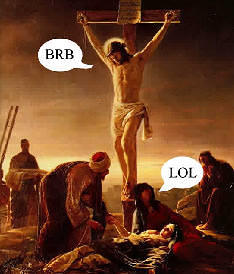
Back In 5 Mins --J.C.
Examining the bible without my Jesus goggles, I started to understand things a little clearer. Things like Jesus's quotes in Matthew. "Immediately after the distress of those days 'the sun will be darkened, and the moon will not give its light; the stars will fall from the sky, and the heavenly bodies will be shaken'... Even so, when you see all these things, you know that it is near, right at the door...I tell you the truth, this generation will certainly not pass away until all these things have happened...I tell you the truth, you will not finish going through the cities of Israel before the Son of Man comes...For the Son of Man is going to come in his Father's glory with his angels, and then he will reward each person according to what he has done. I tell you the truth, some who are standing here will not taste death before they see the Son of Man coming in his kingdom."
That's a pretty clear indication that Jesus expected to return within his follower's lifetime. I find it both amusing and startling how every generation thinks of itself as the quoted "this generation". I guess it makes since to want to be "the generation" that gets to see Glory coming.
Even the apostles of Christ felt similar sentiments. James (5:8) instructs his fellow believers to "be patient and stand firm, because the Lord's coming is near." In fact, a lot of the New Testament is full of this sort of "be ready to go" language.
"For in just a little while, 'He who is coming will come and will not delay'." -Hebrews 10:37
"The hour has come for you to wake up from your slumber, because our salvation is nearer now than when we first believed." -Romans 13:11
"...time is short...For this world in its present form is passing away." -1 Corinthians 7:29
"The end of all things is near." -1 Peter 4:7
Dude, You are Soooooooo Fuggin' Late!
The looming threat of Judgment Day is held over believers by one another and by themselves. The other day I drove past a peeling, weather-worn church sign and I though, It never crosses a Christian's mind when they have to pay for a brand new billboard that says, "Jesus is coming SOON!" when the old one is decrepit and broken and has been sitting there for the past 20 years. Let's face the facts, people: Jesus promised to return soon and very soon, and that was nearly 2,000 years ago. I'm not really sure why Christians need to keep that sense of urgency, though it may have something to do with the fact that their god died 2000 years ago (if he ever really existed in the first place). Otherwise, it's a moot and unostentatious ending.
-STA
When I was a Christian, I was swept up into the idea that I was living in the "end times". The Son of Man would be flying in on clouds of glory, probably in just a couple years. This was back before Y2K, and so we all thought that sounded like a date Jesus would pick. So we all got ready, prayed, and stayed awake, fearing and waiting. And waiting.
And waiting...
Okay, so not the turn of the century. That's fine -- but it will be soon! Just look at all the wars, earthquakes, death, pestilence, and hardships around the world! Kids are listening to heavy metal and cutting themselves! You can't leave your front door unlocked anymore! The world is turning to shit! The end is neigh!!!!!!!!
It wasn't until I escaped Christianity that I realized this was an ongoing thing. Really. Since the dawn of Christianity, believers have been claiming the end of the world was just around the corner. I love browsing the website "A Brief History of the Apocalypse" whenever I hear a doomsday preacher on TV or read an end-times blog post. The phenomenon of predicting the end of the world is almost as old as the world itself.
Back In 5 Mins --J.C.
Examining the bible without my Jesus goggles, I started to understand things a little clearer. Things like Jesus's quotes in Matthew. "Immediately after the distress of those days 'the sun will be darkened, and the moon will not give its light; the stars will fall from the sky, and the heavenly bodies will be shaken'... Even so, when you see all these things, you know that it is near, right at the door...I tell you the truth, this generation will certainly not pass away until all these things have happened...I tell you the truth, you will not finish going through the cities of Israel before the Son of Man comes...For the Son of Man is going to come in his Father's glory with his angels, and then he will reward each person according to what he has done. I tell you the truth, some who are standing here will not taste death before they see the Son of Man coming in his kingdom."
That's a pretty clear indication that Jesus expected to return within his follower's lifetime. I find it both amusing and startling how every generation thinks of itself as the quoted "this generation". I guess it makes since to want to be "the generation" that gets to see Glory coming.
Even the apostles of Christ felt similar sentiments. James (5:8) instructs his fellow believers to "be patient and stand firm, because the Lord's coming is near." In fact, a lot of the New Testament is full of this sort of "be ready to go" language.
"For in just a little while, 'He who is coming will come and will not delay'." -Hebrews 10:37
"The hour has come for you to wake up from your slumber, because our salvation is nearer now than when we first believed." -Romans 13:11
"...time is short...For this world in its present form is passing away." -1 Corinthians 7:29
"The end of all things is near." -1 Peter 4:7
Dude, You are Soooooooo Fuggin' Late!
The looming threat of Judgment Day is held over believers by one another and by themselves. The other day I drove past a peeling, weather-worn church sign and I though, It never crosses a Christian's mind when they have to pay for a brand new billboard that says, "Jesus is coming SOON!" when the old one is decrepit and broken and has been sitting there for the past 20 years. Let's face the facts, people: Jesus promised to return soon and very soon, and that was nearly 2,000 years ago. I'm not really sure why Christians need to keep that sense of urgency, though it may have something to do with the fact that their god died 2000 years ago (if he ever really existed in the first place). Otherwise, it's a moot and unostentatious ending.
-STA
Friday, February 5, 2010
Treaty of Tripoli in Modern Terms
It's common to hear from Christian revisionists that America is a "Christian Nation" founded on Christian values, and other unsupported claims. I've already covered this in another entry, so I won't go through it again.
Instead, today I wanted to take a look at the document known as the Treaty of Tripoli. This was a peace treaty between the US and the Bey of Tripoli in 1797. The treaty was unanimously approved by the Senate and signed by President John Adams and proudly proclaimed to the nation.
The relevant part of the treaty is Article 11, which states in its entirety:
"As the Government of the United States of America is not, in any sense, founded on the Christian religion; as it has in itself no character of enmity against the laws, religion, or tranquillity, of Mussulmen; and, as the said States never entered into any war, or act of hostility against any Mahometan nation, it is declared by the parties, that no pretext arising from religious opinions, shall ever produce an interruption of the harmony existing between the two countries."
America is not a Christian nation -- it can't be. The laws of this country are at odds with the laws the Christian God. If the above isn't clear enough, let's break it down in modern terms:
"The USA is NOT a Christian nation. It has laws that protect all religion, Christianity, Islam, or any other. America welcomes people of all faiths with open arms and does not actively engage in prejudice or hostility based on religion or creed. Both parties signing this treaty of friendship agree that actions and diplomatic discussions will not be hindered by matters of religion or faith-based opinions."
Doesn't that sound like a great place to live? Whether or not Glenn Beck, Sarah Palin, Ray Comfort, or George Bush agrees with sentiments expressed in the treaty, the Constitution backs it up. America was founded on freedom. Anyone can be an American. Any American can have any religion they want, or none at all. The government can't and should not uphold one religion, because doing so pushes all others down. Equality, freedom, and opportunity is the name of the US game, not the laws of Jesus or his Heavenly Father.
-STA
Instead, today I wanted to take a look at the document known as the Treaty of Tripoli. This was a peace treaty between the US and the Bey of Tripoli in 1797. The treaty was unanimously approved by the Senate and signed by President John Adams and proudly proclaimed to the nation.
The relevant part of the treaty is Article 11, which states in its entirety:
"As the Government of the United States of America is not, in any sense, founded on the Christian religion; as it has in itself no character of enmity against the laws, religion, or tranquillity, of Mussulmen; and, as the said States never entered into any war, or act of hostility against any Mahometan nation, it is declared by the parties, that no pretext arising from religious opinions, shall ever produce an interruption of the harmony existing between the two countries."
America is not a Christian nation -- it can't be. The laws of this country are at odds with the laws the Christian God. If the above isn't clear enough, let's break it down in modern terms:
"The USA is NOT a Christian nation. It has laws that protect all religion, Christianity, Islam, or any other. America welcomes people of all faiths with open arms and does not actively engage in prejudice or hostility based on religion or creed. Both parties signing this treaty of friendship agree that actions and diplomatic discussions will not be hindered by matters of religion or faith-based opinions."
Doesn't that sound like a great place to live? Whether or not Glenn Beck, Sarah Palin, Ray Comfort, or George Bush agrees with sentiments expressed in the treaty, the Constitution backs it up. America was founded on freedom. Anyone can be an American. Any American can have any religion they want, or none at all. The government can't and should not uphold one religion, because doing so pushes all others down. Equality, freedom, and opportunity is the name of the US game, not the laws of Jesus or his Heavenly Father.
-STA
Subscribe to:
Posts (Atom)