Coming off the heals of the Bill Nye/Ken Ham creation debate and subsequent discussions has got me thinking about the way in which believers in god find ways to hold onto their cherished, comforting beliefs.
Whether it's through a debate on Creationism, a forum discussion on Big Bang cosmology, or a blog post about science in general, theists often bring up the gaps in our current understanding as a form of proof (or at least, excuse) for justified belief in their particular deity. I've said several times in several places that once the theists arguments are refuted, they hold onto one of three things or a combination thereof as unshakable reasons for them to keep believing: faith, personal experience, and the gaps in our understanding. I've talked about the first two many times on this blog, but the point I wanted to make in this post is on the latter excuse.
Stop-Gap
This argument (which I've also discussed here and elsewhere) is the God-of-the-gaps fallacy. All throughout history, when human beings didn't understand something, they thought strange things about it. This is one of the major reasons for theism, and it still remains even when some bit of knowledge is gained -- the believer just moves the goalposts back. "You haven't dismissed God, you've only explained how he did it!" The problem with this childish game should be apparent to any rational person.
If you have an idea that keeps getting shifted to the beginning of some causal chain in our understanding, you should realize how intellectually dishonest this practice is. The honest thing to do is to discard that idea until there's a reason to add it to the chain in the first place.
Faith to many people is a form of security blanket. It's comforting to think that you're on the right side of truth, to know that your life has been designed specially for you, and that there is reason and purpose to everything. But simply feeling good about something doesn't make it true. I realized several years ago that I cared about what I believed, and wanted to believe as many true things and as few false things as I could. I wanted to know the real answer to things; a placation isn't going to cut it.
Semper Fi
But for a lot of people, they hold fast to their belief even in the face of contrary evidence. It isn't always due to the security-blanket effect either...religion itself promotes and encourages it. Many churches preach the shunning of critical thought and doubt, telling believers to "lean not on your own understanding." The believer didn't start at an intellectually honest point and they continue to fill the blanks in our knowledge with "God did!".
I was daydreaming about some utopian future today in which we get to the "final level" of understanding. There was no more gaps in our knowledge; we knew what happened "in the beginning" and could explain everything up to that point. But it still wasn't good enough for the theist. They would continue to claim that God is still "just beyond" that level of understanding. This was a thought experiment while driving around town today, but the methodology is. I think, a valid example of how many theists operate.
And even if this where a valid way to evaluate the world, it's still a form of special pleading to somehow fill the gap with your god.
-STA
Showing posts with label theism. Show all posts
Showing posts with label theism. Show all posts
Tuesday, February 25, 2014


Friday, February 14, 2014
Relationships Need Input
I'm often encouraged by my opposition to "seek a personal relationship" with the deity they espouse. And indeed, that sounds like a good idea to someone who is curious about a particular god. Despite the fact that I was a tongue-talking Christian for a lot of my young adult life, I'm implored by the religious to get into a relationship with their savior.
1 John 4:8, 1 Corinthians 13:4, Exodus 34:14
But what exactly does that mean? A relationship has at the least, two people. Unless a "personal" relationship is akin to the way a stalker feels about his victim. And since I'm hard-pressed to find a theist who believes their god is a physical person, it seems like the latter is the direction one has to go in.
In an actual relationship between two people, each party grows, changes, and effects one another. Each participating member benefits from the others' involvement. It is possible to be in a relationship and not contribute to it, and those relationships don't last long. I realize that from a theistic standpoint, one can hope to change and grow "in God" or "in Jesus" or "in Minerva", but that really only proves the case for a one-sided relationship.
What can a changeless, all-powerful, all-knowing god hope to gain from a relationship? Gaining something itself implies a lack of something in the first place. If the god knows all in the future, no excitement or surprise can come, so there's no benefit there. Such a deity can't change, can't grow, can't be effected.
I realize at best I'm arguing for deism here, and I don't intend to. Let's turn the focus back to the idea that each worshiper has their own "personal relationship" with God. I don't think I can do a better job of illustrating the flaws with this idea than what has already been done by YouTube user NonStampCollector:
Put simply: there wouldn't be so many differing views on the wishes of a (supposedly) singular entity if all those who profess to engage in a personal relationship with said entity actually did so.
Happy Valentine's Day everyone. Find someone -- a real person -- with whom you have an actual, personal relationship with, and spend some time with them.
-STA
1 John 4:8, 1 Corinthians 13:4, Exodus 34:14
But what exactly does that mean? A relationship has at the least, two people. Unless a "personal" relationship is akin to the way a stalker feels about his victim. And since I'm hard-pressed to find a theist who believes their god is a physical person, it seems like the latter is the direction one has to go in.
In an actual relationship between two people, each party grows, changes, and effects one another. Each participating member benefits from the others' involvement. It is possible to be in a relationship and not contribute to it, and those relationships don't last long. I realize that from a theistic standpoint, one can hope to change and grow "in God" or "in Jesus" or "in Minerva", but that really only proves the case for a one-sided relationship.
What can a changeless, all-powerful, all-knowing god hope to gain from a relationship? Gaining something itself implies a lack of something in the first place. If the god knows all in the future, no excitement or surprise can come, so there's no benefit there. Such a deity can't change, can't grow, can't be effected.
I realize at best I'm arguing for deism here, and I don't intend to. Let's turn the focus back to the idea that each worshiper has their own "personal relationship" with God. I don't think I can do a better job of illustrating the flaws with this idea than what has already been done by YouTube user NonStampCollector:
Put simply: there wouldn't be so many differing views on the wishes of a (supposedly) singular entity if all those who profess to engage in a personal relationship with said entity actually did so.
Happy Valentine's Day everyone. Find someone -- a real person -- with whom you have an actual, personal relationship with, and spend some time with them.
-STA
Tuesday, March 29, 2011
The Molestation of Pachyderms
I was recently offered an old Indian parable by a theist as an attempt to befuddle me into accepting that different religions are all part of the same god. You know the one about the three blind me (or men in the dark) who are asked to describe what an elephant looked like by feeling it. The first man feels the leg and says an elephant is like a tree. The second man feels the tail and proclaims it to be a length of rope. The third feels the tusk and decides this long and sharp object must be a spear. You've probably heard it differently; there's many forms of the story. But the point is that this argument was presented to me as an attempt to show how we all see the same thing in reality, just from different perspectives. This particular theist was using it to further illustrate how science is just another blind man feeling around in the dark. The analogy may sound flowery, philosophical and convincing, but it is fundamentally flawed.
Religion is Blind
The point that was lost on my theistic friend was that religion is like those blind men. It feels around for something and immediately sticks to it's interpretation of what it finds (demons cause disease, anyone?). But science keeps going. It doesn't just proclaim "it's a spear" or "it's a tree trunk". It says, "well, this part resembles a tree trunk, but we need more data". Religion gives up. It has no reason to continue searching or to keep asking questions because it thinks (nay, knows) it has all the answers.
Another point the analogy makes is that the blind men are all wrong. Not only do they get the description of the elephant wrong, but they get the animal itself wrong as well (if you follow the version that is asking the men to describe what they're feeling). Religion says, "yep, it's a spear alright". Science says, "it might be a spear, or spear-like, but we don't yet know".
My theist friend failed to realize that the parable was not meant to be about how religions are the same, but instead about how religion knows nothing. As John Godfrey Sax's poem about it ends:
Not The Same
Further points can be made against the New Age view that all religions are parts of the same whole. While this view is relatively harmless, I don't see it as intellectually honest, and would rather argue on the side of religion for the sake of religious integrity (however frail that may be). As my friend Todd Allen Gates points out in his book, Dialogue with a Christian Proselytizer, the reasons for thinking "all religions are one" fall into five categories.
First, perhaps different religions fill different needs. God made all the world's religions, but he modified them to suite the needs of different regions. This might sound at first to be well and good, but flaws appear after a few moments pf thought. Does this mean that people who, say, travel to India, should observe the caste system? What about people whose divine directives say they should kill all who practice witchcraft? What happens when they travel to a country where the practice of witchcraft is believed to be a commandment from god? The bigger point here is: where do you go for guidelines? Who writes the standards for which doctrine gets observed when overlaps or contradictions occur?
Second is the "corrupted message" view that we see conflict in religions because God's original True Word(TM) has been corrupted by humans. This boils down to, as Gates says, something of a CEO who is too inept to keep unauthorized subordinates from editing the text and -- even worse -- a CEO who stands by idly when the corrupted messages are forged and spread even more widely than the original, true message. This give a contradictory view of God; he's powerful enough to create the universe, but can't seem to keep his mission statement from being tampered with.
Third is the "paradox hypothesis". God made different religions to confuse us on purpose, because those bewildered by conflicting doctrines will reap the benefits of expanded spiritual perceptions. This idea that God purposefully confused us might be supported by a small number of people who feel their spiritual lives have benefited, but when we look at the history of violence and bloodshed caused by this confusion, it makes a caring Creator who wishes such bloody disorder look inept and not so caring. As Gates so eloquently puts it, "it makes little since to believe that such a deity who could so successfully calculate the different respiratory needs of gills versus lungs, would have so badly calculated and miscalculated the effects of inspiring consecrated contradictions".
Fourth is the "emanation hypothesis", that the Creator of the universe didn't set out to inspire any religion, but holy truth simply emanates from it, and different humans in different time periods tap into these emanations. The idea is that there's one divine source, people just pick up on that source in different ways depending on their culture. This too falls into the same basic contradiction-quagmire as the previous two categories: that an all-powerful, all-loving being cares enough about us to want us to be delivered, but offers no way of preventing us from making up our own mind about which is the True(TM) way, however wrong it turns out to be. This deity continues to emanate truths without care as to how those truths are being interpreted and what violence it begets. This position may not exclude a deistic god, but it certainly discredits a personal one.
The fifth and final way in which New Agers claim "all religions are one" is that even though we humans perceive differences and contradictions in religions, that's only due to our limited, finite, or broken human understanding. But this cop-out answer is not the sole property of New Age spiritualists; fundamentalists will use this same rationalization to nonbelievers in their religion. Any difficulty can be explained away by it, but how is it that "we don't know" something can turn into "therefore we know"?
Can't We All Just Get Along?
It would be nice if religions were all parts of the same elephant. Even though they're not, those who wish peace between religions can only want a good thing. The bigger point is this: we don't need religion -- any religion -- to have a peaceful, loving, and productive coexistence. We're better off putting aside religion, or at least cutting out the "love your neighbor" bits and throwing away the rest. One thing is for sure: we're all in this boat together, and we're all a little blind.
-STA
Religion is Blind
The point that was lost on my theistic friend was that religion is like those blind men. It feels around for something and immediately sticks to it's interpretation of what it finds (demons cause disease, anyone?). But science keeps going. It doesn't just proclaim "it's a spear" or "it's a tree trunk". It says, "well, this part resembles a tree trunk, but we need more data". Religion gives up. It has no reason to continue searching or to keep asking questions because it thinks (nay, knows) it has all the answers.
Another point the analogy makes is that the blind men are all wrong. Not only do they get the description of the elephant wrong, but they get the animal itself wrong as well (if you follow the version that is asking the men to describe what they're feeling). Religion says, "yep, it's a spear alright". Science says, "it might be a spear, or spear-like, but we don't yet know".
My theist friend failed to realize that the parable was not meant to be about how religions are the same, but instead about how religion knows nothing. As John Godfrey Sax's poem about it ends:
So oft in theologic wars,
The disputants, I ween,
Rail on in utter ignorance
Of what each other mean,
And prate about an Elephant
Not one of them has seen!
The disputants, I ween,
Rail on in utter ignorance
Of what each other mean,
And prate about an Elephant
Not one of them has seen!
Not The Same
Further points can be made against the New Age view that all religions are parts of the same whole. While this view is relatively harmless, I don't see it as intellectually honest, and would rather argue on the side of religion for the sake of religious integrity (however frail that may be). As my friend Todd Allen Gates points out in his book, Dialogue with a Christian Proselytizer, the reasons for thinking "all religions are one" fall into five categories.
First, perhaps different religions fill different needs. God made all the world's religions, but he modified them to suite the needs of different regions. This might sound at first to be well and good, but flaws appear after a few moments pf thought. Does this mean that people who, say, travel to India, should observe the caste system? What about people whose divine directives say they should kill all who practice witchcraft? What happens when they travel to a country where the practice of witchcraft is believed to be a commandment from god? The bigger point here is: where do you go for guidelines? Who writes the standards for which doctrine gets observed when overlaps or contradictions occur?
Second is the "corrupted message" view that we see conflict in religions because God's original True Word(TM) has been corrupted by humans. This boils down to, as Gates says, something of a CEO who is too inept to keep unauthorized subordinates from editing the text and -- even worse -- a CEO who stands by idly when the corrupted messages are forged and spread even more widely than the original, true message. This give a contradictory view of God; he's powerful enough to create the universe, but can't seem to keep his mission statement from being tampered with.
Third is the "paradox hypothesis". God made different religions to confuse us on purpose, because those bewildered by conflicting doctrines will reap the benefits of expanded spiritual perceptions. This idea that God purposefully confused us might be supported by a small number of people who feel their spiritual lives have benefited, but when we look at the history of violence and bloodshed caused by this confusion, it makes a caring Creator who wishes such bloody disorder look inept and not so caring. As Gates so eloquently puts it, "it makes little since to believe that such a deity who could so successfully calculate the different respiratory needs of gills versus lungs, would have so badly calculated and miscalculated the effects of inspiring consecrated contradictions".
Fourth is the "emanation hypothesis", that the Creator of the universe didn't set out to inspire any religion, but holy truth simply emanates from it, and different humans in different time periods tap into these emanations. The idea is that there's one divine source, people just pick up on that source in different ways depending on their culture. This too falls into the same basic contradiction-quagmire as the previous two categories: that an all-powerful, all-loving being cares enough about us to want us to be delivered, but offers no way of preventing us from making up our own mind about which is the True(TM) way, however wrong it turns out to be. This deity continues to emanate truths without care as to how those truths are being interpreted and what violence it begets. This position may not exclude a deistic god, but it certainly discredits a personal one.
The fifth and final way in which New Agers claim "all religions are one" is that even though we humans perceive differences and contradictions in religions, that's only due to our limited, finite, or broken human understanding. But this cop-out answer is not the sole property of New Age spiritualists; fundamentalists will use this same rationalization to nonbelievers in their religion. Any difficulty can be explained away by it, but how is it that "we don't know" something can turn into "therefore we know"?
Can't We All Just Get Along?
It would be nice if religions were all parts of the same elephant. Even though they're not, those who wish peace between religions can only want a good thing. The bigger point is this: we don't need religion -- any religion -- to have a peaceful, loving, and productive coexistence. We're better off putting aside religion, or at least cutting out the "love your neighbor" bits and throwing away the rest. One thing is for sure: we're all in this boat together, and we're all a little blind.
-STA
Tuesday, April 20, 2010
Why Some People Need A God: Ignorance
In conclusion of this three-part miniseries, we take a look at what is most likely the main reason for some people to need gods or god-like figures in their lives: ignorance. I call it the main reason because it ties together nearly all other reasons. In part one, we discussed the fear of the unknown that drives some people to seek invented and unsupported answers -- in other words, being ignorant of the causes and reasons for those unknowns. Part two discussed companionship, bred from ignorance of the unknown future, and the need for father-figures and "soul-mates".
You Don't Need Empty Answers
Staring into the maw of the unfamiliar and trying to make sense out of it is something we humans do pretty much constantly. It should be no surprise that there should then arise a grand answer to fill those unsettling gaps. There are those who chose to remain purposefully ignorant of scientific knowledge and understanding, and that's a shame. But there are a large portion of moderate believers who are clinging to religious beliefs in order to not have to learn or attempt to learn the answers to life's deep questions.
But once you remove yourself from the realm of religion, you begin to see the reality of the world, and fear actually diminishes. You start realizing that the world is what you make it, how you behave and live your life is ultimately up to you, and the way you treat others matters in this one and only life you get. Sure, we'll all be ignorant about something at some time or another, but it's how we handle that fact that determines the course and nature of our lives.
You Don't Need A God
If you've read this series and are a believer of some kind, I encourage you to challenge yourself with the following exercises. Think about what you would need to change in order to live without God. Think about what God actually "does" in your life that you can't find any other way of accomplishing. Try taking off the theist mindset and view the world -- perhaps only momentarily -- without the need for your deity. Imagine you and your family and friends having to live and help one another through hardships on your own, with the help of only each other. Hopefully you'll find that you do much of this already, you only give God the credit. Maybe you'll grow closer to becoming a person who doesn't need a god.
-STA
You Don't Need Empty Answers
Staring into the maw of the unfamiliar and trying to make sense out of it is something we humans do pretty much constantly. It should be no surprise that there should then arise a grand answer to fill those unsettling gaps. There are those who chose to remain purposefully ignorant of scientific knowledge and understanding, and that's a shame. But there are a large portion of moderate believers who are clinging to religious beliefs in order to not have to learn or attempt to learn the answers to life's deep questions.
But once you remove yourself from the realm of religion, you begin to see the reality of the world, and fear actually diminishes. You start realizing that the world is what you make it, how you behave and live your life is ultimately up to you, and the way you treat others matters in this one and only life you get. Sure, we'll all be ignorant about something at some time or another, but it's how we handle that fact that determines the course and nature of our lives.
You Don't Need A God
If you've read this series and are a believer of some kind, I encourage you to challenge yourself with the following exercises. Think about what you would need to change in order to live without God. Think about what God actually "does" in your life that you can't find any other way of accomplishing. Try taking off the theist mindset and view the world -- perhaps only momentarily -- without the need for your deity. Imagine you and your family and friends having to live and help one another through hardships on your own, with the help of only each other. Hopefully you'll find that you do much of this already, you only give God the credit. Maybe you'll grow closer to becoming a person who doesn't need a god.
-STA
Friday, April 9, 2010
Why Some People Need A God: Companionship
We are by nature social creatures, and when we are young sometimes it's difficult to find other children to play or "practice" with. Just as our brains create dreams probably to function as training grounds for exploration of situations and emotions, our brains also dream up daydreams and imaginary friends to help us learn to socialize.
Talking to Yourself
Or perhaps it goes a little deeper than that. Perhaps the child with an imaginary friend needs said friend for companionship. In The God Delusion, Richard Dawkins reprinted the classic poem by A. A. Milne, "Binker", to illustrate the point of how children create and use imaginary friends to serve needs for companionship. The child in the poem plays with his imaginary friend, teaches him to talk, and shares sweets with him -- all the while realizing that grown-ups don't "get it".
This deep-seated need for companionship gets expressed in the embodiment of so-called spiritual things. Gods, Great Spirits, and other deities serve the basic social needs of some people. Once we see a god as nothing more than an imaginary friend, we realize the same power exists: to comfort, to commune. God fills the gaps in people's lives who need someone to talk to; to understand what they're feeling or explore questions. God relieves the tension we feel and supports our natural desires for companionship.
You See it Too
Not only that, but another layer gets added on when believers fellowship with each other. Suddenly, a very real person with the same imaginary friend becomes a companion, and subsequent stories can be shared that reinforce the feelings supplied by the deity. Where the imaginary entity fails (in the lack of physical embraces, for example), the other believers succeed. This is a powerful social reality that has direct, lasting consequences and effects in the lives of real people, and is not to be overlooked.
Even if you, reader, are a believer in a god (or perhaps an imaginary friend), I encourage you to think about the idea that your deity is nothing more than a concept you invented. Think about what that would entail, and note the similarities if that were the case. I think you'll find, probably initially to your horror, that the similarities are immense. Your God hates the things you hate, loves the people you love, and will understand you deeper than any other person. How is that any different than Binker?
-STA
Talking to Yourself
Or perhaps it goes a little deeper than that. Perhaps the child with an imaginary friend needs said friend for companionship. In The God Delusion, Richard Dawkins reprinted the classic poem by A. A. Milne, "Binker", to illustrate the point of how children create and use imaginary friends to serve needs for companionship. The child in the poem plays with his imaginary friend, teaches him to talk, and shares sweets with him -- all the while realizing that grown-ups don't "get it".
This deep-seated need for companionship gets expressed in the embodiment of so-called spiritual things. Gods, Great Spirits, and other deities serve the basic social needs of some people. Once we see a god as nothing more than an imaginary friend, we realize the same power exists: to comfort, to commune. God fills the gaps in people's lives who need someone to talk to; to understand what they're feeling or explore questions. God relieves the tension we feel and supports our natural desires for companionship.
You See it Too
Not only that, but another layer gets added on when believers fellowship with each other. Suddenly, a very real person with the same imaginary friend becomes a companion, and subsequent stories can be shared that reinforce the feelings supplied by the deity. Where the imaginary entity fails (in the lack of physical embraces, for example), the other believers succeed. This is a powerful social reality that has direct, lasting consequences and effects in the lives of real people, and is not to be overlooked.
Even if you, reader, are a believer in a god (or perhaps an imaginary friend), I encourage you to think about the idea that your deity is nothing more than a concept you invented. Think about what that would entail, and note the similarities if that were the case. I think you'll find, probably initially to your horror, that the similarities are immense. Your God hates the things you hate, loves the people you love, and will understand you deeper than any other person. How is that any different than Binker?
-STA
Tuesday, March 2, 2010
Divine Slang, or How "Soon" Means "A Really Long Time"
You Better Watch Out...
When I was a Christian, I was swept up into the idea that I was living in the "end times". The Son of Man would be flying in on clouds of glory, probably in just a couple years. This was back before Y2K, and so we all thought that sounded like a date Jesus would pick. So we all got ready, prayed, and stayed awake, fearing and waiting. And waiting.
And waiting...
Okay, so not the turn of the century. That's fine -- but it will be soon! Just look at all the wars, earthquakes, death, pestilence, and hardships around the world! Kids are listening to heavy metal and cutting themselves! You can't leave your front door unlocked anymore! The world is turning to shit! The end is neigh!!!!!!!!
It wasn't until I escaped Christianity that I realized this was an ongoing thing. Really. Since the dawn of Christianity, believers have been claiming the end of the world was just around the corner. I love browsing the website "A Brief History of the Apocalypse" whenever I hear a doomsday preacher on TV or read an end-times blog post. The phenomenon of predicting the end of the world is almost as old as the world itself.
Back In 5 Mins --J.C.
Examining the bible without my Jesus goggles, I started to understand things a little clearer. Things like Jesus's quotes in Matthew. "Immediately after the distress of those days 'the sun will be darkened, and the moon will not give its light; the stars will fall from the sky, and the heavenly bodies will be shaken'... Even so, when you see all these things, you know that it is near, right at the door...I tell you the truth, this generation will certainly not pass away until all these things have happened...I tell you the truth, you will not finish going through the cities of Israel before the Son of Man comes...For the Son of Man is going to come in his Father's glory with his angels, and then he will reward each person according to what he has done. I tell you the truth, some who are standing here will not taste death before they see the Son of Man coming in his kingdom."
That's a pretty clear indication that Jesus expected to return within his follower's lifetime. I find it both amusing and startling how every generation thinks of itself as the quoted "this generation". I guess it makes since to want to be "the generation" that gets to see Glory coming.
Even the apostles of Christ felt similar sentiments. James (5:8) instructs his fellow believers to "be patient and stand firm, because the Lord's coming is near." In fact, a lot of the New Testament is full of this sort of "be ready to go" language.
"For in just a little while, 'He who is coming will come and will not delay'." -Hebrews 10:37
"The hour has come for you to wake up from your slumber, because our salvation is nearer now than when we first believed." -Romans 13:11
"...time is short...For this world in its present form is passing away." -1 Corinthians 7:29
"The end of all things is near." -1 Peter 4:7
Dude, You are Soooooooo Fuggin' Late!
The looming threat of Judgment Day is held over believers by one another and by themselves. The other day I drove past a peeling, weather-worn church sign and I though, It never crosses a Christian's mind when they have to pay for a brand new billboard that says, "Jesus is coming SOON!" when the old one is decrepit and broken and has been sitting there for the past 20 years. Let's face the facts, people: Jesus promised to return soon and very soon, and that was nearly 2,000 years ago. I'm not really sure why Christians need to keep that sense of urgency, though it may have something to do with the fact that their god died 2000 years ago (if he ever really existed in the first place). Otherwise, it's a moot and unostentatious ending.
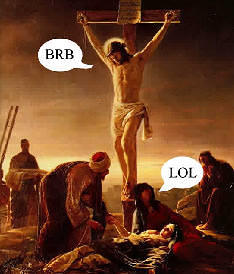
-STA
When I was a Christian, I was swept up into the idea that I was living in the "end times". The Son of Man would be flying in on clouds of glory, probably in just a couple years. This was back before Y2K, and so we all thought that sounded like a date Jesus would pick. So we all got ready, prayed, and stayed awake, fearing and waiting. And waiting.
And waiting...
Okay, so not the turn of the century. That's fine -- but it will be soon! Just look at all the wars, earthquakes, death, pestilence, and hardships around the world! Kids are listening to heavy metal and cutting themselves! You can't leave your front door unlocked anymore! The world is turning to shit! The end is neigh!!!!!!!!
It wasn't until I escaped Christianity that I realized this was an ongoing thing. Really. Since the dawn of Christianity, believers have been claiming the end of the world was just around the corner. I love browsing the website "A Brief History of the Apocalypse" whenever I hear a doomsday preacher on TV or read an end-times blog post. The phenomenon of predicting the end of the world is almost as old as the world itself.
Back In 5 Mins --J.C.
Examining the bible without my Jesus goggles, I started to understand things a little clearer. Things like Jesus's quotes in Matthew. "Immediately after the distress of those days 'the sun will be darkened, and the moon will not give its light; the stars will fall from the sky, and the heavenly bodies will be shaken'... Even so, when you see all these things, you know that it is near, right at the door...I tell you the truth, this generation will certainly not pass away until all these things have happened...I tell you the truth, you will not finish going through the cities of Israel before the Son of Man comes...For the Son of Man is going to come in his Father's glory with his angels, and then he will reward each person according to what he has done. I tell you the truth, some who are standing here will not taste death before they see the Son of Man coming in his kingdom."
That's a pretty clear indication that Jesus expected to return within his follower's lifetime. I find it both amusing and startling how every generation thinks of itself as the quoted "this generation". I guess it makes since to want to be "the generation" that gets to see Glory coming.
Even the apostles of Christ felt similar sentiments. James (5:8) instructs his fellow believers to "be patient and stand firm, because the Lord's coming is near." In fact, a lot of the New Testament is full of this sort of "be ready to go" language.
"For in just a little while, 'He who is coming will come and will not delay'." -Hebrews 10:37
"The hour has come for you to wake up from your slumber, because our salvation is nearer now than when we first believed." -Romans 13:11
"...time is short...For this world in its present form is passing away." -1 Corinthians 7:29
"The end of all things is near." -1 Peter 4:7
Dude, You are Soooooooo Fuggin' Late!
The looming threat of Judgment Day is held over believers by one another and by themselves. The other day I drove past a peeling, weather-worn church sign and I though, It never crosses a Christian's mind when they have to pay for a brand new billboard that says, "Jesus is coming SOON!" when the old one is decrepit and broken and has been sitting there for the past 20 years. Let's face the facts, people: Jesus promised to return soon and very soon, and that was nearly 2,000 years ago. I'm not really sure why Christians need to keep that sense of urgency, though it may have something to do with the fact that their god died 2000 years ago (if he ever really existed in the first place). Otherwise, it's a moot and unostentatious ending.
-STA
Saturday, January 9, 2010
Why And How To Worship God
In recent talks with theists I've once again come across the question of what I would do if "God" showed up to me. While that is a big discussion in itself, another aspect arrives from contemplating the question: worship. Why should we worship a reveled God, and what exactly does it mean to worship it?
Brown-Nosed And Rolling Over
Assuming the God in question is the all-powerful creator of everything, several factors reveal themselves in this scenario (at least to an armchair psychologist), the first of which is fear. We are naturally (be it by evolution or intelligent design) submissive to those with greater power than our own. We create hierarchical social structures and our treatment of others reflects our perceived level of dominance of them, among other things. From an evolutionary standpoint, it's a survival mechanism. Sure, we could all just fight to the death but that would help anyone, especially ourselves. So we push as far as we can, gaining and giving as much as beneficially possible. Therefore, should a mighty creator being suddenly plop down and begin issuing edicts, we'd most likely obey out of fear and a desire to live and remain unharmed.
The other side to this is the protection such a being would offer. Just as the tiny fish seek protection and food from a shark, so too would many humans begin to suck up to the regnant deity. True, some may also seek companionship and an honest exploration of the previously unstudied. But I think that most would simply bow out of fear and respect to power unlimited.
Here I Am, Now Entertain Me
That might be the why, but what about the how? What does it mean to worship a being? Is it unquestionable love and veneration? Is it reverence in the form of consent? I wouldn't expect to automatically love any being just out of awe, surprise, or fear. Love is earned. I might be able to respect the deity's authority and powers, but love is an entirely different ball game.
I suppose too that it would depend on the demands made by the god. Will it stand before us and proudly exclaim, "Bow down to me or be crushed!"? I'm willing to bet that the best form of "worship" would be the actions, words, and behaviors that the god did not ask for. Many people may solicit the being to gain protection, companionship, a freedom from responsibilities, or to share in the power. I would rather worship (and be worship by) beings that love or respect me enough to want to make me happy -- not out of fear of punishment or hopes of reward -- but just out of the goodness of the heart.
R-E-S-P-E-C-T, Find Out What It Means To Me
I can hear the religious people now, "But that's just exactly what God wants! He wants you to love him out of your own free will, and he wants to be worshiped by you and share his glory with you." I'm sorry, but it would depend on the character of your God. If, as I've said before, the deity is the actual Yahweh from the Old Testament, I wouldn't worship him if he threatened me directly to my face. Might doesn't make right. I don't care how powerful it is or how much right it has to me as its property, being my creator and being stronger than me doesn't give it the prerogative of my respect, honor, love, worship, or even acknowledgment. The content of its character and its actions toward others determine where it would sit in my book. I'll obey the might only if I accept its justifications for the requests it makes, and only if its standards meet those worthy of devotion. The Gods of people today do not warrant my respect, and they are not worthy of worship by anyone, including you.
-STA
Brown-Nosed And Rolling Over
Assuming the God in question is the all-powerful creator of everything, several factors reveal themselves in this scenario (at least to an armchair psychologist), the first of which is fear. We are naturally (be it by evolution or intelligent design) submissive to those with greater power than our own. We create hierarchical social structures and our treatment of others reflects our perceived level of dominance of them, among other things. From an evolutionary standpoint, it's a survival mechanism. Sure, we could all just fight to the death but that would help anyone, especially ourselves. So we push as far as we can, gaining and giving as much as beneficially possible. Therefore, should a mighty creator being suddenly plop down and begin issuing edicts, we'd most likely obey out of fear and a desire to live and remain unharmed.
The other side to this is the protection such a being would offer. Just as the tiny fish seek protection and food from a shark, so too would many humans begin to suck up to the regnant deity. True, some may also seek companionship and an honest exploration of the previously unstudied. But I think that most would simply bow out of fear and respect to power unlimited.
Here I Am, Now Entertain Me
That might be the why, but what about the how? What does it mean to worship a being? Is it unquestionable love and veneration? Is it reverence in the form of consent? I wouldn't expect to automatically love any being just out of awe, surprise, or fear. Love is earned. I might be able to respect the deity's authority and powers, but love is an entirely different ball game.
I suppose too that it would depend on the demands made by the god. Will it stand before us and proudly exclaim, "Bow down to me or be crushed!"? I'm willing to bet that the best form of "worship" would be the actions, words, and behaviors that the god did not ask for. Many people may solicit the being to gain protection, companionship, a freedom from responsibilities, or to share in the power. I would rather worship (and be worship by) beings that love or respect me enough to want to make me happy -- not out of fear of punishment or hopes of reward -- but just out of the goodness of the heart.
R-E-S-P-E-C-T, Find Out What It Means To Me
I can hear the religious people now, "But that's just exactly what God wants! He wants you to love him out of your own free will, and he wants to be worshiped by you and share his glory with you." I'm sorry, but it would depend on the character of your God. If, as I've said before, the deity is the actual Yahweh from the Old Testament, I wouldn't worship him if he threatened me directly to my face. Might doesn't make right. I don't care how powerful it is or how much right it has to me as its property, being my creator and being stronger than me doesn't give it the prerogative of my respect, honor, love, worship, or even acknowledgment. The content of its character and its actions toward others determine where it would sit in my book. I'll obey the might only if I accept its justifications for the requests it makes, and only if its standards meet those worthy of devotion. The Gods of people today do not warrant my respect, and they are not worthy of worship by anyone, including you.
-STA
Thursday, December 3, 2009
Prayer and the Internet
The bible states that prayer somehow works better when you get a bunch of like-minded people together. You'd think that with the invention of the internet and therefore the ability for billions of believers to sync up their communication channels to God and send requests en mass, we could easily change things. Things like, oh I don't know, world peace, the end of hunger, cancer, and other needless suffering. After millennia of just a spattering of people here and there asking for a global change, we have now within our means a way to systematically connect all the conduits of faith, and with a glorious roar reminiscent of Horton Hears a Who, simultaneously unleash a massive prayer toward the heavens.
But still nothing happens. Either everyone isn't synced up just right, or not enough people care about the state of things, or too many people are talking to too many different Gods, or -- the more likely answer -- prayer just doesn't work.
-STA
But still nothing happens. Either everyone isn't synced up just right, or not enough people care about the state of things, or too many people are talking to too many different Gods, or -- the more likely answer -- prayer just doesn't work.
-STA
Tuesday, December 1, 2009
Who Really Needs God?
I hope everyone's Thanksgiving weekend went well. How many of you nonbelievers had discussions with religious family members? I'm betting a lot of you 1) sat quietly through the prayer before dinner, and then 2) listened to your aunt bitch about how Obama is the Muslim Communist Antichrist. I was lucky enough to only have to deal with a few racist jokes this year; and all-in-all fairly good Thanksgiving.
This time of year always gets me thinking about why people cling to the ideas they have. What makes these otherwise kind, sane, decent people feel the need to uphold barbaric, antiquated, immoral concepts?
Religion Binds Culture
Religions tend to contain directives that are divisive and harmful. They are prone to being used by people who are willing to take the necessary actions suggested by them. Take the passage of "thou shall not suffer a witch to live". That passage is toothless until someone comes along who is of such character as to accept it as an authority and then act upon it. Therefore, the passage (or the religion, moreover) becomes a reflection of that individual's character.
Not only that, but religions change -- and poison -- the culture they're in. They increase the likelihood that people with these characteristics will be cultivated. Cultures change over time if left to their own devices. The problem is that a religion, upon its creation, encodes the current culture. Once locked in, it attempts to maintain the status quo. This is why the believers of the Bronze Age ideals of Christianity and Islam are trying to keep their outdated ways of thinking in the norm. Religion shackles culture, inhibits progress, and encourages stasis and stagnation.
Breaking The Chains
So who needs religion? Many people feel that without religion humanity would have no sense of right and wrong. Some even feel that its impossible to breath without God.
A lot of the ideas modern folks have about God, prayer, and religion has grown out of the mindset of the contemporaries of their belief systems. As stated above, religion naturally assumes the state in which it is founded. Those who hold Bronze Age beliefs come from a long line of people wanting a better life. The average poor person in America would be considered rich by the standards at the time the New Testament was written. The average tween probably knows more and is generally smarter than anyone who lived over two thousand years ago.
But even by comparison, some people today still feel like the world is against them. They covet the positions of the rich, feel like the "good guys" are loosing, and see the world as doomed. Most people still cling to hopes for a better life. I suppose in some sense that will never go away; no matter how good things get, there will always be a need to find something better. Religion thrives on this idea. It tells you that things are guaranteed to be better for you, if not in this life, then in the next. It's the ultimate "grass is greener" mentality -- something that's extremely appealing to the downtrodden.
We have to eliminate the need for god. We have to realize, as a whole, that together we can accomplish amazing things. With the scientific discoveries of the century, we've discovered microbiology, cured major diseases, and even walked on the moon. As long as our society neglects people, as long as there is major injustice and suffering, god will be there as the last resort and the empty hope for surrendered minds.
-STA
This time of year always gets me thinking about why people cling to the ideas they have. What makes these otherwise kind, sane, decent people feel the need to uphold barbaric, antiquated, immoral concepts?
Religion Binds Culture
Religions tend to contain directives that are divisive and harmful. They are prone to being used by people who are willing to take the necessary actions suggested by them. Take the passage of "thou shall not suffer a witch to live". That passage is toothless until someone comes along who is of such character as to accept it as an authority and then act upon it. Therefore, the passage (or the religion, moreover) becomes a reflection of that individual's character.
Not only that, but religions change -- and poison -- the culture they're in. They increase the likelihood that people with these characteristics will be cultivated. Cultures change over time if left to their own devices. The problem is that a religion, upon its creation, encodes the current culture. Once locked in, it attempts to maintain the status quo. This is why the believers of the Bronze Age ideals of Christianity and Islam are trying to keep their outdated ways of thinking in the norm. Religion shackles culture, inhibits progress, and encourages stasis and stagnation.
Breaking The Chains
So who needs religion? Many people feel that without religion humanity would have no sense of right and wrong. Some even feel that its impossible to breath without God.
A lot of the ideas modern folks have about God, prayer, and religion has grown out of the mindset of the contemporaries of their belief systems. As stated above, religion naturally assumes the state in which it is founded. Those who hold Bronze Age beliefs come from a long line of people wanting a better life. The average poor person in America would be considered rich by the standards at the time the New Testament was written. The average tween probably knows more and is generally smarter than anyone who lived over two thousand years ago.
But even by comparison, some people today still feel like the world is against them. They covet the positions of the rich, feel like the "good guys" are loosing, and see the world as doomed. Most people still cling to hopes for a better life. I suppose in some sense that will never go away; no matter how good things get, there will always be a need to find something better. Religion thrives on this idea. It tells you that things are guaranteed to be better for you, if not in this life, then in the next. It's the ultimate "grass is greener" mentality -- something that's extremely appealing to the downtrodden.
We have to eliminate the need for god. We have to realize, as a whole, that together we can accomplish amazing things. With the scientific discoveries of the century, we've discovered microbiology, cured major diseases, and even walked on the moon. As long as our society neglects people, as long as there is major injustice and suffering, god will be there as the last resort and the empty hope for surrendered minds.
-STA
Friday, November 20, 2009
Same Camp, Same Colors
A Mild Delusion
I sometimes hear from Christians that don't accept the ways of the fundies. Though we can both agree on their outrageous antics, we disagree when it comes to who takes the blame. That's where I put moderates in the same bucket as the fundamentalists. It doesn't matter what the amount of delusion is, it's the problems at the core that tie them all together.
Moderate and liberal believers act as a safe house for fundamentalists and provide a shield for them. Whenever the majority becomes comprised of relaxed moderates and anything bad happens that would cause them to think God is angry with them or the world or whatever, the moderates begin thinking, "What did we stop doing that would cause God to be vengeful? What changed?" They most often find the answer in fundamentalism.
If You Can't Beat 'em, Keep 'em Around
I used to be a fundamentalist Christian, growing ever increasingly moderate all the way out. Even though my tactics and reasoning were changing, I still had a mindset of a core fundamentalist. I'd see someone going "a little too far" on something, but I always knew their heart was in the right place. We had an elderly couple who began to grow more and more vocal over the choice of clothing the girls in the youth group wore to church: the dreaded and sinful pair of jeans. "That's no way for a woman to dress!" they could be overheard exclaiming as the congregation filed out of services. I didn't think God gave a damn about something as materialistic as pants, they backed up their objections with claims from the bible. I don't recall any particular passages, but it's not uncommon for a believer to say, "well, that's Bible!" when it comes to something they firmly believe -- whether or not it is actually stated in there. The point is that none of us less-sexist of the flock could shake the couple's certainty of the sin being committed, and we couldn't show them otherwise using the same "logical" tactics and arguments from the bible and faith. Those types of disagreements always come down to, "I'll have to pray about it".
The harboring of fundamentalist ideals is performed by all believers, be they liberal, moderate, or extremist. It's because the ideological framework is built using the same wood from the same tree (if you'll pardon the labored metaphor, and those that follow). The scaffolding may reach differing heights, but the foundation is the same unfounded illusion. Until the entire structure is torn down and can be rebuilt using actual knowledge and sound critical-thinking methods, the intellectual groundwork of moderates is indistinguishable from even the most delusional fundamentalists.
-STA
I sometimes hear from Christians that don't accept the ways of the fundies. Though we can both agree on their outrageous antics, we disagree when it comes to who takes the blame. That's where I put moderates in the same bucket as the fundamentalists. It doesn't matter what the amount of delusion is, it's the problems at the core that tie them all together.
Moderate and liberal believers act as a safe house for fundamentalists and provide a shield for them. Whenever the majority becomes comprised of relaxed moderates and anything bad happens that would cause them to think God is angry with them or the world or whatever, the moderates begin thinking, "What did we stop doing that would cause God to be vengeful? What changed?" They most often find the answer in fundamentalism.
If You Can't Beat 'em, Keep 'em Around
I used to be a fundamentalist Christian, growing ever increasingly moderate all the way out. Even though my tactics and reasoning were changing, I still had a mindset of a core fundamentalist. I'd see someone going "a little too far" on something, but I always knew their heart was in the right place. We had an elderly couple who began to grow more and more vocal over the choice of clothing the girls in the youth group wore to church: the dreaded and sinful pair of jeans. "That's no way for a woman to dress!" they could be overheard exclaiming as the congregation filed out of services. I didn't think God gave a damn about something as materialistic as pants, they backed up their objections with claims from the bible. I don't recall any particular passages, but it's not uncommon for a believer to say, "well, that's Bible!" when it comes to something they firmly believe -- whether or not it is actually stated in there. The point is that none of us less-sexist of the flock could shake the couple's certainty of the sin being committed, and we couldn't show them otherwise using the same "logical" tactics and arguments from the bible and faith. Those types of disagreements always come down to, "I'll have to pray about it".
The harboring of fundamentalist ideals is performed by all believers, be they liberal, moderate, or extremist. It's because the ideological framework is built using the same wood from the same tree (if you'll pardon the labored metaphor, and those that follow). The scaffolding may reach differing heights, but the foundation is the same unfounded illusion. Until the entire structure is torn down and can be rebuilt using actual knowledge and sound critical-thinking methods, the intellectual groundwork of moderates is indistinguishable from even the most delusional fundamentalists.
-STA
Thursday, November 5, 2009
Paying for Prayer
Are you sitting down? Good. Here's a couple news items from this week.
An All-Christian Prison
Oklahoma plans to build a Christian-run prison to give Christian inmates special privileges. So where's the all-atheist prison, or the all-Muslim prison? Sure, that's exactly what they need. Pray to an invisible friend that will take away all the bad things you've done in your life so that you can feel better about yourself, and read your bibles that tell stories of unicorns, dragons, satyrs, and talking donkeys. "Ninety-eight percent of offenders are going to get out of prison," says the project's leader. "What kind of offender do you want living next door?"
Priest Same As Doctor
Congressional members are again kowtowing to Christian Science by sponsoring a provision in the health care reform bill to allow prayer to be considered medicine. The Christian Science Church has pushed throughout its history to secure official recognition for its paid prayer practitioners. That's right, I said paid prayer practitioners. Their job is to pray for healing and charge for treatment at rates similar to those of medical doctors. Imagine having a job where you just pray for someone to get better all the while earning doctor's wages! I guess if you don't have a conscience or care at all about people, that's the best job in the world. If praying for someone to get better counts as medicine, shouldn't praying for someone to die be considered an attempt at murder? Does praying to win the lottery amount to fraud?
-STA
An All-Christian Prison
Oklahoma plans to build a Christian-run prison to give Christian inmates special privileges. So where's the all-atheist prison, or the all-Muslim prison? Sure, that's exactly what they need. Pray to an invisible friend that will take away all the bad things you've done in your life so that you can feel better about yourself, and read your bibles that tell stories of unicorns, dragons, satyrs, and talking donkeys. "Ninety-eight percent of offenders are going to get out of prison," says the project's leader. "What kind of offender do you want living next door?"
Priest Same As Doctor
Congressional members are again kowtowing to Christian Science by sponsoring a provision in the health care reform bill to allow prayer to be considered medicine. The Christian Science Church has pushed throughout its history to secure official recognition for its paid prayer practitioners. That's right, I said paid prayer practitioners. Their job is to pray for healing and charge for treatment at rates similar to those of medical doctors. Imagine having a job where you just pray for someone to get better all the while earning doctor's wages! I guess if you don't have a conscience or care at all about people, that's the best job in the world. If praying for someone to get better counts as medicine, shouldn't praying for someone to die be considered an attempt at murder? Does praying to win the lottery amount to fraud?
-STA
Friday, October 23, 2009
The Bible Warns Against Learning
Time for a quick Friday rant. The bEarthDay thing has got me thinking about the humorous side that religion brings, but I can't help but shake the fact that it's ultimately detrimental to society as a whole. It seems I'm always talking about this: religion is counter-productive to the advancement of human understanding and knowledge. We cannot learn as a whole as long as we are shackled by the chains of this way of thinking -- or should I say, not thinking.
I'm targeting the bible here, but all religions are guilty of this. The fact that Christianity is based on the idea of how wrong it is to learn something new. The Genesis story tells of humanities first and largest sin: gaining forbidden knowledge. All throughout the bible, we can find passages that strictly condemn thinking. Proverbs 3:5-6, Ecclesiastes 1:18, Philippians 2:14, Romans 1:22, and 1 Corinthians 1:19,27 are just a few examples of this wonderful guidebook that about one third of the planet identifies as the backbone of society. The bible states very clearly: don't think for yourself.
The idea that thinking for yourself is fundamentally against faith or the laws of the creator of the universe is dangerous and it squelches any hope of advancement for humankind. The fact that you're reading this right now is testament to the power of understanding brought on -- not by the wisdom of an almighty ghost -- but by the labors of reason and the drive to understand reality. I find it simultaneously absurd and terrifying that people fight tooth and nail to try to keep us in the Dark Ages by blocking off any progress in the battle against ignorance.
-STA
I'm targeting the bible here, but all religions are guilty of this. The fact that Christianity is based on the idea of how wrong it is to learn something new. The Genesis story tells of humanities first and largest sin: gaining forbidden knowledge. All throughout the bible, we can find passages that strictly condemn thinking. Proverbs 3:5-6, Ecclesiastes 1:18, Philippians 2:14, Romans 1:22, and 1 Corinthians 1:19,27 are just a few examples of this wonderful guidebook that about one third of the planet identifies as the backbone of society. The bible states very clearly: don't think for yourself.
The idea that thinking for yourself is fundamentally against faith or the laws of the creator of the universe is dangerous and it squelches any hope of advancement for humankind. The fact that you're reading this right now is testament to the power of understanding brought on -- not by the wisdom of an almighty ghost -- but by the labors of reason and the drive to understand reality. I find it simultaneously absurd and terrifying that people fight tooth and nail to try to keep us in the Dark Ages by blocking off any progress in the battle against ignorance.
-STA
Wednesday, September 30, 2009
Happy Blasphemy Day
September 30th is international Blasphemy Day. Here's Penn explaining it.
So go out and express disrespect for the god of your choice. If you're religious, you're encouraged to blaspheme too -- it'll mean more if you do it.
Happy Blasphemy Day, everyone...and fuck Ra!
-STA
So go out and express disrespect for the god of your choice. If you're religious, you're encouraged to blaspheme too -- it'll mean more if you do it.
Happy Blasphemy Day, everyone...and fuck Ra!
-STA
Saturday, September 5, 2009
Wednesday, August 5, 2009
God is THE Answer
I occasionally need a quick laugh and while traveling, nothing is easier than flipping on a Christian radio talk show. This particular one had me listening in for a few minutes, intrigued by the conversation between the host and a caller. The topic was the seemingly-out-of-place book of Ecclesiastes, a rather hard book for Christians to read without adding and changing the wording to make its message of "life is meaningless" mean something different (even though the book itself explicitly warns not to add to the book). The show's caller asked something regarding the mysterious ways of God. The host's response made me choke on my Skittles: "God doesn't give us answers, He gives us theology."
Not On Your Own Understanding
In the effort to once again tie atheism with nihilism, the Christian radio host continued to spout of claims that a life without God is a meaningless, hopeless life. These claims were of course not supported by anything other than the same words spoken with different inflection. But we've heard that song over and over and have proven it false. The thing that truly bothered me was how crass and willfully ignorant that statement was.
Now I've known first-hand how religion works and I talk with religious people on an almost daily basis, yet every time I hear this stuff I want to rip my hair out. They say things like "don't question, just accept" and claim it is the smartest thing you could ever do. They tout incredulity and gullibility as their highest virtue.
The radio preacher's words reminded me why I make videos and posts and why I talk to people about religion. The harm it causes to not only the believers and their family, but to the rest of the world, now and future generations. Not being able to think critically about ANYTHING is a greater risk to public safety than worrying about seat-belt laws. Those with this mentality of "we don't need answers, we just need God" scare the Jeebus out of me.
-STA
Not On Your Own Understanding
In the effort to once again tie atheism with nihilism, the Christian radio host continued to spout of claims that a life without God is a meaningless, hopeless life. These claims were of course not supported by anything other than the same words spoken with different inflection. But we've heard that song over and over and have proven it false. The thing that truly bothered me was how crass and willfully ignorant that statement was.
Now I've known first-hand how religion works and I talk with religious people on an almost daily basis, yet every time I hear this stuff I want to rip my hair out. They say things like "don't question, just accept" and claim it is the smartest thing you could ever do. They tout incredulity and gullibility as their highest virtue.
The radio preacher's words reminded me why I make videos and posts and why I talk to people about religion. The harm it causes to not only the believers and their family, but to the rest of the world, now and future generations. Not being able to think critically about ANYTHING is a greater risk to public safety than worrying about seat-belt laws. Those with this mentality of "we don't need answers, we just need God" scare the Jeebus out of me.
-STA
Wednesday, July 22, 2009
The Unmoving Mover
I realize I haven't done much lately as far as posting videos or making blog entries. That got me thinking about the definitions I'm often hearing about "God". Hopefully you'll see the connection in a minute.
Not only is the traditional concept of God a logically self-contradictory idea (consciousness without matter, life without birth or death, complexity without evolution, simultaneously all-knowing and all-powerful), it also produces static divinity.
A Static God
If God is everywhere, then there is nowhere he can go. I have the freedom to sit in that chair, but God doesn't because he's already in it. He is omnipresent and omnidirectional . If he knows everything already, then there's nothing he can learn (or change). He can't "want" something, because he's supposed to be perfect (and you can't want what you lack). He is essentially an unchanging, unmoving, inactive idea; an everything and a nothing all at once. Add one to the self-contradictory list.
The theists will disagree, but the basic God-triangle (omnipotent, omniscient, omnibenevolent) produces a static deity. The omnipotence paradox and the omnipotence-omniscience paradox show how God is restricted by simply applying the "omni-" attribute. Another simpler way to look at it is the phrase "a expert of everything is an expert of nothing". You can't judge your expertise against anything if you're already counting everything. Maybe all that means to you is that your god is super-powerful, but to me that means he can't change. Change is good and necessary, especially in a being that's supposed to be a healthy judge.
-STA
Not only is the traditional concept of God a logically self-contradictory idea (consciousness without matter, life without birth or death, complexity without evolution, simultaneously all-knowing and all-powerful), it also produces static divinity.
A Static God
If God is everywhere, then there is nowhere he can go. I have the freedom to sit in that chair, but God doesn't because he's already in it. He is omnipresent and omnidirectional . If he knows everything already, then there's nothing he can learn (or change). He can't "want" something, because he's supposed to be perfect (and you can't want what you lack). He is essentially an unchanging, unmoving, inactive idea; an everything and a nothing all at once. Add one to the self-contradictory list.
The theists will disagree, but the basic God-triangle (omnipotent, omniscient, omnibenevolent) produces a static deity. The omnipotence paradox and the omnipotence-omniscience paradox show how God is restricted by simply applying the "omni-" attribute. Another simpler way to look at it is the phrase "a expert of everything is an expert of nothing". You can't judge your expertise against anything if you're already counting everything. Maybe all that means to you is that your god is super-powerful, but to me that means he can't change. Change is good and necessary, especially in a being that's supposed to be a healthy judge.
-STA
Monday, June 8, 2009
Tassel Hassle
I've been in Texas over the weekend for a family member's graduation. With a few hundred graduates seated on the floor of the local Expo center, I was prepared for a long evening. I was in for a surprise when the ceremony begin with a prayer.
You, Me, and MY God
I don't know why I was surprised. The graduating student opened with a prayer to the Christian God, thanking him for getting them through the school year alive, and asked that everyone -- not just her, her family, or even the class...EVERYONE in the building -- continue to "seek God and do His will". I shouldn't have to say how presumptuous, disrespectful, and unnecessary this was, but I'll do it for the benefit of the believers who read this and just can't see why it's not okay to assume that everybody within earshot believes in YOUR god.
As the ceremony progressed, I was increasingly disheartened by the notion that nearly every speaker just had to say something about God. One even read from the bible! After every mention of religion, I found myself tuning out the speaker. I would be agreeing right up until I heard them talk about how Jesus blessed them with the knowledge they have. No matter what came after, it would be tainted with the discovery that the speaker lacked true critical thinking skills. I wonder what exactly was talked about in their government, history, and science classes. "We've learn a lot," one would say. Have you?
We Did It
One theme that was common was the motto, "we did it", a pretty universal high-school graduation adage. And yet, the religious graduates continually described how God gave them this, God blessed them with that, "God's hand has been on our class". One student's speech started out with her thanking God for everything, THEN giving thanks to the apparently less important ones like her mom and dad. I see this all the time from god-believers and those who specialize in doublethink. "We did everything; we're smart, we have wonderful teachers and supporting parents. But GOD gave us the knowledge and the blessing and blah blah blah". Either give the credit to the ones who've earned it (yourselves) or sit there like the puppet you think you are and give all the credit to your "savior and Heavenly Father"!
I was relieved to discover the school had a disclaimer printed at the bottom of the program that stated the students were given the chance to make speeches on the topic of their choice, and their views didn't reflect nor were they endorsed by the school. I am all for free expression, and I'm in no way condemning the students for exercising their rights and choices. I just wish they'd made a little better informed ones. All in all, I (and perhaps a few others in the large audience) was uncomfortable and belittled, but at least I got to see my cousin graduate.
-STA
You, Me, and MY God
I don't know why I was surprised. The graduating student opened with a prayer to the Christian God, thanking him for getting them through the school year alive, and asked that everyone -- not just her, her family, or even the class...EVERYONE in the building -- continue to "seek God and do His will". I shouldn't have to say how presumptuous, disrespectful, and unnecessary this was, but I'll do it for the benefit of the believers who read this and just can't see why it's not okay to assume that everybody within earshot believes in YOUR god.
As the ceremony progressed, I was increasingly disheartened by the notion that nearly every speaker just had to say something about God. One even read from the bible! After every mention of religion, I found myself tuning out the speaker. I would be agreeing right up until I heard them talk about how Jesus blessed them with the knowledge they have. No matter what came after, it would be tainted with the discovery that the speaker lacked true critical thinking skills. I wonder what exactly was talked about in their government, history, and science classes. "We've learn a lot," one would say. Have you?
We Did It
One theme that was common was the motto, "we did it", a pretty universal high-school graduation adage. And yet, the religious graduates continually described how God gave them this, God blessed them with that, "God's hand has been on our class". One student's speech started out with her thanking God for everything, THEN giving thanks to the apparently less important ones like her mom and dad. I see this all the time from god-believers and those who specialize in doublethink. "We did everything; we're smart, we have wonderful teachers and supporting parents. But GOD gave us the knowledge and the blessing and blah blah blah". Either give the credit to the ones who've earned it (yourselves) or sit there like the puppet you think you are and give all the credit to your "savior and Heavenly Father"!
I was relieved to discover the school had a disclaimer printed at the bottom of the program that stated the students were given the chance to make speeches on the topic of their choice, and their views didn't reflect nor were they endorsed by the school. I am all for free expression, and I'm in no way condemning the students for exercising their rights and choices. I just wish they'd made a little better informed ones. All in all, I (and perhaps a few others in the large audience) was uncomfortable and belittled, but at least I got to see my cousin graduate.
-STA
Wednesday, May 27, 2009
W's Religious War
Recently declassified briefings from the Bush administration further reveal the link between our current war and religion. The cover sheets to these documents are adorned with pictures of troops and other war images captioned with quotes from the Christian bible. These briefings were delivered by Rumsfeld to the White House. Although this propaganda wasn't directly sent to the troops themselves, the fact of the matter is that those in power believed war was the correct course of action because of their religious belief. I think the images speak for themselves.

-STA
-STA
Tuesday, May 12, 2009
How to Argue Like a Theist
So what am I doing making a post with such a title? Over the years of arguing with them, I've learned to anticipate the arguments that theists will use in a discussion. It's like you can write a script for nearly every single debate (at least the ones with theists who haven't really debated before, or haven't given much thought as to why they think what they do). We nonbelievers have learned all the theists' tricks simply because these arguments are all that they have. They just keep using them again and again, no matter how many times they've been proven wrong.
The first step (depending on how threatened the theist feels) is to attempt to rid themselves of the burden of proof. They may also falsely confuse passion with anger and try to use emotional arguments, claiming that the atheist must have been "hurt" by religion in the past. When these attempts fail, the next step is to argue from design. As the nonbeliever will typically use current scientific understanding to combat these weak attacks, the believer's next attempt is to attack science itself, claiming that scientific methods are invalid or flawed and will commonly use the "well, it's just a theory!". Once shown that science works, they resort to the only thing the atheist can't take away from them: personal experience. By the end of the discussion (if both parties ever reach such a point), the theist will throw out an argument from morality and begin considering what would be required to "believe IN" if one doesn't believe in God.
This is in no way a complete list, nor is it a script that occurs at each encounter. As I said earlier, it's the most common arguments that I find believers using to try to justify their unjustifiable beliefs. Yet the nonbeliever usually finds that every counter-attack has the opposite result: the more you show them there's no proof, the stronger they become in their belief! Faith is the evidence of what you can't see or prove. That's how you know, you just HAVE to know, and then you know. Faith (read: ignorance) can prevail.
Tracie Harris (who writes the Atheist Eve web comic) provides a similar list of theistic tactics, though in a different order:

-STA
- Attack #1: Shift the burden of proof ("Can you prove God doesn't exist?")
- Attack #2: What did God do to make you so angry?
- Attack #3: Can you prove love?
- Attack #4: Pascal's Wager
- Attack #5: Watchmaker and other painter/painting Ray Comfort BS pseudo-arguments
- Attack #6: Since science doesn't know how we got here, it must be God.
- Attack #7: Offer personal experiences (you can't say I'm wrong now...I just *feel* it!)
- Attack #8: Then what do you believe in? (purpose in life, morality, etc.)
- Attack #n: see Ways to Annoy an Atheist
The first step (depending on how threatened the theist feels) is to attempt to rid themselves of the burden of proof. They may also falsely confuse passion with anger and try to use emotional arguments, claiming that the atheist must have been "hurt" by religion in the past. When these attempts fail, the next step is to argue from design. As the nonbeliever will typically use current scientific understanding to combat these weak attacks, the believer's next attempt is to attack science itself, claiming that scientific methods are invalid or flawed and will commonly use the "well, it's just a theory!". Once shown that science works, they resort to the only thing the atheist can't take away from them: personal experience. By the end of the discussion (if both parties ever reach such a point), the theist will throw out an argument from morality and begin considering what would be required to "believe IN" if one doesn't believe in God.
This is in no way a complete list, nor is it a script that occurs at each encounter. As I said earlier, it's the most common arguments that I find believers using to try to justify their unjustifiable beliefs. Yet the nonbeliever usually finds that every counter-attack has the opposite result: the more you show them there's no proof, the stronger they become in their belief! Faith is the evidence of what you can't see or prove. That's how you know, you just HAVE to know, and then you know. Faith (read: ignorance) can prevail.
Tracie Harris (who writes the Atheist Eve web comic) provides a similar list of theistic tactics, though in a different order:

-STA
Monday, April 27, 2009
God Is Love
Here's a poem from a guy I'm subscribed to on YouTube:
-----------------
He tempted Eve with a forbidden tree
God is Love
He allows Satan to wander free
God is Love
He killed newborn babies with a worldwide flood
God is Love
He just cant get enough fresh blood
God is Love
He killed poor Uzzah just for saving the ark
God is Love
He hated vegetables and gave Cain a mark
God is Love
He fried little babies in Sodom and Gomorrah
God is Love
He killed thousands more in the Amalekite slaughter
God is Love
He caused Davids newborn son to die
God is Love
Yet honored Rahab for her lie
God is Love
He let the devil ruin Job
God is Love
So he could brag and he could boast
God is Love
He hardened poor old Pharaohs heart
God is Love
Condemned by God, doomed from the start
God is Love
But with escape he was not content
God is Love
All firstborn died before they went
God is Love
He spared not one poor Canaanite
God is Love
The newborn went without a fight
God is Love
He killed forty-two boys with a grizzly bear
God is Love
Because Elisha had no hair
God is Love
He killed Ananias and Sapphira too
God is Love
For holding back their portion due
God is Love
So to cap off all that he had done
God is Love
He tortured and killed his only son
God is love?
© 2001, TruthSurge
-----------------
He tempted Eve with a forbidden tree
God is Love
He allows Satan to wander free
God is Love
He killed newborn babies with a worldwide flood
God is Love
He just cant get enough fresh blood
God is Love
He killed poor Uzzah just for saving the ark
God is Love
He hated vegetables and gave Cain a mark
God is Love
He fried little babies in Sodom and Gomorrah
God is Love
He killed thousands more in the Amalekite slaughter
God is Love
He caused Davids newborn son to die
God is Love
Yet honored Rahab for her lie
God is Love
He let the devil ruin Job
God is Love
So he could brag and he could boast
God is Love
He hardened poor old Pharaohs heart
God is Love
Condemned by God, doomed from the start
God is Love
But with escape he was not content
God is Love
All firstborn died before they went
God is Love
He spared not one poor Canaanite
God is Love
The newborn went without a fight
God is Love
He killed forty-two boys with a grizzly bear
God is Love
Because Elisha had no hair
God is Love
He killed Ananias and Sapphira too
God is Love
For holding back their portion due
God is Love
So to cap off all that he had done
God is Love
He tortured and killed his only son
God is love?
© 2001, TruthSurge
Subscribe to:
Posts (Atom)