I've been feeling down as of late. It might be lack of sun or some vitamin I'm not getting, but this uneasiness has caused me to come back to this blog after yet another long hiatus.
As I sit here typing, my second monitor is displaying a picture of my daughter when she was a newborn. The auto-slideshow just changed it to her playing her drumkit when she was three. That seems like yesterday. She'll be starting school very soon; leaving the house for hours out of the day when neither me nor her mom will be with her...
And I'm scared.
Good Ol' Days
It's becoming more obvious that I'm slowly losing her to the world. As parents we can fight all we want but we can't win that war. We can't shelter them forever, nor should we, for the sake of health. But still, as a parent you want to keep them all to yourself, safe in the cave. I knew this day would come and I know that other, even harder days will eventually come too. But I still can't help but be scared.
The world I'm giving her to seems to be a frothing, bubbling cauldron of chaos. Mass shootings, out-of-control law enforcement, governmental quagmires, corporate megalomania, destabilizing climate, ubiquitous vapid entertainment, and eroding common sense are a few of the things I can't help but spot as my eyes scan the horizon for danger before letting my cub out of this cave. I just saw there was another shooting in a movie theater yesterday. You used to not even think about being scared to go out and watch a movie, but now it crosses my mind every time I step into one. I'm always planning ahead, running "what-if's" in my head in an attempt to be ready for anything, not just at a movie theater but everywhere I go. Maybe that's been heightened since I became a parent...I'm sure all parents do that to some extent. I'm watching out for my little girl whenever I can.
But she's growing up faster than I can think. She'll be going off to school -- another place that used to be safe.
Didn't it?
It's easy to think that the world is going to pot. I hear people saying that things have gotten worse, throwing around the old "used to not have to lock the front door" argument. I have to catch myself and remember to be rational when I hear these things. Because in point of fact, things have been and continue to be better. Statistically, we're safer than ever, and crime has been in steady decline. Through technological advancements, the world is becoming better and better each day. But it's hard to miss the big stories and headlines. But it's a product of our modern world. If not for our ability to get 24/7, instant notification of nearly anything we want, it wouldn't seem like everything is so bad. It's all in how you look at it.
Bad things happen every day. Bad things have always happened every day, only now we know about them faster, so it seems like it's getting worse than it used to be. But it's not.
It's easy to think that before Columbine, school shootings where "just something you didn't ever see". But that phenomenon it didn't start in 1999. Ever since there have been guns and schools, there have been school shootings. A man entered a school in Pennsylvania with a gun, shot and killed a teacher and nine kids. That could be a report from any day in the last decade -- but it happened in 1764. And things like that have happened ever since. Look up the number of deaths from school shootings in the US since 2000. The number fluctuates from 19 one year to 4 to the next; from 38 to only 3. Now granted, every single one of those are tragedies and I don't think I'd give a good goddamn that crime has dropped in this country if my daughter were one of those cold statistics. "I know she's gone, but there were only 3 this year...it's actually getting better!"
We're better informed about the news of terrible events (if not informed, at least aware -- hell, we can know there's a shooting taking place before we even know how many people are pulling triggers), but we're at a loss for the reasons why some of these things happen. Of course each is it's own issue and a blanket statement is both belittling to those issues themselves and a non-sequitur of any kind of approach to dealing with them, but nevertheless I hear a rather loud majority unfolding their favorite blanket: religion.
(I'm going to digress into preachy mode now...this is my atheist blog by the way)
Can't Reconcile Fact and Faith
We don't have enough of it, they claim. We've "turned away from God" and "taken the Lord out of" every facet of our lives, so it shouldn't be such a shock when someone shoots a building full of innocent people.
Indeed, why would an all-loving, infinitely powerful force lift an invisible finger to help us if we hurt its feelings?
This is not going to be a post about tearing that argument apart. You've probably already done that before reading this sentence. Instead, I'm more interested in a larger and clearer problem. And it stems from this: I agree. Religion is likely the problem.
But it isn't because we are not as fundamental as the fundies want us to be. On the contrary; it's because people believe in it, and it's hard to believe in, even for the believers. I think that a majority of people are good, decent and loving. We all want our kids to be safe and happy, and we all don't want to die just because we're in close proximity to a crowd of others. This is true no matter your country of origin or background in life; it's universal. But believers been suckered into thinking that they need religion in order to be decent and loving -- that in fact those qualities come from religion itself. (Each religious and "spiritual" person will have their own exact deity or force in the end, but for the sake of argument we can lump it together here.) And those who believe that must reconcile the world we all live in with the claims their religion makes.
If you believe in some kind of loving God, you have to try to rationalize the problem of evil, there's no way around it. I'm just arm-chairing here, but I think that doing so causes so much cognitive dissonance that it leads to detrimental effects. I don't have the clinical knowledge to even begin to really talk about such things, but to me, it seems an easy sell.
I say that because of personal experience; I've been there. I know what it's like to have that internal struggle...that "crisis of faith". I also know what it's like to think I have beaten that, to keep thinking that God loves the world while horrible things keep happening...that there's a "reason for everything". I know the arguments and the bible verses. I get how comforting religion can be whenever these bad things happen. And now, as an atheist, I can't call upon a sense of love and safety in a deity. But by facing the truth that I'm alone in the universe (theologically speaking) I've found out how to be on my own. I know now how to find true, real hope. I've reconciled personal fears about death, for myself and others. It's something everyone has to do for themselves...I don't have a guide for that. But I can say that I feel healthier and more at ease for understanding the world around me now that I'm not trying to fit a God in there somewhere.
Many people claim we need religion for comfort. But when I have to watch someone I love die slowly, it's comforting to know that it's not because of some supernatural Shakespearean drama between magical forces. When my grandmother died, I found it comforting to know that there was no outside force that failed to save her, and that there was no outside force that caused her demise. She wasn't "called home" and she didn't die because we failed to pray hard enough. To me, it's more painful to think one or both of those things is true than to look Truth in the eye.
And in the end, I think that's what make most people uneasy. Maybe that's a reason for a lot of the behavior of people, from rebellious pre-teens up to mass-murdering adults. They're stuck on the problem of trying to get an answer out of an unanswerable question, like trying to squeeze blood from a stone.
Not everyone will take the time or effort as I have -- either through a lack of personal ability or overwhelming apathy, or something else entirely --- to sit down and think about all this "God stuff". A lot of people I've talked to are on the fence when it comes to religion. There's too much misunderstanding and stigma attached to the "'A' Word" and people wind up being "just spiritual" or "agnostic" in the wrong sense. We don't like to challenge our own thoughts.
As an animal, we seek to minimize pain. This includes mental anguish. Therefore, I don't find it surprising that humans take comfort in religion rather than tackle the hard parts of life (including questioning said religion). And I understand that having to deal with those feelings when you realize religion is empty of real hope can seem daunting. It takes more work, but you get real, tangible, substantive joy from it.
Ditch Faith, Find Hope
When we were burying my grandmother, we stood for the preacher's final words before departing the cemetery. Then he said something along the lines of, "Without Jesus there is no hope...for everlasting life." The ellipsis there represents a pause he took, a pretty important pause. If he had ended his sentence before then, I'd have probably made a scene right there my grandmother's funeral. Not only do I hate having to sit through religious funerals where we are mostly there for church and not to remember the one we've all lost, but then to be told I have no hope on top of that...
But he did finish the sentence. And honestly, he did a good job with the service overall. It was more about her than church (although just barely). I only bring it up now because of that one incident.
He is right, ya know; without believing in Jesus you can't pretend you'll live forever. Well, unless you're one of those "spiritual" folks. If you are, try talking to someone. Preferably to someone who doesn't believe the same things you do. Challenge everything you believe, not just religion or "spiritual" stuff. Ideas are either strengthened or forgotten by challenge.
[To all my loyal readers who come to this blog for concise, well-written posts: forgive this rambling mess as I try to re-enter the blogosphere. I've got some rust to knock off.]
-STA
Showing posts sorted by relevance for query hope. Sort by date Show all posts
Showing posts sorted by relevance for query hope. Sort by date Show all posts
Friday, July 24, 2015


Friday, April 4, 2008
Nothing Works Like Prayer
Sorry for the delay, folks. I've been in the process of moving to a new Small Town, and the move has been a bit crazy.
But nothing like this:
Idol Hands
Fifteen-month old baby Ana Worthington died on the second day of last month. Her parents belong to the Followers of Christ Church, a church that preaches against the use of medicine, opting instead for prayer to cure illness. Ana died from bronchial pneumonia and a blood infection that could have been treated with simple antibiotics.
But her parents chose Jesus.
Madeline Neumann died March 23rd from a rare but treatable form of diabetes. Her parents blame her lack of faith on her death, and claim that she will be resurrected soon. All the 11-year old needed was a shot of insulin.
But her parents instead chose Jesus.
Faith Isn't Medicine
I was recently criticized for speaking out against irrationality. I hope these two recent cases of child murder shake you to your core. If they don't, you may be beyond hope. I realize that these are just the minority of crazy nuts, but this is how faith can allow for such atrocities. Madeline's parents last took her to a doctor when she was just three years old. Her siblings still live with her parents. The investigators in each of these cases claim that the parents were not crazy nor neglectful people; they just believed that prayer would work.
Regardless of your religious believes, think about Ana and Madeline the next time you are confronted with a choice of faith over medical science. It seems that we atheists are the only ones who are telling these insanely irrational people that their highly incorrect in their way of thinking. But why does it have to be just non-believers? Christians, if these people are in your minority, then YOU should stand up against them too. They will most likely listen to you than to someone who doesn't believe in their God.
I've got to go. I should probably do these stories more justice, but it will have to wait. Once I get settled in my new Small Town we can continue. Don't worry, unlike Jesus, I'll be back!
-STA
But nothing like this:
Idol Hands
Fifteen-month old baby Ana Worthington died on the second day of last month. Her parents belong to the Followers of Christ Church, a church that preaches against the use of medicine, opting instead for prayer to cure illness. Ana died from bronchial pneumonia and a blood infection that could have been treated with simple antibiotics.
But her parents chose Jesus.
Madeline Neumann died March 23rd from a rare but treatable form of diabetes. Her parents blame her lack of faith on her death, and claim that she will be resurrected soon. All the 11-year old needed was a shot of insulin.
But her parents instead chose Jesus.
Faith Isn't Medicine
I was recently criticized for speaking out against irrationality. I hope these two recent cases of child murder shake you to your core. If they don't, you may be beyond hope. I realize that these are just the minority of crazy nuts, but this is how faith can allow for such atrocities. Madeline's parents last took her to a doctor when she was just three years old. Her siblings still live with her parents. The investigators in each of these cases claim that the parents were not crazy nor neglectful people; they just believed that prayer would work.
Regardless of your religious believes, think about Ana and Madeline the next time you are confronted with a choice of faith over medical science. It seems that we atheists are the only ones who are telling these insanely irrational people that their highly incorrect in their way of thinking. But why does it have to be just non-believers? Christians, if these people are in your minority, then YOU should stand up against them too. They will most likely listen to you than to someone who doesn't believe in their God.
I've got to go. I should probably do these stories more justice, but it will have to wait. Once I get settled in my new Small Town we can continue. Don't worry, unlike Jesus, I'll be back!
-STA
Friday, February 14, 2014
Relationships Need Input
I'm often encouraged by my opposition to "seek a personal relationship" with the deity they espouse. And indeed, that sounds like a good idea to someone who is curious about a particular god. Despite the fact that I was a tongue-talking Christian for a lot of my young adult life, I'm implored by the religious to get into a relationship with their savior.
1 John 4:8, 1 Corinthians 13:4, Exodus 34:14
But what exactly does that mean? A relationship has at the least, two people. Unless a "personal" relationship is akin to the way a stalker feels about his victim. And since I'm hard-pressed to find a theist who believes their god is a physical person, it seems like the latter is the direction one has to go in.
In an actual relationship between two people, each party grows, changes, and effects one another. Each participating member benefits from the others' involvement. It is possible to be in a relationship and not contribute to it, and those relationships don't last long. I realize that from a theistic standpoint, one can hope to change and grow "in God" or "in Jesus" or "in Minerva", but that really only proves the case for a one-sided relationship.
What can a changeless, all-powerful, all-knowing god hope to gain from a relationship? Gaining something itself implies a lack of something in the first place. If the god knows all in the future, no excitement or surprise can come, so there's no benefit there. Such a deity can't change, can't grow, can't be effected.
I realize at best I'm arguing for deism here, and I don't intend to. Let's turn the focus back to the idea that each worshiper has their own "personal relationship" with God. I don't think I can do a better job of illustrating the flaws with this idea than what has already been done by YouTube user NonStampCollector:
Put simply: there wouldn't be so many differing views on the wishes of a (supposedly) singular entity if all those who profess to engage in a personal relationship with said entity actually did so.
Happy Valentine's Day everyone. Find someone -- a real person -- with whom you have an actual, personal relationship with, and spend some time with them.
-STA
1 John 4:8, 1 Corinthians 13:4, Exodus 34:14
But what exactly does that mean? A relationship has at the least, two people. Unless a "personal" relationship is akin to the way a stalker feels about his victim. And since I'm hard-pressed to find a theist who believes their god is a physical person, it seems like the latter is the direction one has to go in.
In an actual relationship between two people, each party grows, changes, and effects one another. Each participating member benefits from the others' involvement. It is possible to be in a relationship and not contribute to it, and those relationships don't last long. I realize that from a theistic standpoint, one can hope to change and grow "in God" or "in Jesus" or "in Minerva", but that really only proves the case for a one-sided relationship.
What can a changeless, all-powerful, all-knowing god hope to gain from a relationship? Gaining something itself implies a lack of something in the first place. If the god knows all in the future, no excitement or surprise can come, so there's no benefit there. Such a deity can't change, can't grow, can't be effected.
I realize at best I'm arguing for deism here, and I don't intend to. Let's turn the focus back to the idea that each worshiper has their own "personal relationship" with God. I don't think I can do a better job of illustrating the flaws with this idea than what has already been done by YouTube user NonStampCollector:
Put simply: there wouldn't be so many differing views on the wishes of a (supposedly) singular entity if all those who profess to engage in a personal relationship with said entity actually did so.
Happy Valentine's Day everyone. Find someone -- a real person -- with whom you have an actual, personal relationship with, and spend some time with them.
-STA
Tuesday, December 1, 2009
Who Really Needs God?
I hope everyone's Thanksgiving weekend went well. How many of you nonbelievers had discussions with religious family members? I'm betting a lot of you 1) sat quietly through the prayer before dinner, and then 2) listened to your aunt bitch about how Obama is the Muslim Communist Antichrist. I was lucky enough to only have to deal with a few racist jokes this year; and all-in-all fairly good Thanksgiving.
This time of year always gets me thinking about why people cling to the ideas they have. What makes these otherwise kind, sane, decent people feel the need to uphold barbaric, antiquated, immoral concepts?
Religion Binds Culture
Religions tend to contain directives that are divisive and harmful. They are prone to being used by people who are willing to take the necessary actions suggested by them. Take the passage of "thou shall not suffer a witch to live". That passage is toothless until someone comes along who is of such character as to accept it as an authority and then act upon it. Therefore, the passage (or the religion, moreover) becomes a reflection of that individual's character.
Not only that, but religions change -- and poison -- the culture they're in. They increase the likelihood that people with these characteristics will be cultivated. Cultures change over time if left to their own devices. The problem is that a religion, upon its creation, encodes the current culture. Once locked in, it attempts to maintain the status quo. This is why the believers of the Bronze Age ideals of Christianity and Islam are trying to keep their outdated ways of thinking in the norm. Religion shackles culture, inhibits progress, and encourages stasis and stagnation.
Breaking The Chains
So who needs religion? Many people feel that without religion humanity would have no sense of right and wrong. Some even feel that its impossible to breath without God.
A lot of the ideas modern folks have about God, prayer, and religion has grown out of the mindset of the contemporaries of their belief systems. As stated above, religion naturally assumes the state in which it is founded. Those who hold Bronze Age beliefs come from a long line of people wanting a better life. The average poor person in America would be considered rich by the standards at the time the New Testament was written. The average tween probably knows more and is generally smarter than anyone who lived over two thousand years ago.
But even by comparison, some people today still feel like the world is against them. They covet the positions of the rich, feel like the "good guys" are loosing, and see the world as doomed. Most people still cling to hopes for a better life. I suppose in some sense that will never go away; no matter how good things get, there will always be a need to find something better. Religion thrives on this idea. It tells you that things are guaranteed to be better for you, if not in this life, then in the next. It's the ultimate "grass is greener" mentality -- something that's extremely appealing to the downtrodden.
We have to eliminate the need for god. We have to realize, as a whole, that together we can accomplish amazing things. With the scientific discoveries of the century, we've discovered microbiology, cured major diseases, and even walked on the moon. As long as our society neglects people, as long as there is major injustice and suffering, god will be there as the last resort and the empty hope for surrendered minds.
-STA
This time of year always gets me thinking about why people cling to the ideas they have. What makes these otherwise kind, sane, decent people feel the need to uphold barbaric, antiquated, immoral concepts?
Religion Binds Culture
Religions tend to contain directives that are divisive and harmful. They are prone to being used by people who are willing to take the necessary actions suggested by them. Take the passage of "thou shall not suffer a witch to live". That passage is toothless until someone comes along who is of such character as to accept it as an authority and then act upon it. Therefore, the passage (or the religion, moreover) becomes a reflection of that individual's character.
Not only that, but religions change -- and poison -- the culture they're in. They increase the likelihood that people with these characteristics will be cultivated. Cultures change over time if left to their own devices. The problem is that a religion, upon its creation, encodes the current culture. Once locked in, it attempts to maintain the status quo. This is why the believers of the Bronze Age ideals of Christianity and Islam are trying to keep their outdated ways of thinking in the norm. Religion shackles culture, inhibits progress, and encourages stasis and stagnation.
Breaking The Chains
So who needs religion? Many people feel that without religion humanity would have no sense of right and wrong. Some even feel that its impossible to breath without God.
A lot of the ideas modern folks have about God, prayer, and religion has grown out of the mindset of the contemporaries of their belief systems. As stated above, religion naturally assumes the state in which it is founded. Those who hold Bronze Age beliefs come from a long line of people wanting a better life. The average poor person in America would be considered rich by the standards at the time the New Testament was written. The average tween probably knows more and is generally smarter than anyone who lived over two thousand years ago.
But even by comparison, some people today still feel like the world is against them. They covet the positions of the rich, feel like the "good guys" are loosing, and see the world as doomed. Most people still cling to hopes for a better life. I suppose in some sense that will never go away; no matter how good things get, there will always be a need to find something better. Religion thrives on this idea. It tells you that things are guaranteed to be better for you, if not in this life, then in the next. It's the ultimate "grass is greener" mentality -- something that's extremely appealing to the downtrodden.
We have to eliminate the need for god. We have to realize, as a whole, that together we can accomplish amazing things. With the scientific discoveries of the century, we've discovered microbiology, cured major diseases, and even walked on the moon. As long as our society neglects people, as long as there is major injustice and suffering, god will be there as the last resort and the empty hope for surrendered minds.
-STA
Monday, June 30, 2008
Not 50/50
Professor Richard Dawkins had a chapter in his recent book The God Delusion that was devoted to the probability of God. The idea is still very much ingrained in the minds of theists (committed or not) that the probability that a god exists is exactly proportionate to the probability that a god does not exist. Many people think it's 50/50. You can't prove nor disprove the existence of god, so that gives him a 50/50 shot at being real, right?
Know When To Walk Away...
Wrong. Those who think so don't truly understand the laws governing probability. Suppose you are in your car driving toward an intersection. The choice is: do you stop at the sign? Well, you either will or will not get hit by an oncoming car, so your chances are 50/50, right? Again, wrong. I hope this simple analogy illustrates the point that just by having two choices doesn't automatically place said choices on equal footing. This should be obvious to anyone -- but if you still don't think so, I hope I won't meet you out on the highway.
In his chapter on the God Hypothesis, Professor Dawkins looks at a "spectrum of probability", with seven benchmarks ranging from "I KNOW there is a god" to "I KNOW there is no god". Both such claims require evidence to be taken seriously. Dawkins then goes on throughout the book showing the so-called "evidence" for God's existence is nothing short of infinitesimal. In short, there is more evidence in favor of no god than in favor for it.
Because We're Here...
But Christians, Muslims, Hindus, Janists, Zoroastrians, or any other God-believing school of thought would say otherwise. It is in the area of scientific inquiry that the claims of evidence for the existence of deities must be tried and tested. So far, those tests have shown absolutly nothing supernatural or God-like. Perhaps one day we'll find a nugget of evidence that can't be explained any possible way other than appeals to God, but such a day would also morn the loss of science itself. For simply concluding "god did it" is not an answer. There will always be questions. How did "god" do it, exactly? With what? And what IS this god anyway? To throw your hands up and say "god" is to embrace ignorance and bemoan true understanding.
-STA
Know When To Walk Away...
Wrong. Those who think so don't truly understand the laws governing probability. Suppose you are in your car driving toward an intersection. The choice is: do you stop at the sign? Well, you either will or will not get hit by an oncoming car, so your chances are 50/50, right? Again, wrong. I hope this simple analogy illustrates the point that just by having two choices doesn't automatically place said choices on equal footing. This should be obvious to anyone -- but if you still don't think so, I hope I won't meet you out on the highway.
In his chapter on the God Hypothesis, Professor Dawkins looks at a "spectrum of probability", with seven benchmarks ranging from "I KNOW there is a god" to "I KNOW there is no god". Both such claims require evidence to be taken seriously. Dawkins then goes on throughout the book showing the so-called "evidence" for God's existence is nothing short of infinitesimal. In short, there is more evidence in favor of no god than in favor for it.
Because We're Here...
But Christians, Muslims, Hindus, Janists, Zoroastrians, or any other God-believing school of thought would say otherwise. It is in the area of scientific inquiry that the claims of evidence for the existence of deities must be tried and tested. So far, those tests have shown absolutly nothing supernatural or God-like. Perhaps one day we'll find a nugget of evidence that can't be explained any possible way other than appeals to God, but such a day would also morn the loss of science itself. For simply concluding "god did it" is not an answer. There will always be questions. How did "god" do it, exactly? With what? And what IS this god anyway? To throw your hands up and say "god" is to embrace ignorance and bemoan true understanding.
-STA
Wednesday, October 10, 2007
Arguing From The Bubble
Recently, I was in a pseudo-debate with a Christian on an internet forum. After enduring several claims of "fact", appeals to emotion, and general lack of cohesive reasoning from said Christian, I reached the conclusion that he was either A) too ignorant--and too blissfully therein--to ever understand his fallacies, or B) he was simply disregarding logic and formal rules of argument for the, pardon the pun, hell of it. I hope the latter wasn't the case, but even the former brings me grief to consider. I also hope I planted at least one seed of doubt in him. Whatever the case, it spurred me to make this post.
Does Not Compute
Einstein once said, "Logic will get you from A to B. Imagination will take you everywhere." My Christian opponent had an expansive imagination. He didn't (or chose to discard) the basic principals of logical reasoning, and I'm sure other apologists don't either.
Logic, as the study of the rules of correct thinking have shown, is fundamentally necessary for an argument to hold any weight or be taken as true in any useful sense. For it to remain consistent, an argument must provide set of statements, one of which is the conclusion, and the rest as premises supporting the conclusion. In other words, a statement along with the evidence that supports it. If your conclusion isn't held up by evidence, you've committed some kind of logical fallacy; you've broken the laws of logic. I cover these fallacies on this blog every Friday, so I need not go into them now.
Above I stated that most apologists don't hold to these principals, though I'm sure they all disagree. One might wonder how this could be possible. How could any religion survive for centuries if they aren't logically sound? The answers to these questions cover an extremely large amount of topics that I am not qualified to discuss (biology, psychology, sociology, history, etc.), and besides that it isn't the purpose of my blog. A more simple and purposeful answer: they are.
Superman, Hands Down
Yeah. Some religions are logically sound, but (you really didn't think there wasn't a kicker, right?) they are only sound internally; on the inside. Here's what I mean: If, for the sake of this example, Jesus really was the son of God...
Sorry, I nearly passed out just thinking of the number of leaps of faith that would take to believe. Anyway:
-If Jesus really was the son of God, then walking on water would be simple. He could do it.
-If the Hindu gods really drink soma, the moon would naturally wane because the gods are drinking away some of its properties.
-The angel Moroni must have told Joe Smith the truth, because the angel was from God, and angels can't lie.
-If Adam and Eve were oblivious to their nakedness, then eating from the Tree would indeed open their eyes.
All of the above logically follow from the premise. The problem is of course that the premises must be rejected outright, or at least backed up by something that, in turn is backed up by another thing, which is in turn backed up by another, which is itself backed up by another--how ever many or few steps this takes--all with sound reasoning. This is the labyrinth of logic that theists get lost in.
The point here is that yes, you can argue just fine within the bubble of your religion. This same principle is the reason why Trekkies can argue to the point of exhaustion regarding the layout of the Enterprise, or the inner workings of hyperdrive or whatever the fuck it is. The same goes for arguing a case for Neville Longbottom fulfilling the prophesy instead of Harry Potter, or what would happen if Spiderman fought Superman. The point is: THE SHIT AIN'T REAL.
A Ship of Corn Flakes Upon a Milk Sea
I don't give a fuck if you can convince yourself and your 8-year old daughter that humanity is suffering, and the only way to not suffer for the rest of eternity is to find Jesus. You must still show how any of that shit makes logical sense IN THE FIRST PLACE!!!!
I'm sorry for this rather blunt way of putting things, but this stuff really gets in my craw. Of course it's fine to argue and speculate on who would win in a fight between superheroes, or even what would happen if Jesus came back. The problems arise when you take these fanciful arguments as truth without backing up their underlying proposition. Even worse when you start taking actions against others for not agreeing.
It is in the best interest of your children, your countrymen, and yourself to learn to think critically, and learn how to logically get from A to B.
-STA
Does Not Compute
Einstein once said, "Logic will get you from A to B. Imagination will take you everywhere." My Christian opponent had an expansive imagination. He didn't (or chose to discard) the basic principals of logical reasoning, and I'm sure other apologists don't either.
Logic, as the study of the rules of correct thinking have shown, is fundamentally necessary for an argument to hold any weight or be taken as true in any useful sense. For it to remain consistent, an argument must provide set of statements, one of which is the conclusion, and the rest as premises supporting the conclusion. In other words, a statement along with the evidence that supports it. If your conclusion isn't held up by evidence, you've committed some kind of logical fallacy; you've broken the laws of logic. I cover these fallacies on this blog every Friday, so I need not go into them now.
Above I stated that most apologists don't hold to these principals, though I'm sure they all disagree. One might wonder how this could be possible. How could any religion survive for centuries if they aren't logically sound? The answers to these questions cover an extremely large amount of topics that I am not qualified to discuss (biology, psychology, sociology, history, etc.), and besides that it isn't the purpose of my blog. A more simple and purposeful answer: they are.
Superman, Hands Down
Yeah. Some religions are logically sound, but (you really didn't think there wasn't a kicker, right?) they are only sound internally; on the inside. Here's what I mean: If, for the sake of this example, Jesus really was the son of God...
Sorry, I nearly passed out just thinking of the number of leaps of faith that would take to believe. Anyway:
-If Jesus really was the son of God, then walking on water would be simple. He could do it.
-If the Hindu gods really drink soma, the moon would naturally wane because the gods are drinking away some of its properties.
-The angel Moroni must have told Joe Smith the truth, because the angel was from God, and angels can't lie.
-If Adam and Eve were oblivious to their nakedness, then eating from the Tree would indeed open their eyes.
All of the above logically follow from the premise. The problem is of course that the premises must be rejected outright, or at least backed up by something that, in turn is backed up by another thing, which is in turn backed up by another, which is itself backed up by another--how ever many or few steps this takes--all with sound reasoning. This is the labyrinth of logic that theists get lost in.
The point here is that yes, you can argue just fine within the bubble of your religion. This same principle is the reason why Trekkies can argue to the point of exhaustion regarding the layout of the Enterprise, or the inner workings of hyperdrive or whatever the fuck it is. The same goes for arguing a case for Neville Longbottom fulfilling the prophesy instead of Harry Potter, or what would happen if Spiderman fought Superman. The point is: THE SHIT AIN'T REAL.
A Ship of Corn Flakes Upon a Milk Sea
I don't give a fuck if you can convince yourself and your 8-year old daughter that humanity is suffering, and the only way to not suffer for the rest of eternity is to find Jesus. You must still show how any of that shit makes logical sense IN THE FIRST PLACE!!!!
I'm sorry for this rather blunt way of putting things, but this stuff really gets in my craw. Of course it's fine to argue and speculate on who would win in a fight between superheroes, or even what would happen if Jesus came back. The problems arise when you take these fanciful arguments as truth without backing up their underlying proposition. Even worse when you start taking actions against others for not agreeing.
It is in the best interest of your children, your countrymen, and yourself to learn to think critically, and learn how to logically get from A to B.
-STA
Friday, February 29, 2008
Everybody Leap!
It's leap day again, the time when science has shown that we need to add an extra calendar day so that the Christians can worship Jesus on his "real birthday". Right? Wouldn't want to be late or anything...
Ha.
But seriously, since today is all about jumping, I wanted to focus on the "leaps of faith" that a lot of believers make in order to justify the conclusions they reach. [Note: we'll get back to Fallacy Friday next week!]
ACA, Praise Be To Ye
Before I start, I need to plug the Atheist Community of Austin (TX) and the Atheist-Experience, the local TV show they sponsor. Even though the show is local, each episode gets a podcast and Google video, and they've heard from literally all over the world. I'm a huge fan of the show and can honestly say that I have the host, Matt Dillahunty, and the other co-hosts to thank for helping me to understand what atheism is. They helped me de-convert!
The reason I'm mentioning them is not just for the plug. One of the talks that co-host Don Baker gave in an episode last year is where I will draw the main meat of this post from. Don should be credited for the idea of this.
The Mathematics of Belief
When Christians and other theists talk about "faith", generally mean it as "believing something that you have no evidence for". It's basically an uneducated guess and therefore the likelihood of it being correct is extremely small. If you start stacking these guesses one atop the other, that chance of being right gets multiplied. The combined effect of all these assumptions is that you end up with an almost 0% chance of being 100% right.
Don counted around thirty of these "leaps of faith", jumping from one unfounded belief to another--from atheism (no god belief) to theism (the batshit crazy kind). That's like taking thirty wild guesses, each depending upon the previous, and arriving at a true conclusion. I won't go through them all; you can check out the video here.
Jump for Jesus
So believers, hopefully you'll understand why I don't believe the things you do, and why I think you're crazy for believing them.
Leapfrog
I hope you can see how each of these statements (each being a shot in the dark with no proof for any of it) multiplied together leaves you almost dizzy. If not, consider an experiment: like in Office Space, make your own "jump to conclusions" pad, or "leaps of faith" pad. Mark out squares on the ground big enough to physically jump to. Space each square out, and name each one based on your own personal beliefs. Try to scale it to how hard you really feel each square should be to mentally leap to as best you can (I wouldn't be able to actually do this, as I don't think there's enough surface area on the planet for the space between Leap #1 and the starting square). Remember, the space represents the "faith" required to reach the next platform. If you had actual evidence, then you should just be able to walk across the squares.
I guess one could argue that if you accept Leap #1, making the jump to the rest is a breeze. Hell, if you're willing to accept that fuchsia space gnomes are holding the planet up by the strands of their pubic hair, I guess accepting that they're all named "Merry Sunshine" isn't that hard!
-STA
Ha.
But seriously, since today is all about jumping, I wanted to focus on the "leaps of faith" that a lot of believers make in order to justify the conclusions they reach. [Note: we'll get back to Fallacy Friday next week!]
ACA, Praise Be To Ye
Before I start, I need to plug the Atheist Community of Austin (TX) and the Atheist-Experience, the local TV show they sponsor. Even though the show is local, each episode gets a podcast and Google video, and they've heard from literally all over the world. I'm a huge fan of the show and can honestly say that I have the host, Matt Dillahunty, and the other co-hosts to thank for helping me to understand what atheism is. They helped me de-convert!
The reason I'm mentioning them is not just for the plug. One of the talks that co-host Don Baker gave in an episode last year is where I will draw the main meat of this post from. Don should be credited for the idea of this.
The Mathematics of Belief
When Christians and other theists talk about "faith", generally mean it as "believing something that you have no evidence for". It's basically an uneducated guess and therefore the likelihood of it being correct is extremely small. If you start stacking these guesses one atop the other, that chance of being right gets multiplied. The combined effect of all these assumptions is that you end up with an almost 0% chance of being 100% right.
Don counted around thirty of these "leaps of faith", jumping from one unfounded belief to another--from atheism (no god belief) to theism (the batshit crazy kind). That's like taking thirty wild guesses, each depending upon the previous, and arriving at a true conclusion. I won't go through them all; you can check out the video here.
Jump for Jesus
So believers, hopefully you'll understand why I don't believe the things you do, and why I think you're crazy for believing them.
- Leap #1: A god exists.
Woah, that's an enormous leap right outta the gate! You'd have to back up that big-ass claim with some serious evidence if you're gonna convince a skeptic. Because faith doesn't require evidence, this main leap is justified in the believer's mind.
- Leap #2: There exists only one God.
This narrowing of belief shuts out any belief other than the monotheistic sort. I've capitalized the word "God" to formalize it with the Abrahamic Big-Three. It can be argued that a polytheist pantheon of gods makes more sense from a practical standpoint than one god, but I'm not going to brabble about it right now. Again the non-believer asks, but how do you know that?
- Leap #3: God is intelligent.
This starts to define God, yet it starts open up a whole can of worms, so to speak. Intelligence implies a physical brain and the limitations inherent in the definition of a "being". As a skeptic, I'd ask what level of intelligence does this god have? How is it measured? I assume it's "more than us". Again, how do you know that? (Note: This will be a caveat that each "leap" must cross.)
- Leap #4: God is all-powerful.
Great...more logical problems. The issue of omnipotence also encompasses the free will problems as well (like if humans have free will, then they effectively have power that God doesn't have). Another issue is the "omnipotent paradox", something I hope to be covering in upcoming videos.
- Leap #5: God is self-creating.
This gets into First Cause arguments and an infinite regress problem, but it's needed for the sake of "theistic logic".
- Leap #6: God decided to create the universe.
A conscious decision to do something is completely at odds with the idea of God being perfect. If this god is complete, there is no need to create the universe. If you're perfect, you can't want anything.
- Leap #7: God created the universe and everything in it
This jump has the same problems with Leap #5. There's also the logical catch of an all-powerful God wanting to create a universe, but that the universe already existed.
Leapfrog
I hope you can see how each of these statements (each being a shot in the dark with no proof for any of it) multiplied together leaves you almost dizzy. If not, consider an experiment: like in Office Space, make your own "jump to conclusions" pad, or "leaps of faith" pad. Mark out squares on the ground big enough to physically jump to. Space each square out, and name each one based on your own personal beliefs. Try to scale it to how hard you really feel each square should be to mentally leap to as best you can (I wouldn't be able to actually do this, as I don't think there's enough surface area on the planet for the space between Leap #1 and the starting square). Remember, the space represents the "faith" required to reach the next platform. If you had actual evidence, then you should just be able to walk across the squares.
I guess one could argue that if you accept Leap #1, making the jump to the rest is a breeze. Hell, if you're willing to accept that fuchsia space gnomes are holding the planet up by the strands of their pubic hair, I guess accepting that they're all named "Merry Sunshine" isn't that hard!
-STA
Wednesday, June 11, 2008
But I Got PERSONAL Experience
Nine times out of ten -- after all their arguments are laid bear, torn apart, and scattered on the ground, soaking in the tears of the theist who produced them -- a believer will resort to one of two (or perhaps both) arguments left to defend his beliefs: "I just have faith!" which we've covered here before; or "I have personal experience".
Very Superstitious
The uselessness of that argument should be clear to see because anyone can say anything about anything. We can't just take someone for their word. And calm down; I'm NOT saying you're lying. I think you really believe what you're saying. The issue is that people can be fooled.
It's no surprise that a lot of magicians are atheists. Guys like Penn and Teller or Jamie Ian Swiss or Steve Shaw understand how easy it is to fool our senses; to make people think that experienced something that can't happen. Magicians have intimate knowledge about the tricks and nuances of human perception, and the better ones know how exactly to work them.
So why is it that whenever you see a magic trick and you exclaim "Wow...how did you do that?", you are never satisfied with the answer "It's magic"? Don't won't you accept that as an answer? Probably because you know that magic isn't real...you understand that there must be some explanation for it. Saying "it's just magic" is equivalent to saying "invisible card-changing pixies did it", or "supernatural forces altered your perception of reality", or "God did it".
It's Always Personal If You're A Person
Not only can you not always trust your senses -- especially if your brain is experiencing some kind of trauma -- but other people can't always trust your judgment either. Again, it's not always that you're actively lying. Maybe you saw/heard/felt something you didn't. Maybe your mind was/is in a state that interpreted the actual event unfaithfully. Or maybe you really experienced something.
There's no doubt that experiences can have profound effects on a person's life. Many people have religious experience, and it changes their life. But this doesn't have to mean that the experience was real. Read that sentence again.
It is very possible to have experiences that are not real. Think about this scenario: Sally Sue spends the night in a house that she's told is haunted by evil spirits. She believes in ghosts, but she doesn't know exactly what they are or how they got there, etc. Her personality drives her to seek out strange things like haunted houses, but she's never actually seen a ghost before. She hopes she will tonight. As Sally is creeping around the dark upstairs hallways with her partner (come on, no one in their right mind would stay alone in an old abandoned house!) they exchange stories of the murders, suicides, and tortures that went on in this old house, all the while "building the suspense".
Ever been in a situation like that before? Where you psyche yourself up? Ever notice how fragile and easy-to-spook a mind can get when its in that hairpin-trigger state? Anyway, back to the scenario...
Sally Sue's mind is busy conjuring up images and sounds of these horrible stories, when a sudden "pop" breaks the darkness. Sally and her ghost-hunting partner freeze and look each other in the eyes. Suddenly, Sally feels something brush her arm, and she screams and starts to run. Another loud popping, cracking sound rings out, but Sally is running full-tilt toward the stairs. Other sounds echo from seemingly all around her as she turns back just in time to see her friend disappear through the floor. An instant before she rounds the corner, she swears she sees a face or a figure in the dust through her tears.
Years later, Sally still remembers the night her friend died. They said the rotten floorboard gave way and she fell through, embedding herself on a large piece of wood. Perhaps she could have survived if someone had been there to help her. Sally's life was changed.
Ya Know, I've Learn Something Today...
Look, I don't want to make this some kind of moral lesson, but I do want to convey the way in which our perceptions alter reality FOR US. Let's take an honest look at the story.
Here we have a girl who's hoping to see ghosts. She believes they're real, and wants to have an encounter. So, her emotionally-charged is fueled by ghost-stories (anyone ever had this experience as a kid around a campfire?) and by her friend. We scare easily, but even more-so when we're with someone. We scare each other in a back-and-forth, domino-effect kind of way. When they heard something, they looked at each other -- something common to all humans and a lot of animals. It's how we gauge what's going on when we're clueless about something. We watch each other for signs of how we should act. Should we run? Do you know what it was? Are you afraid? Should I be?
By this time, Sally's nerves are bristling. One touch -- could be an insect, a spider's web, or even just the air moving mites around on her skin -- was enough to start a chain reaction of scare-me-scare-you. Her brain was telling her what she wanted it to; what she had conditioned it to. But what about that face in the dust? Was it the figure of an evil ghost killing her friend? Or was it the way the light played off the dusty hallways and refracted against her tears? Or is it something her mind filled in later, after the fact?
I hope none of you are actually thinking to yourself, "maybe it was a ghost...you don't know". I do know. I made it up. If you're really trying to reason it out to be an actual "ghost attack" you might be too far gone in the realm of fantasy to ever hope to understand the lesson here. That lesson is this: Sally's life was changed. Her experience actually had a real, life-altering effect on her. But her experience wasn't real (not just because the story is fake). She lost a friend and suffered serious emotional trama.
So the next time you claim "You can't say God isn't real because I've had an experience that changed my life!" or something along those lines, think about Sally and think about how I can't take your word about experiences I didn't have. You try telling Sally it wasn't a ghost!
-STA
Very Superstitious
The uselessness of that argument should be clear to see because anyone can say anything about anything. We can't just take someone for their word. And calm down; I'm NOT saying you're lying. I think you really believe what you're saying. The issue is that people can be fooled.
It's no surprise that a lot of magicians are atheists. Guys like Penn and Teller or Jamie Ian Swiss or Steve Shaw understand how easy it is to fool our senses; to make people think that experienced something that can't happen. Magicians have intimate knowledge about the tricks and nuances of human perception, and the better ones know how exactly to work them.
So why is it that whenever you see a magic trick and you exclaim "Wow...how did you do that?", you are never satisfied with the answer "It's magic"? Don't won't you accept that as an answer? Probably because you know that magic isn't real...you understand that there must be some explanation for it. Saying "it's just magic" is equivalent to saying "invisible card-changing pixies did it", or "supernatural forces altered your perception of reality", or "God did it".
It's Always Personal If You're A Person
Not only can you not always trust your senses -- especially if your brain is experiencing some kind of trauma -- but other people can't always trust your judgment either. Again, it's not always that you're actively lying. Maybe you saw/heard/felt something you didn't. Maybe your mind was/is in a state that interpreted the actual event unfaithfully. Or maybe you really experienced something.
There's no doubt that experiences can have profound effects on a person's life. Many people have religious experience, and it changes their life. But this doesn't have to mean that the experience was real. Read that sentence again.
It is very possible to have experiences that are not real. Think about this scenario: Sally Sue spends the night in a house that she's told is haunted by evil spirits. She believes in ghosts, but she doesn't know exactly what they are or how they got there, etc. Her personality drives her to seek out strange things like haunted houses, but she's never actually seen a ghost before. She hopes she will tonight. As Sally is creeping around the dark upstairs hallways with her partner (come on, no one in their right mind would stay alone in an old abandoned house!) they exchange stories of the murders, suicides, and tortures that went on in this old house, all the while "building the suspense".
Ever been in a situation like that before? Where you psyche yourself up? Ever notice how fragile and easy-to-spook a mind can get when its in that hairpin-trigger state? Anyway, back to the scenario...
Sally Sue's mind is busy conjuring up images and sounds of these horrible stories, when a sudden "pop" breaks the darkness. Sally and her ghost-hunting partner freeze and look each other in the eyes. Suddenly, Sally feels something brush her arm, and she screams and starts to run. Another loud popping, cracking sound rings out, but Sally is running full-tilt toward the stairs. Other sounds echo from seemingly all around her as she turns back just in time to see her friend disappear through the floor. An instant before she rounds the corner, she swears she sees a face or a figure in the dust through her tears.
Years later, Sally still remembers the night her friend died. They said the rotten floorboard gave way and she fell through, embedding herself on a large piece of wood. Perhaps she could have survived if someone had been there to help her. Sally's life was changed.
Ya Know, I've Learn Something Today...
Look, I don't want to make this some kind of moral lesson, but I do want to convey the way in which our perceptions alter reality FOR US. Let's take an honest look at the story.
Here we have a girl who's hoping to see ghosts. She believes they're real, and wants to have an encounter. So, her emotionally-charged is fueled by ghost-stories (anyone ever had this experience as a kid around a campfire?) and by her friend. We scare easily, but even more-so when we're with someone. We scare each other in a back-and-forth, domino-effect kind of way. When they heard something, they looked at each other -- something common to all humans and a lot of animals. It's how we gauge what's going on when we're clueless about something. We watch each other for signs of how we should act. Should we run? Do you know what it was? Are you afraid? Should I be?
By this time, Sally's nerves are bristling. One touch -- could be an insect, a spider's web, or even just the air moving mites around on her skin -- was enough to start a chain reaction of scare-me-scare-you. Her brain was telling her what she wanted it to; what she had conditioned it to. But what about that face in the dust? Was it the figure of an evil ghost killing her friend? Or was it the way the light played off the dusty hallways and refracted against her tears? Or is it something her mind filled in later, after the fact?

I hope none of you are actually thinking to yourself, "maybe it was a ghost...you don't know". I do know. I made it up. If you're really trying to reason it out to be an actual "ghost attack" you might be too far gone in the realm of fantasy to ever hope to understand the lesson here. That lesson is this: Sally's life was changed. Her experience actually had a real, life-altering effect on her. But her experience wasn't real (not just because the story is fake). She lost a friend and suffered serious emotional trama.
So the next time you claim "You can't say God isn't real because I've had an experience that changed my life!" or something along those lines, think about Sally and think about how I can't take your word about experiences I didn't have. You try telling Sally it wasn't a ghost!
-STA
Thursday, June 26, 2008
Forest for the Trees
I was recently accused by a New-Ager for "not seeing the forest for the trees"; he claimed I was too concerned with the physical, observable, material universe to see his god. Poor thing. If only there were some way to make sure he was right without having to wait on my own divine revelation...
I hope I've already made it absolutely clear on this blog why we can't just trust people's word of personal revelation. It's frightening how many people think that science is an enemy of mankind and if we just trusted our gut feelings we'd be better off. As Carl Sagan best said, "I try not to think with my gut. If I'm serious about understanding the world, thinking with anything besides my brain, as tempting as that might be, is likely to get me into trouble."
If we are to entertain the ideas that a transcendent, eternal, spiritual something-or-other exists (though not in any honest sense of the word) and has feelings, thoughts, and desires for us, it's best that we try to determine the validity of those ideas within the current framework of understanding that we possess -- a framework that has made our more longer and more enjoyable. If that's paying too much attention to the bark and ignoring the beauty of the forest, so be it. At least we'll be able to tell if the trees can talk, or at the very least be able to tell what kind of tree it is, where in the world it might be, and how best to get out of the wilderness.
-STA
I hope I've already made it absolutely clear on this blog why we can't just trust people's word of personal revelation. It's frightening how many people think that science is an enemy of mankind and if we just trusted our gut feelings we'd be better off. As Carl Sagan best said, "I try not to think with my gut. If I'm serious about understanding the world, thinking with anything besides my brain, as tempting as that might be, is likely to get me into trouble."
If we are to entertain the ideas that a transcendent, eternal, spiritual something-or-other exists (though not in any honest sense of the word) and has feelings, thoughts, and desires for us, it's best that we try to determine the validity of those ideas within the current framework of understanding that we possess -- a framework that has made our more longer and more enjoyable. If that's paying too much attention to the bark and ignoring the beauty of the forest, so be it. At least we'll be able to tell if the trees can talk, or at the very least be able to tell what kind of tree it is, where in the world it might be, and how best to get out of the wilderness.
-STA
Wednesday, December 19, 2007
Christmas Cheer
Hey everyone! I hope you're enjoying the holiday season. We'll pick up the posts next year, but for now I just wanted to pass this along from mattbors.com.

Merry Christmas, and Fuck the Pope!
-STA

Merry Christmas, and Fuck the Pope!
-STA
Tuesday, September 4, 2007
Hello (Godless) World
WTF? Who are you?
It's tough harboring dissenting opinions, especially when everywhere you turn you see the opposing majority. I know. I'm the Small Town Atheist. I'll be using the handle STA for now, simply because my identity is not important. Those who need to know will know me, but I intentionally remain obscure for the basic purposes of this blog: I know what it's like to be a minority (a very, very minor minority), and I want to be able to represent and connect with others and help out where I can. That's what I'm doing here.
So, Why A Blog?
This blog is a place for me (and you) to rant about theism and the like, share viewpoints, and help spread the good word. I'm aiming is at my fellow freethinkers, but if you are a person of faith, I'd love to hear your thoughts.
What's the plan?
In these next couple of posts I'll cover "Atheism 101", just to have a place for those less familiar with my position to get their feet wet. In future posts I'll cover the basic defenses of my viewpoint with a few critiques of religion in the process. In other posts I'll talk about books, movies, and events pertaining to atheism, religion, etc. I'll share my comments on events in my own personal life and try to relate it to the larger picture of atheism in America. I'm not sure if there will be a schedule to my posts (I've been unsuccessful with those in the past), but I will try to post at the very least once a month, but probably many more if something sticks in my craw.
That's all for now. My apologies for this hurried and drab intro. Future posts will be a bit more exciting, I'm sure. I hope you enjoy your time spent here, and if nothing else, learn something. I'll try to address every comment (worth a response) and answer any question I can. Change starts with thought.
-STA
It's tough harboring dissenting opinions, especially when everywhere you turn you see the opposing majority. I know. I'm the Small Town Atheist. I'll be using the handle STA for now, simply because my identity is not important. Those who need to know will know me, but I intentionally remain obscure for the basic purposes of this blog: I know what it's like to be a minority (a very, very minor minority), and I want to be able to represent and connect with others and help out where I can. That's what I'm doing here.
So, Why A Blog?
This blog is a place for me (and you) to rant about theism and the like, share viewpoints, and help spread the good word. I'm aiming is at my fellow freethinkers, but if you are a person of faith, I'd love to hear your thoughts.
What's the plan?
In these next couple of posts I'll cover "Atheism 101", just to have a place for those less familiar with my position to get their feet wet. In future posts I'll cover the basic defenses of my viewpoint with a few critiques of religion in the process. In other posts I'll talk about books, movies, and events pertaining to atheism, religion, etc. I'll share my comments on events in my own personal life and try to relate it to the larger picture of atheism in America. I'm not sure if there will be a schedule to my posts (I've been unsuccessful with those in the past), but I will try to post at the very least once a month, but probably many more if something sticks in my craw.
That's all for now. My apologies for this hurried and drab intro. Future posts will be a bit more exciting, I'm sure. I hope you enjoy your time spent here, and if nothing else, learn something. I'll try to address every comment (worth a response) and answer any question I can. Change starts with thought.
-STA
Wednesday, December 15, 2010
The Reason
It's that time of year again, isn't it. The time when we come together as family and friends and express our love and appreciation toward each other. Many of us celebrate family traditions of one type or another in a festive and happy atmosphere. There are some, however, who are frothing at the mouth and angry over how others choose to spend these several weeks in the middle of winter. They are the ones who rant about "the reason for the season" and how everyone is ruining the "true meaning of Christmas".
What these folks fail to realize is that most of what they believe constitutes the "true meaning" is actually an aggregation of many different traditions and rituals from multiple religions, pagan customs, and secular sources.
Deck the Halls
Take for instance, the iconic Christmas tree. The practice of cutting down a tree and bringing it indoors during the cold winter nights is derived from several solstice traditions. The Romans decked their halls with garlands of laurel and placed candles in live trees to decorate for the celebration of Saturnalia. In Scandinavia, apples were hung from evergreen trees at the winder solstice in remembrance that spring and summer will come again. The evergreen tree itself was the special plant of their sun god, Baldor. In fact, the Christian bible expressly forbids believers to practice this tradition or act like the pagans do. As late as 1800, devout Christian sects like the Puritans forbade the celebration of Christmas because it was thought of as a pagan holiday.
Mistletoe, another iconic "Christmas" tradition, finds its roots as an ancient Druid custom during the winter solstice, complete with the concept of kissing underneath it. Mistletoe was considered a divine plant and it symbolized love and peace.
The Scandinavian solstice traditions had a lot of influences on our celebration besides the hanging of ornaments on evergreen trees. Their ancient festival of Yuletide celebrated the return of the sun, during which the Yule log (the center of the trunk of a tree) was dragged to a large fireplace where it was supposed to burn for twelve days.
Oh Holy Night
The "birth of the sun" was an integral part in ancient times, because the concept of year-around food was unattainable. The hope of an early spring and the return of long days of bright warm sunlight were things anyone eeking out a meager existence in freezing cold climates with no central heating would wish for. The early Christian church was tired of trying to get the pagan believers to stop celebrating the birth of Mithras, the Persian sun god (a deity of light and truth). So in 320 C.E., Pope Julius formally selected December 25 as the official birthday of Christ, to circumvent Mithraism. If Jesus was born at all, it would likely have been some time midsummer.
Santa Claus is Coming to Town
Even our traditions of Santa Claus have little, if nothing, to do with Christianity. The 14th century St. Francis of Assisi is the likely model of Santa, a benevolent character who is popular for giving gifts to the poor and needy, mainly women and children. The name Santa Claus is derived from the Sinter Klass, which is the Dutch pronunciation for St. Nicholas, who is said to be the patron saint for many groups of people including children, orphans, thieves, sailors, students, pawnbrokers and countries like Russia and Greece. He did a lot of work to spread Christianity among the people of Rome. This may be part of the reason why Santa Claus is similar in nature to the stories of Jesus, and the legends and myths that expound from such historical events can easily become pseudohistory for those who do not wish to investigate it. Flying reindeer too likely come from Norse legends of Thor flying through the sky in a chariot pulled by magical goats called Gnasher and Cracker.
Chestnuts Roasting on an Open Fire
The Roman celebration of Saturnalia provides a large part of our modern traditions, including large feasts and gift-giving. The pre-Christian holiday of merriment honored Saturus, the god of seed and sowing. The festival was marked by the exchange of good-luck charms and other gifts, and great feasting in which even the slaves would be allowed to participate. God bless us, every one indeed.
The Reason
Many of our current traditions began more than 4000 years ago, and even their beginnings were more than likely the result of other superstition and traditional beliefs that came before them. So the next time you hear about how Walmart or atheism is destroying the meaning of Christmas, remember this: the SEASON is the reason for the season, not a bronze-age myth that has been formed out of the debris of myths that preceded it. After all, you're not a Celtic who takes to animal sacrifice to ward off evil spirits, right? So why celebrate Halloween? And, you don't hunt colored eggs or eat chocolate bunnies to celebrate the fertility and advent of springtime in honor of the Saxon goddess Eostre or the Norse equivalent Ostara, do you? So why celebrate Easter? And even if you don't want to celebrate the birth of America, having a reason for picnicking and shooting fireworks is enough to party on July 4, isn't it?
For whatever your holiday, for whatever your reason, at the bare minimum you should acknowledge it as a time to be close to the one's you love, because we're all only here for a little while. Have a great solstice, everyone! And may the New Year bring you joy, peace, and reason.
-STA
What these folks fail to realize is that most of what they believe constitutes the "true meaning" is actually an aggregation of many different traditions and rituals from multiple religions, pagan customs, and secular sources.
Deck the Halls
Take for instance, the iconic Christmas tree. The practice of cutting down a tree and bringing it indoors during the cold winter nights is derived from several solstice traditions. The Romans decked their halls with garlands of laurel and placed candles in live trees to decorate for the celebration of Saturnalia. In Scandinavia, apples were hung from evergreen trees at the winder solstice in remembrance that spring and summer will come again. The evergreen tree itself was the special plant of their sun god, Baldor. In fact, the Christian bible expressly forbids believers to practice this tradition or act like the pagans do. As late as 1800, devout Christian sects like the Puritans forbade the celebration of Christmas because it was thought of as a pagan holiday.
Mistletoe, another iconic "Christmas" tradition, finds its roots as an ancient Druid custom during the winter solstice, complete with the concept of kissing underneath it. Mistletoe was considered a divine plant and it symbolized love and peace.
The Scandinavian solstice traditions had a lot of influences on our celebration besides the hanging of ornaments on evergreen trees. Their ancient festival of Yuletide celebrated the return of the sun, during which the Yule log (the center of the trunk of a tree) was dragged to a large fireplace where it was supposed to burn for twelve days.
Oh Holy Night
The "birth of the sun" was an integral part in ancient times, because the concept of year-around food was unattainable. The hope of an early spring and the return of long days of bright warm sunlight were things anyone eeking out a meager existence in freezing cold climates with no central heating would wish for. The early Christian church was tired of trying to get the pagan believers to stop celebrating the birth of Mithras, the Persian sun god (a deity of light and truth). So in 320 C.E., Pope Julius formally selected December 25 as the official birthday of Christ, to circumvent Mithraism. If Jesus was born at all, it would likely have been some time midsummer.
Santa Claus is Coming to Town
Even our traditions of Santa Claus have little, if nothing, to do with Christianity. The 14th century St. Francis of Assisi is the likely model of Santa, a benevolent character who is popular for giving gifts to the poor and needy, mainly women and children. The name Santa Claus is derived from the Sinter Klass, which is the Dutch pronunciation for St. Nicholas, who is said to be the patron saint for many groups of people including children, orphans, thieves, sailors, students, pawnbrokers and countries like Russia and Greece. He did a lot of work to spread Christianity among the people of Rome. This may be part of the reason why Santa Claus is similar in nature to the stories of Jesus, and the legends and myths that expound from such historical events can easily become pseudohistory for those who do not wish to investigate it. Flying reindeer too likely come from Norse legends of Thor flying through the sky in a chariot pulled by magical goats called Gnasher and Cracker.
Chestnuts Roasting on an Open Fire
The Roman celebration of Saturnalia provides a large part of our modern traditions, including large feasts and gift-giving. The pre-Christian holiday of merriment honored Saturus, the god of seed and sowing. The festival was marked by the exchange of good-luck charms and other gifts, and great feasting in which even the slaves would be allowed to participate. God bless us, every one indeed.
The Reason
Many of our current traditions began more than 4000 years ago, and even their beginnings were more than likely the result of other superstition and traditional beliefs that came before them. So the next time you hear about how Walmart or atheism is destroying the meaning of Christmas, remember this: the SEASON is the reason for the season, not a bronze-age myth that has been formed out of the debris of myths that preceded it. After all, you're not a Celtic who takes to animal sacrifice to ward off evil spirits, right? So why celebrate Halloween? And, you don't hunt colored eggs or eat chocolate bunnies to celebrate the fertility and advent of springtime in honor of the Saxon goddess Eostre or the Norse equivalent Ostara, do you? So why celebrate Easter? And even if you don't want to celebrate the birth of America, having a reason for picnicking and shooting fireworks is enough to party on July 4, isn't it?
For whatever your holiday, for whatever your reason, at the bare minimum you should acknowledge it as a time to be close to the one's you love, because we're all only here for a little while. Have a great solstice, everyone! And may the New Year bring you joy, peace, and reason.
-STA
Tuesday, May 27, 2008
You Saw God, Didja George?
So after an awesome weekend out on the lake with my relatives, I got the opportunity to listen in on the current country music status quo provided by the local "non-stop continuous today's hottest country music with less talk and fewer commercials...we'll be right back" radio station. I'm not a huge fan of country music, but I was raised on it and there aren't many places around here where I can escape it.
Fallacy With A Twang
We're sitting around talking, waiting on the food to come off the grill, when this lovely line comes over the speakers: "I saw God today". My ears refocused immediately. "Oh?" I thought. "You don't say. Tell me more."
Ah yes. Good ol'fashioned teleological argument writ large -- and with acoustic guitars -- fed straight (or Strait, rather) to a willing demographic. George Strait granted my motion and gave me the chorus:
"Great," I thought with a sigh. "How many other toothless inbreds have you convinced using that rhetoric?"
There IS Beauty in Nature
After I returned to civilization, I immediately found the lyrics to this imbecilicly quaint little rhyme. I know...I'm a deviant. The song is about a guy who's wife is in the hospital having a baby. The father steps out for a break, sees beauty and happiness and peace in sunsets and rainbows and puppies, and finds God there. The chorus paints a clear -- and very common -- picture of a man who's been raised in a society where God is "there", but the man's not religious. I can relate.
In the song, the father sees another couple who's expecting a child while he's outside pondering the sunset. How many times have you, the reader, stood slack-jawed gazing up at the grandeur of the universe? Some, like George's character, see God there. I see something bigger.
There is wonder and magnificence in the universe. But positing a supernatural being that lacks any explanatory power whatsoever cheapens the true beauty, I think. Why 'God', George? Why not 'Allah', or 'Brahma', or 'Kukulkan', or 'Adora', or 'Tonacatecuhtli'? Why didn't you see any of them? Could it be the culture of your upbringing (one that I hope you won't stuff your children into)?
The narrator also contemplates the beautiful flowers and thinks about how it's almost like they were "planted right there for me". So does the puddle who thinks that the hole it's it was made for it...it fits so perfectly!
A Conclusion That's 'Good Enough For Me'
The final verse goes like this:
Fallacy With A Twang
We're sitting around talking, waiting on the food to come off the grill, when this lovely line comes over the speakers: "I saw God today". My ears refocused immediately. "Oh?" I thought. "You don't say. Tell me more."
Ah yes. Good ol'fashioned teleological argument writ large -- and with acoustic guitars -- fed straight (or Strait, rather) to a willing demographic. George Strait granted my motion and gave me the chorus:
I've been to church
I've read the book
I know he's here
But I don't look
Near as often as I should
Yeah, I know I should
His fingerprints are everywhere
I just slowed down to stop and stare
Opened my eyes and man I swear
I saw God today
I've read the book
I know he's here
But I don't look
Near as often as I should
Yeah, I know I should
His fingerprints are everywhere
I just slowed down to stop and stare
Opened my eyes and man I swear
I saw God today
"Great," I thought with a sigh. "How many other toothless inbreds have you convinced using that rhetoric?"
There IS Beauty in Nature
After I returned to civilization, I immediately found the lyrics to this imbecilicly quaint little rhyme. I know...I'm a deviant. The song is about a guy who's wife is in the hospital having a baby. The father steps out for a break, sees beauty and happiness and peace in sunsets and rainbows and puppies, and finds God there. The chorus paints a clear -- and very common -- picture of a man who's been raised in a society where God is "there", but the man's not religious. I can relate.
In the song, the father sees another couple who's expecting a child while he's outside pondering the sunset. How many times have you, the reader, stood slack-jawed gazing up at the grandeur of the universe? Some, like George's character, see God there. I see something bigger.
There is wonder and magnificence in the universe. But positing a supernatural being that lacks any explanatory power whatsoever cheapens the true beauty, I think. Why 'God', George? Why not 'Allah', or 'Brahma', or 'Kukulkan', or 'Adora', or 'Tonacatecuhtli'? Why didn't you see any of them? Could it be the culture of your upbringing (one that I hope you won't stuff your children into)?
The narrator also contemplates the beautiful flowers and thinks about how it's almost like they were "planted right there for me". So does the puddle who thinks that the hole it's it was made for it...it fits so perfectly!
A Conclusion That's 'Good Enough For Me'
The final verse goes like this:
Got my face pressed up against the nursery glass
She's sleepin' like a rock
My name on her wrist
Wearin' tiny pink socks
She's got my nose, she's got her mama's eyes
My brand new baby girl
She's a miracle
I saw God today
I know many people who became more spiritual after the birth of their first child. I know it can happen. Again I'm not trying to diminish the ideals of the song, as far as the notion that nature is beautiful, and so are babies. But "miracle"? How many times does something have to happen over and over again before it isn't considered a miracle anymore?
The man in the song was convinced before his child was born. He wasn't a nonbeliever beforehand. He's one of those people who already has an ingrained image of God. And whenever something wonderful happens -- like the birth of his daughter -- he immediately credits this image. He hasn't thought through any of it because, like most religious occurrences, it's purely emotional. I'm not trying to undermine his faith here; I'm saying that if he'd really THINK about it without letting the emotional agitation of childbirth to get in the way, he might not be so quick to give credit of a natural and ordinary process to a supernatural and extraordinary idea.
We atheists can find beauty, peace, and joy in nature and babies, and we don't need a God to have it. In the immortal words of Douglas Adams: "Isn't it enough to see that a garden is beautiful without having to believe that there are fairies at the bottom of it too?"
More of my adventures with Country music can be found here.
-STA
She's sleepin' like a rock
My name on her wrist
Wearin' tiny pink socks
She's got my nose, she's got her mama's eyes
My brand new baby girl
She's a miracle
I saw God today
I know many people who became more spiritual after the birth of their first child. I know it can happen. Again I'm not trying to diminish the ideals of the song, as far as the notion that nature is beautiful, and so are babies. But "miracle"? How many times does something have to happen over and over again before it isn't considered a miracle anymore?
The man in the song was convinced before his child was born. He wasn't a nonbeliever beforehand. He's one of those people who already has an ingrained image of God. And whenever something wonderful happens -- like the birth of his daughter -- he immediately credits this image. He hasn't thought through any of it because, like most religious occurrences, it's purely emotional. I'm not trying to undermine his faith here; I'm saying that if he'd really THINK about it without letting the emotional agitation of childbirth to get in the way, he might not be so quick to give credit of a natural and ordinary process to a supernatural and extraordinary idea.
We atheists can find beauty, peace, and joy in nature and babies, and we don't need a God to have it. In the immortal words of Douglas Adams: "Isn't it enough to see that a garden is beautiful without having to believe that there are fairies at the bottom of it too?"
More of my adventures with Country music can be found here.
-STA
Sunday, December 6, 2009
Day In The Life: Accused
I just have to share this because I'm jazzed about it.
Many of my regular readers will know that while I'm very outspoken about my atheism on the web, I'm still a mostly-in-the-closet atheist when it comes to my immediate family members. (I know, I'm working on it; these things take time.) Said family members were have their Thanksgiving celebration yesterday, myself included. I love our Thanksgiving. I mean, sure, I still like going to the houses of parents' and grandparents' of extended family for the holidays, but nothing can beat the spread, quality, and atmosphere of having Thanksgiving at home (and Mom's food is always better). They're not an overtly religious bunch. None go to church regularly and holidays have always been about family and food and togetherness, never about Jesus or other religious hogwash. So there I was, sitting at the dinner table in the house that I grew up in, stuffing my face with...well, stuffing, when one of my grandmother's many brothers walked into the kitchen with his southern boisterous ululations.
"You god-damned atheist!" he roared.
I froze, heart thumping.
"With yer bumper sticker saying 'The hard work of one does more than the prayers of millions'! I'm gonna go get Brother Jack and we're going to send you straight to hell!"
I nearly choked on the turkey -- with laughter. "Well, send him over!" I quipped. My mother chuckled.
You'd probably have to know the man to appreciate it all. He's known for that type of language, but I was surprised to hear it and being in the form a joke softened it a little. But the fact was there...I was called an ATHEIST in front of my whole family! Holy shit! I'm sure because of me not objecting to the term and congenially welcoming the attack was in a way a coming out of sorts. At least I'm sure it will aid in the real event, should it arise in the future. It was great. In one instant I essentially made the topic accessible. Call me an atheist, I don't mind.
I assume that my family suspects at least something's up. I mean, they realize I stopped going to church. And I have that bumper sticker and an EvolveFish on my truck. And I made the priest who came into my hospital room when I had my cholecystectomy leave immediately. And I sent my mom a reply linking to this blog when she forwarded me a stupid email. And some of my kinfolks and related-in-law already know for sure, through either direct conversation or finding me on the internet (no telling who they talk to). So I think at least some of my core family members might get the picture, although they're not aware of all the details.
My great uncle was joking, of course. He meant no ill toward me, though I'm not entirely sure he'd be so cordial if I had stood up and said, "yeah, I'm a soulless, faithless, godless atheist...so what?!" And I was all ready to defend my position. This is it, I thought. Oh well, perhaps for the better; it may have ruined the festivities. But at least my uncle can joke about it. He was raised in a tough Catholic school way back in the days where they would beat your hands with rulers for not obeying their strict requirements. He hates nuns now.
Anyway, I'm still all goosebumpy over it even though it literally was one sentence and nothing more from anybody. I never thought I'd be (semi)outed by one of own family. Being called an atheist, just out in public like that, was exilerating.
I hope it happens again.
-STA
Many of my regular readers will know that while I'm very outspoken about my atheism on the web, I'm still a mostly-in-the-closet atheist when it comes to my immediate family members. (I know, I'm working on it; these things take time.) Said family members were have their Thanksgiving celebration yesterday, myself included. I love our Thanksgiving. I mean, sure, I still like going to the houses of parents' and grandparents' of extended family for the holidays, but nothing can beat the spread, quality, and atmosphere of having Thanksgiving at home (and Mom's food is always better). They're not an overtly religious bunch. None go to church regularly and holidays have always been about family and food and togetherness, never about Jesus or other religious hogwash. So there I was, sitting at the dinner table in the house that I grew up in, stuffing my face with...well, stuffing, when one of my grandmother's many brothers walked into the kitchen with his southern boisterous ululations.
"You god-damned atheist!" he roared.
I froze, heart thumping.
"With yer bumper sticker saying 'The hard work of one does more than the prayers of millions'! I'm gonna go get Brother Jack and we're going to send you straight to hell!"
I nearly choked on the turkey -- with laughter. "Well, send him over!" I quipped. My mother chuckled.
You'd probably have to know the man to appreciate it all. He's known for that type of language, but I was surprised to hear it and being in the form a joke softened it a little. But the fact was there...I was called an ATHEIST in front of my whole family! Holy shit! I'm sure because of me not objecting to the term and congenially welcoming the attack was in a way a coming out of sorts. At least I'm sure it will aid in the real event, should it arise in the future. It was great. In one instant I essentially made the topic accessible. Call me an atheist, I don't mind.
I assume that my family suspects at least something's up. I mean, they realize I stopped going to church. And I have that bumper sticker and an EvolveFish on my truck. And I made the priest who came into my hospital room when I had my cholecystectomy leave immediately. And I sent my mom a reply linking to this blog when she forwarded me a stupid email. And some of my kinfolks and related-in-law already know for sure, through either direct conversation or finding me on the internet (no telling who they talk to). So I think at least some of my core family members might get the picture, although they're not aware of all the details.
My great uncle was joking, of course. He meant no ill toward me, though I'm not entirely sure he'd be so cordial if I had stood up and said, "yeah, I'm a soulless, faithless, godless atheist...so what?!" And I was all ready to defend my position. This is it, I thought. Oh well, perhaps for the better; it may have ruined the festivities. But at least my uncle can joke about it. He was raised in a tough Catholic school way back in the days where they would beat your hands with rulers for not obeying their strict requirements. He hates nuns now.
Anyway, I'm still all goosebumpy over it even though it literally was one sentence and nothing more from anybody. I never thought I'd be (semi)outed by one of own family. Being called an atheist, just out in public like that, was exilerating.
I hope it happens again.
-STA
Tuesday, December 15, 2009
Get Back To The True Meaning
Every year America is inundated with pleas from the Christian populace to cast off the secular traditions and once again return to the true meaning of Christmas.
If only they'd study a little history.
Origins of Christmastime
Roman pagans first introduced the holiday of Saturnalia, a week long period of lawlessness celebrated between December 17-25. Saturnus, the god of seed and sowing, was honored with a festival. During this time the Roman courts were closed, law was lifted, and the social order was inverted. Slaves didn't have to work, banquets were held, and all seriousness was essentially barred. There were gifts given and informal dress with felt hats (normally used by slaves) were worn to symbolize the freedom of the celebration.
It was an occasion for jubilation, visits to friends, and the presentation of gifts. Slaves were treated as equals, allowed to wear their masters' clothing, and be waited on at meal time in remembrance of an earlier golden age thought to have been ushered in by the god Saturn. Lucian of Samosata wrote, "Drinking, noise and games and dice, appointing of kings and feasting of slaves, singing naked, clapping of frenzied hands, an occasional ducking of corked faces in icy water—such are the functions over which I preside." The Saturnalia continued to be celebrated as Brumalia, the winter solstice, down to the Christian era, when its rituals had become absorbed in the celebration of Christmas (just as the festival of the Germanic goddess Eastre).

The Real Reason
When I was a Christian, I despised what I saw as the corruption and commercialization of my Lord's birthday by the evils of Walmart, Target, and Santa Claus (who I saw as a way of getting Christ's message across to heathens). Now that I actually looked into a bit of history surrounding the time, it's clear that we're not too far off from the "original meaning". I admit that I was an ignorant theist, as I think many today are; they don't want to learn anything past Jesus. They don't realize that centuries of time, traditions, and practices came before the third century! Just as with Christmas, they stop at 4AD and refuse to accept that gods like Mithra, Horace, Dionysus, Osiris, and lots of others all call that date their birthday.
Traditions get taken over as ideas slowly change. As the culture changes, you either adopt the new traditions by relating to them in some way, or you ignore them outright. I find it amusing that the pagan influences are still wrapped around the Christian face of the holiday. Jeremiah 10:2-4 warns not to put up what we today call a Christmas tree. And yet how many Christians have a tree in there house right now? Like I said, you go with the flow and change the meanings to fit your own tastes and beliefs or you die by the wayside. Our contemporary traditions are just as much the "true meaning" as any.
The fact is, the season is the reason for the season; it's the winter solstice. We must realize that feasts and festivals in honor of to the gods and forces of the seasons have existed for millenia. In our modern times of abundance and prevalence of food (the fact that you can get strawberries in the winter, etc.), in a way removes the reasons for many of our traditional holidays like Thanksgiving and Christmas. Thus, we're free to "celebrate" whatever we want. If you want to view Christmas as a celebration of the hope of the next spring, go for it. If you want to see it as another chance to spend time with loved ones, be my guest. If you want to think that it's the day your god was born or as a festival to one of the many fertility gods, that's fine too. Whatever reason you decide the season is for, just make sure to eat, drink, and be merry -- and don't force your practices on everyone else.
And have a wonderful Christma-Hanu-Rama-Ka-Dona-Kwanzaa-Wali-Solstice!
-STA
If only they'd study a little history.
Origins of Christmastime
Roman pagans first introduced the holiday of Saturnalia, a week long period of lawlessness celebrated between December 17-25. Saturnus, the god of seed and sowing, was honored with a festival. During this time the Roman courts were closed, law was lifted, and the social order was inverted. Slaves didn't have to work, banquets were held, and all seriousness was essentially barred. There were gifts given and informal dress with felt hats (normally used by slaves) were worn to symbolize the freedom of the celebration.
It was an occasion for jubilation, visits to friends, and the presentation of gifts. Slaves were treated as equals, allowed to wear their masters' clothing, and be waited on at meal time in remembrance of an earlier golden age thought to have been ushered in by the god Saturn. Lucian of Samosata wrote, "Drinking, noise and games and dice, appointing of kings and feasting of slaves, singing naked, clapping of frenzied hands, an occasional ducking of corked faces in icy water—such are the functions over which I preside." The Saturnalia continued to be celebrated as Brumalia, the winter solstice, down to the Christian era, when its rituals had become absorbed in the celebration of Christmas (just as the festival of the Germanic goddess Eastre).
The Real Reason
When I was a Christian, I despised what I saw as the corruption and commercialization of my Lord's birthday by the evils of Walmart, Target, and Santa Claus (who I saw as a way of getting Christ's message across to heathens). Now that I actually looked into a bit of history surrounding the time, it's clear that we're not too far off from the "original meaning". I admit that I was an ignorant theist, as I think many today are; they don't want to learn anything past Jesus. They don't realize that centuries of time, traditions, and practices came before the third century! Just as with Christmas, they stop at 4AD and refuse to accept that gods like Mithra, Horace, Dionysus, Osiris, and lots of others all call that date their birthday.
Traditions get taken over as ideas slowly change. As the culture changes, you either adopt the new traditions by relating to them in some way, or you ignore them outright. I find it amusing that the pagan influences are still wrapped around the Christian face of the holiday. Jeremiah 10:2-4 warns not to put up what we today call a Christmas tree. And yet how many Christians have a tree in there house right now? Like I said, you go with the flow and change the meanings to fit your own tastes and beliefs or you die by the wayside. Our contemporary traditions are just as much the "true meaning" as any.
The fact is, the season is the reason for the season; it's the winter solstice. We must realize that feasts and festivals in honor of to the gods and forces of the seasons have existed for millenia. In our modern times of abundance and prevalence of food (the fact that you can get strawberries in the winter, etc.), in a way removes the reasons for many of our traditional holidays like Thanksgiving and Christmas. Thus, we're free to "celebrate" whatever we want. If you want to view Christmas as a celebration of the hope of the next spring, go for it. If you want to see it as another chance to spend time with loved ones, be my guest. If you want to think that it's the day your god was born or as a festival to one of the many fertility gods, that's fine too. Whatever reason you decide the season is for, just make sure to eat, drink, and be merry -- and don't force your practices on everyone else.
And have a wonderful Christma-Hanu-Rama-Ka-Dona-Kwanzaa-Wali-Solstice!
-STA
Saturday, March 27, 2010
Why Some People Need A God: Fear
In this, the first post in a three-part miniseries exploring some of the common responses from theists to the question, why do you need a god?
Help Me...Someone?
Many of those responses include, at least in part, a desire to be safe and secure. We all need a Superman every now and then; someone who can "take the wheel" as it were. Even those of us who have no illusions of magical beings that interact with or even guide our day-to-day activities occasionally yearn for a break.
At the heart of it all lies fear -- generally of the unknown. People are afraid of death, afraid of not knowing what tomorrow will bring, afraid of being helpless in any given situation. To a lot of these people, their deities come to the rescue.
As with most of the reasons theists give for being theists, however seemingly innocuous, this reason hinges on the idea that you cannot help yourself. How many of you (theist or otherwise) have heard phrases like, "put it in God's hands", or "God has it all planned out"? It is true that there are certain situations in which we all find ourselves unable to cope or do something to better are predicament. Those helpless situations reveal two distinct types of people: those who resort to fanciful ideas and talk of magic, and those who find comfort and strength in themselves and their fellow humans. While it may not be easy to be the latter, it is certainly more honest and, I think, ultimately better than wishful thinking.
Don't get me wrong; I'm not saying nobody should ever hope for anything. I'm saying stop lying to yourself and saying that you can't get out of bed without Jesus, or you could have never ran that obstacle course without the strength of the Lord. Start doing things for yourself. Find self-confidence and throw away these primitive notions of doom and antiquated doctrines that tell you you're worthless and undeserving of happiness. You don't need that bullshit, and you don't need a God to find help, happiness, love, peace, or an end to your fear.
-STA
Help Me...Someone?
Many of those responses include, at least in part, a desire to be safe and secure. We all need a Superman every now and then; someone who can "take the wheel" as it were. Even those of us who have no illusions of magical beings that interact with or even guide our day-to-day activities occasionally yearn for a break.
At the heart of it all lies fear -- generally of the unknown. People are afraid of death, afraid of not knowing what tomorrow will bring, afraid of being helpless in any given situation. To a lot of these people, their deities come to the rescue.
As with most of the reasons theists give for being theists, however seemingly innocuous, this reason hinges on the idea that you cannot help yourself. How many of you (theist or otherwise) have heard phrases like, "put it in God's hands", or "God has it all planned out"? It is true that there are certain situations in which we all find ourselves unable to cope or do something to better are predicament. Those helpless situations reveal two distinct types of people: those who resort to fanciful ideas and talk of magic, and those who find comfort and strength in themselves and their fellow humans. While it may not be easy to be the latter, it is certainly more honest and, I think, ultimately better than wishful thinking.
Don't get me wrong; I'm not saying nobody should ever hope for anything. I'm saying stop lying to yourself and saying that you can't get out of bed without Jesus, or you could have never ran that obstacle course without the strength of the Lord. Start doing things for yourself. Find self-confidence and throw away these primitive notions of doom and antiquated doctrines that tell you you're worthless and undeserving of happiness. You don't need that bullshit, and you don't need a God to find help, happiness, love, peace, or an end to your fear.
-STA
Thursday, January 24, 2008
STATube
Sorry I haven't been posting here very much. I'm juggling between this blog, Gather.com, and now my YouTube channel. All that, and I still gotta work!
Come check out my videos at youtube.com/smalltownatheist
I'm also available at my stickam.com account, so drop by and chat me up. My stickam player is now at the bottom of the blog, so now anytime I go live, you'll be able to see it here!
We'll hit a Fallacy Friday tomorrow. Hope to see you soon, somewhere!
-STA
Come check out my videos at youtube.com/smalltownatheist
I'm also available at my stickam.com account, so drop by and chat me up. My stickam player is now at the bottom of the blog, so now anytime I go live, you'll be able to see it here!
We'll hit a Fallacy Friday tomorrow. Hope to see you soon, somewhere!
-STA
Friday, October 24, 2008
Wake Me Up for The Truth
I got woken up today by my doorbell ringing. This is a rarity, so I jumped into some close and went upstairs: no one in sight. Then I noticed the piece of paper tucked into the door handle. I groaned and shut the door. It's an occasional thing that we'll get a service schedule from one of the fifteen churches within walking distance. When I went back out to retrieve it after sleeping some more, I saw that it was even better than a Come-To-Jesus-Meeting invite. It's a tract put out by Watch Tower Bible and Tract Society of Pennsylvania for a book titled "What Does The Bible Really Teach?". Since I wasn't able to chat with the person who delivered this wonderful bit of morning tripe I'll have to make due with refuting it here. Why waste my time doing that?
Because it's easy.
The tract contains two front-and-back pages with "answers" to six of life's big questions that are posed underneath the heading, "Would you like to know THE TRUTH?". Each question contains a sentence or two about why the question arises, then a paragraph on what the bible teaches. I'm actually reading this for the first time as I'm writing, so let's break it down one apologia at a time.
Does God really care about us?
First off, the tract admits that the world is riddled with cruelty and injustice. It also states that many religions teach that suffering is God's will. This obviously isn't one of the Calvinist brands of Christianity...must be Jehovah's Witnesses. Under it's subheading for "What the Bible teaches" are the words "God never causes what is wicked", followed by verse references to Job 34:10, Matthew 6:9, and John 3:16.
But hang on...Isaiah 45:7, anyone? "I form the light, and create darkness: I make peace, and create evil: I the LORD do all these things." ?!?!?!?! Even if you want to use your New World translations, you still are left with "I bring prosperity and create disaster", "I make harmonies and create discords", "[I am] creating calamity", "I send good times and bad times", "[I create] happiness and sorrow". I would have guessed that the only way to make sense of this was to hone in on one verse, then find others to match and conveniently ignore the ones that contradict that idea. Sermons are crafted by this approach.
Will War and Suffering Ever End?
More suffering. Again, the tract starts by using the Logos tool of argumentation that is concession. It agrees that, yeah, bad shit is happening. Let's see what God's Book says about it.
I have good news my friends! The answer is a roaring YES....but only when the world ends. The tract points to Revelation and Isaiah where promises of God establishing his kingdom on earth and ending suffering. So just hang in there, all you starving children, all you sick and dying. When Jesus brings the pork chops, God will make you forget.
What Happens to Us When We Die?
I was prepared to be sarcastic, expecting the usual drivel about Heaven, but here's what I found. I was so shocked I had to read it a few more times to make sure: "Most of the world's religions teach that something inside a person continues living after death. Some hold that the dead can harm the living or that God punishes the wicked by condemning them to eternal torment in a fiery hell. What the Bible teaches: At death, humans cease to exist."
I'm stunned. This is usually not something a Christian would admit -- but, are Jehovah's Witnesses "Christians"? It references Ecclesiastes 9:5 ("The dead ... are conscious of nothing at all") and says "Since the dead cannot know, feel, or experience anything, they cannot harm--or help--the living; Psalm 146:3,4". Yeah, that's about right. I didn't think I'd be saying that anything in this tract would be correct, but it seems they're right about this point...although their source is shady.
Is There Any Hope for the Dead?
"Most people who have died will be resurrected." Oh. So that's the tricky way you're gonna sneak it in? And here I was thinking that maybe, just maybe, you were onto something. Shoulda known better. Read John, Luke, Job, and Acts to see where they get their "credible information" on this.
How Can I Pray and Be Heard by God?
The tract tells you to listen to Jesus' words on not praying by repeating set formulas, but that "if we want God to listen to our prayers, we must pray in the way that he approves". To do that, we have to learn God's will and then pray accordingly. So basically, if you want me to drive you to the store, don't ask me unless I was already planning on going there. Only then would you actually have a shot at going. Gee, thanks God.
How Can I Find Happiness in Life?
Like all good Christians, the people passing out this tract target those who are unhappy in life. After all, there's no better need for religion than suffering, depression, or general sadness. And like most Christians, this tract offers the same old story: don't hold to worldly possessions like money, fame, or beauty, but seek spiritual (whatever that means) happiness. So don't worry about being able to feed yourself, or try to make a better life for your family; you should be focused on the spiritual realm.
This tract then offers a form to order the book, or to enroll in a program in which a Jehovah's Witness "friendly neighbor" will come to your house and teach you the Bible each week. Maybe I should...they have a lot of shit wrong with their flier.
Well, I guess that's all for now. It was simple to discredit this, and I somewhat enjoyed the exercise since I haven't done much writing since my gall-bladder episode (which, by the way, should be ripped from my body sometime next month).
-STA
Because it's easy.
The tract contains two front-and-back pages with "answers" to six of life's big questions that are posed underneath the heading, "Would you like to know THE TRUTH?". Each question contains a sentence or two about why the question arises, then a paragraph on what the bible teaches. I'm actually reading this for the first time as I'm writing, so let's break it down one apologia at a time.
Does God really care about us?
First off, the tract admits that the world is riddled with cruelty and injustice. It also states that many religions teach that suffering is God's will. This obviously isn't one of the Calvinist brands of Christianity...must be Jehovah's Witnesses. Under it's subheading for "What the Bible teaches" are the words "God never causes what is wicked", followed by verse references to Job 34:10, Matthew 6:9, and John 3:16.
But hang on...Isaiah 45:7, anyone? "I form the light, and create darkness: I make peace, and create evil: I the LORD do all these things." ?!?!?!?! Even if you want to use your New World translations, you still are left with "I bring prosperity and create disaster", "I make harmonies and create discords", "[I am] creating calamity", "I send good times and bad times", "[I create] happiness and sorrow". I would have guessed that the only way to make sense of this was to hone in on one verse, then find others to match and conveniently ignore the ones that contradict that idea. Sermons are crafted by this approach.
Will War and Suffering Ever End?
More suffering. Again, the tract starts by using the Logos tool of argumentation that is concession. It agrees that, yeah, bad shit is happening. Let's see what God's Book says about it.
I have good news my friends! The answer is a roaring YES....but only when the world ends. The tract points to Revelation and Isaiah where promises of God establishing his kingdom on earth and ending suffering. So just hang in there, all you starving children, all you sick and dying. When Jesus brings the pork chops, God will make you forget.
What Happens to Us When We Die?
I was prepared to be sarcastic, expecting the usual drivel about Heaven, but here's what I found. I was so shocked I had to read it a few more times to make sure: "Most of the world's religions teach that something inside a person continues living after death. Some hold that the dead can harm the living or that God punishes the wicked by condemning them to eternal torment in a fiery hell. What the Bible teaches: At death, humans cease to exist."
I'm stunned. This is usually not something a Christian would admit -- but, are Jehovah's Witnesses "Christians"? It references Ecclesiastes 9:5 ("The dead ... are conscious of nothing at all") and says "Since the dead cannot know, feel, or experience anything, they cannot harm--or help--the living; Psalm 146:3,4". Yeah, that's about right. I didn't think I'd be saying that anything in this tract would be correct, but it seems they're right about this point...although their source is shady.
Is There Any Hope for the Dead?
"Most people who have died will be resurrected." Oh. So that's the tricky way you're gonna sneak it in? And here I was thinking that maybe, just maybe, you were onto something. Shoulda known better. Read John, Luke, Job, and Acts to see where they get their "credible information" on this.
How Can I Pray and Be Heard by God?
The tract tells you to listen to Jesus' words on not praying by repeating set formulas, but that "if we want God to listen to our prayers, we must pray in the way that he approves". To do that, we have to learn God's will and then pray accordingly. So basically, if you want me to drive you to the store, don't ask me unless I was already planning on going there. Only then would you actually have a shot at going. Gee, thanks God.
How Can I Find Happiness in Life?
Like all good Christians, the people passing out this tract target those who are unhappy in life. After all, there's no better need for religion than suffering, depression, or general sadness. And like most Christians, this tract offers the same old story: don't hold to worldly possessions like money, fame, or beauty, but seek spiritual (whatever that means) happiness. So don't worry about being able to feed yourself, or try to make a better life for your family; you should be focused on the spiritual realm.
This tract then offers a form to order the book, or to enroll in a program in which a Jehovah's Witness "friendly neighbor" will come to your house and teach you the Bible each week. Maybe I should...they have a lot of shit wrong with their flier.
Well, I guess that's all for now. It was simple to discredit this, and I somewhat enjoyed the exercise since I haven't done much writing since my gall-bladder episode (which, by the way, should be ripped from my body sometime next month).
-STA
Monday, February 9, 2009
Indulge In Lunacy
In today's modern age, we're used to getting things fast. Our food, our money, even our social interactions can be brought to us at the speed of light and in the comfort of our home. And now, from the guys who first invented and then abolished Limbo, you can get to your afterlife faster.
The Catholic Church announced today that they're bringing back Plenary Indulgences. According to the church teaching, sinners still face Purgatory (an imaginary place where they have to face punishment before going on to heaven). Even if you are absolved in the confessional and say your Our Fathers or Hail Marys as penance, you still gotta stop by heaven's waiting room when you die. But now, thanks to the Church, you can receive an indulgence that reduces or eliminates the your stay in Purgatory.
This idea of indulgence isn't new; back in the 1500's, the Church would literally sell them. But now they come free with one confession per year. Dioceses are hard-up for people to go hold fast to their traditions and keep the Church as the number-one authority of matters of sin and afterlife, and they're offering this incentive to try to reclaim their dwindling numbers. As said Bishop Nicholas DiMarzio of Brooklyn, "We just want to people to return to the ideas they used to know."
The very nature of religion is exposed in that statement. After all that we've learned since the Bronze Age, why on Earth would anyone want to return to the ways we used to do things? I'll tell you why: it's because they want to live in their fantasy. They don't like the fact that we're learning more and more about how reality works, and they just wish we could go back to the days of witch-burnings, bloodletting, and the iron rule superstition. We're dragging them, kicking and screaming, into the twenty-first century's light of reason and science -- and they're scared to death.
I hope this backfires, and more and more intellectually inquisitive people continue to doubt the ridiculous ideas that the Vatican comes up with. If they can just make this shit up without any sort of evidence, there's no reason at all for agreeing with them. It's like the saying goes, "if you give a mouse a cookie, he'll want a glass of milk". If we continue to keep a mindset of "Well, you can't DISPROVE it" then this and anything else is fair game. Hell, maybe tomorrow they'll say that members of the Church get a free t-shirt when they enter heaven. You gonna buy that too?
-STA
The Catholic Church announced today that they're bringing back Plenary Indulgences. According to the church teaching, sinners still face Purgatory (an imaginary place where they have to face punishment before going on to heaven). Even if you are absolved in the confessional and say your Our Fathers or Hail Marys as penance, you still gotta stop by heaven's waiting room when you die. But now, thanks to the Church, you can receive an indulgence that reduces or eliminates the your stay in Purgatory.
This idea of indulgence isn't new; back in the 1500's, the Church would literally sell them. But now they come free with one confession per year. Dioceses are hard-up for people to go hold fast to their traditions and keep the Church as the number-one authority of matters of sin and afterlife, and they're offering this incentive to try to reclaim their dwindling numbers. As said Bishop Nicholas DiMarzio of Brooklyn, "We just want to people to return to the ideas they used to know."
The very nature of religion is exposed in that statement. After all that we've learned since the Bronze Age, why on Earth would anyone want to return to the ways we used to do things? I'll tell you why: it's because they want to live in their fantasy. They don't like the fact that we're learning more and more about how reality works, and they just wish we could go back to the days of witch-burnings, bloodletting, and the iron rule superstition. We're dragging them, kicking and screaming, into the twenty-first century's light of reason and science -- and they're scared to death.
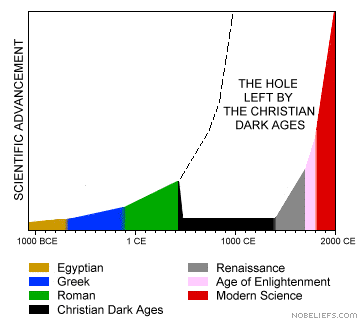
I hope this backfires, and more and more intellectually inquisitive people continue to doubt the ridiculous ideas that the Vatican comes up with. If they can just make this shit up without any sort of evidence, there's no reason at all for agreeing with them. It's like the saying goes, "if you give a mouse a cookie, he'll want a glass of milk". If we continue to keep a mindset of "Well, you can't DISPROVE it" then this and anything else is fair game. Hell, maybe tomorrow they'll say that members of the Church get a free t-shirt when they enter heaven. You gonna buy that too?
-STA
Friday, January 4, 2008
Same Shit, Different Toilet
Now that the holiday breaks are over, it's time to get back to the grindstone. I hope you all enjoyed your time off with friends and family, and I'm sure some of you have made your resolutions for the new year.
Mine is simple: be a little more open with my stance on religion. Now I'm not one to go around trying to "de-convert" anybody, or preemptively engage in theological conversation. Indeed, it's a matter of tact. But I'll shorten my threshold for tolerance when it comes to theists assuming that I or everyone else in the room (or the country) thinks like they do.
The plan for the new year as far as the blog goes is to, well, keep going. I haven't posted very much in the few months that this blog has been up to begin with, so expect to see more of the same. We'll talk about the daily grind of being a non-believer in a sea of mind-diseased theists, continue to discuss logic and reason with Fallacy Friday, study the Unholy Bible (and perhaps other works of fiction), review movies, and educate you--the reader--on the thoughts of being a Small Town Atheist. And of course I'll cover events in the media that pertain to theism or lack thereof, though I highly encourage you to read the blogs and sites listed at the bottom right of the page. Those guys always do better than I could.
All in all, I look forward to the new year. Before I go, I'd just like to say: fuck the Pope, and fuck Mitt Romney.
Oh, and pick up one of these with your extra holiday cash...they're great!
-STA
Mine is simple: be a little more open with my stance on religion. Now I'm not one to go around trying to "de-convert" anybody, or preemptively engage in theological conversation. Indeed, it's a matter of tact. But I'll shorten my threshold for tolerance when it comes to theists assuming that I or everyone else in the room (or the country) thinks like they do.
The plan for the new year as far as the blog goes is to, well, keep going. I haven't posted very much in the few months that this blog has been up to begin with, so expect to see more of the same. We'll talk about the daily grind of being a non-believer in a sea of mind-diseased theists, continue to discuss logic and reason with Fallacy Friday, study the Unholy Bible (and perhaps other works of fiction), review movies, and educate you--the reader--on the thoughts of being a Small Town Atheist. And of course I'll cover events in the media that pertain to theism or lack thereof, though I highly encourage you to read the blogs and sites listed at the bottom right of the page. Those guys always do better than I could.
All in all, I look forward to the new year. Before I go, I'd just like to say: fuck the Pope, and fuck Mitt Romney.
Oh, and pick up one of these with your extra holiday cash...they're great!
-STA
Subscribe to:
Posts (Atom)